

Best Noise Cancelling Headphones Under 100 in 2026
A usable awareness mode can matter as much as noise reduction when you need to hear announcements or nearby conversation. For transport rumble, the JLab JBuds Lux ANC is the measured value pick; the Soundcore Life Q20 2024 offers longer ANC-on endurance, while the Razer Opus X suits gaming when low-latency audio matters more than maximum quiet.
Updated for October 2026. Choose headphones by the noise they reduce, how long they run with ANC on, and whether their fit and awareness mode work for your routine. An ANC button alone says little about those trade-offs.
Train rumble and office ventilation can push you to raise the volume. A bigger battery claim or bolder cancellation promise does not guarantee a better fit or a more usable listening experience. The best noise cancelling headphones under 100 balance measured bass reduction, ANC-on endurance, and comfort you can live with.
The Under-100 Shortlist by What You Hear
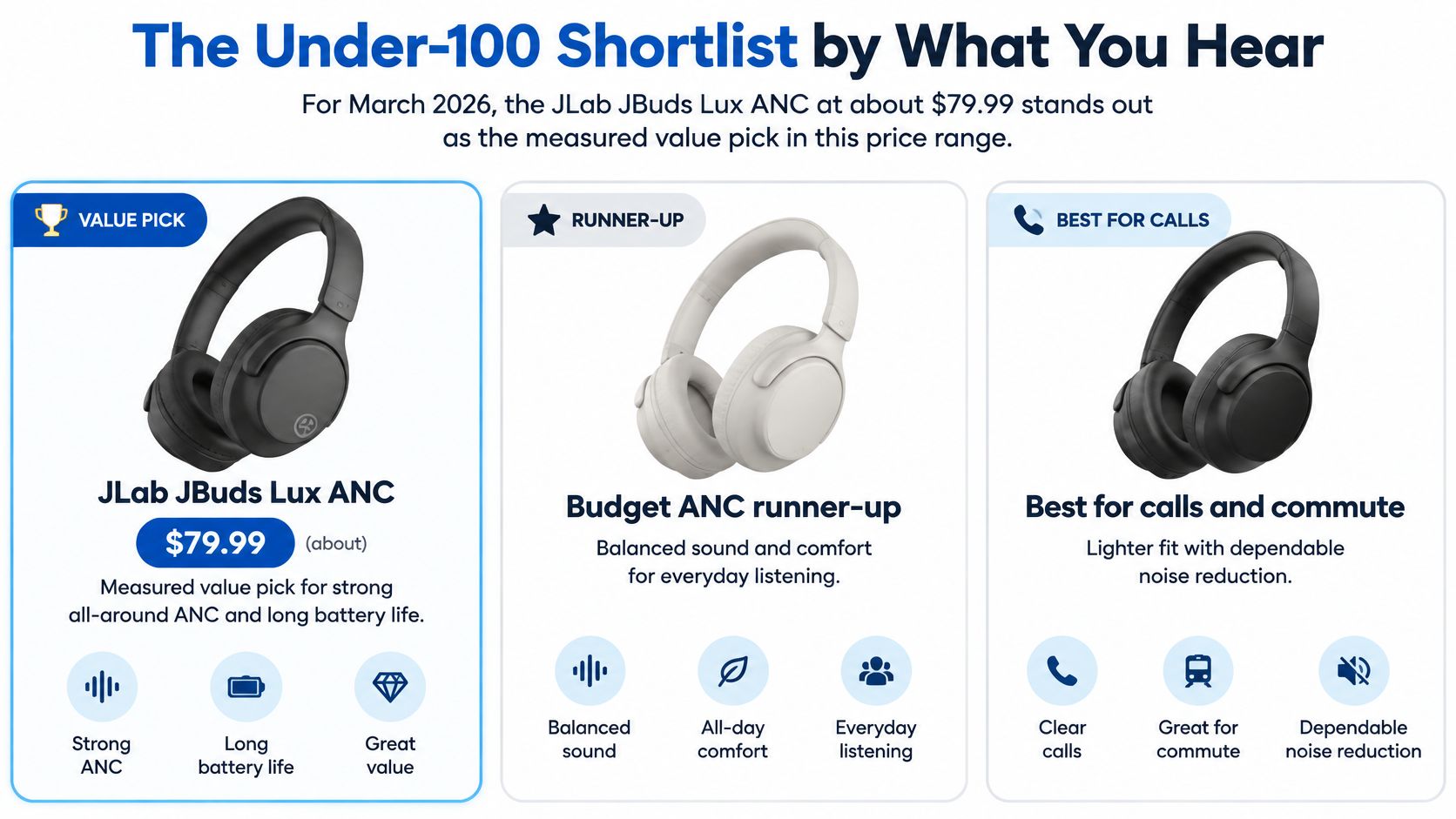
A headphone's ANC label won't tell you how much engine rumble it reduces or how long it lasts with cancellation on. Those differences matter more than the label when choosing a pair for commuting, work, or travel.
Under-$100 ANC shortlist for October 2026
| Model | Street price | Measured strength | ANC-on battery | Buy if |
|---|---|---|---|---|
| JLab JBuds Lux ANC | About $79.99 | 10–20 dB below 700 Hz | 44 hours 22 minutes | Commute rumble and multi-day travel |
| Anker Soundcore Life Q30 | Under $100 | Low-frequency engine rumble and some conversation | About 44 hours of continuous playback | Flights and long office days |
| Soundcore Life Q20 2024 | Under $100 | Low-frequency noise reduction | About 49 hours with ANC on | Endurance matters more than newer features |
| Razer Opus X | Under $100 | Weaker against bass-heavy transport noise | Not established by an equally specific test | Low-latency gaming or video sync |
The JLab figures show the shortlist's strongest quantified low-frequency result. For the other models, RTINGS' budget over-ear recommendations report about 44 hours of continuous playback for the Life Q30 and about 49 hours with ANC enabled for the Life Q20 2024. The Opus X stands out for its low-latency mode.
The Q30's continuous-playback figure is not necessarily an ANC-on result. Treat it as a reference, not a direct comparison with the Q20's ANC-on runtime.
Match the purchase to the interruption
For a bus passenger, persistent low-frequency rumble may matter most. For video editing or gaming, audio timing can take priority over stronger cancellation. At a shared desk, a comfortable fit and an awareness mode you can use while talking may be the better trade.
- Choose rumble reduction when engines or ventilation dominate your day.
- Choose endurance when you wear headphones through meetings and focused work.
- Choose low latency when wireless delay affects games or dialogue.
- Choose usable awareness when you switch between listening and conversation.
Buying rule: Bass-range attenuation and long playback do not promise full-spectrum silence or certified hearing protection.
Prices can change, so check a live listing before buying. A long battery figure won't solve speech leakage or delayed game audio.
What Budget ANC Actually Cancels
Active noise cancellation uses microphones, signal processing, and headphone drivers to reduce incoming sound. It works alongside the earcups' physical seal, not as a digital wall around your ears.
As Phys.org explains in its overview of active noise control, microphones capture environmental sound, a processor calculates an opposing signal, and the drivers play it back with a similar magnitude and a 180-degree phase difference. Some designs also use an internal feedback microphone to monitor the sound that remains.
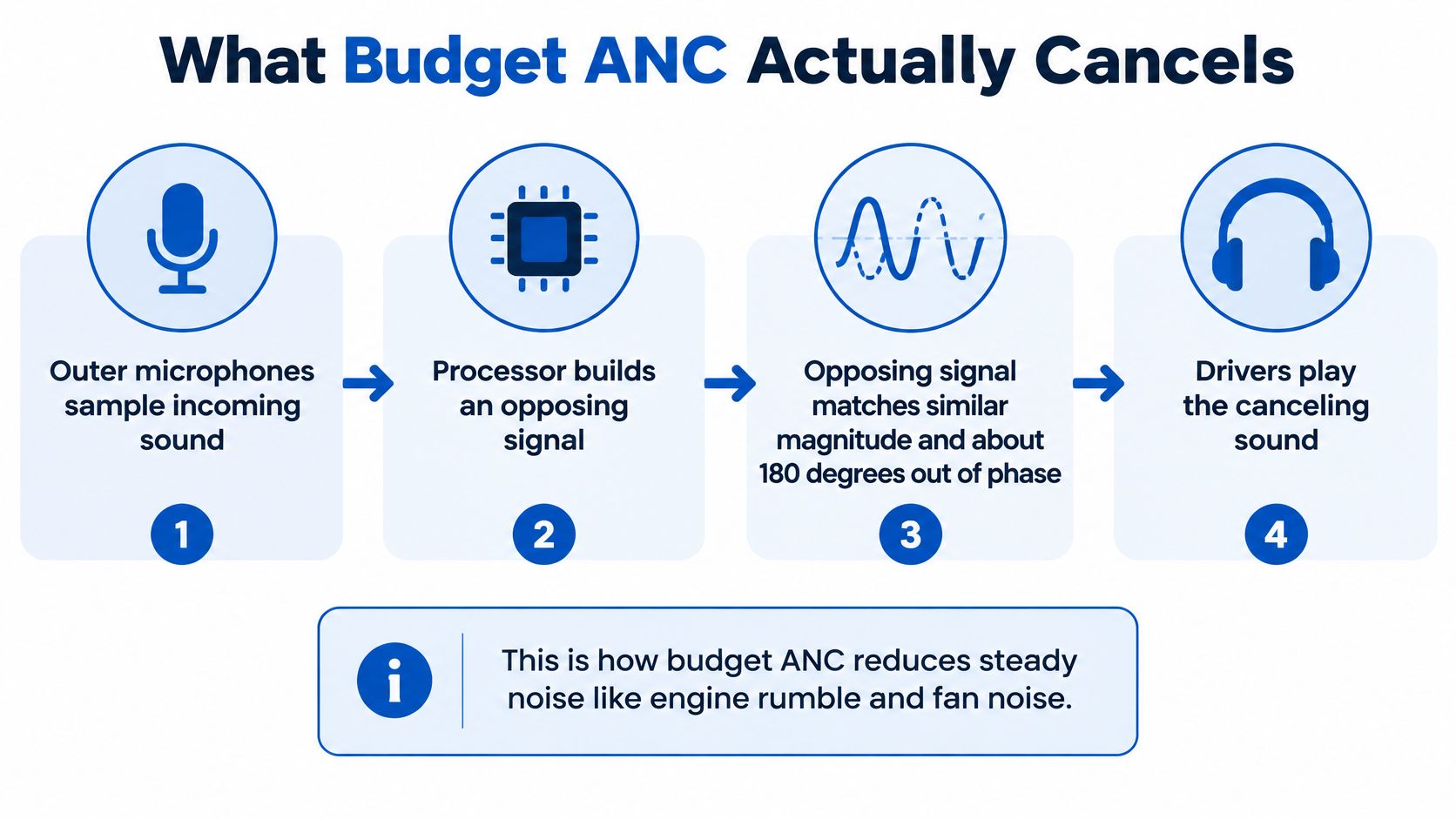
Why the fan fades but the conversation remains
A steady engine or ventilation drone is relatively predictable, so the processor can counter it more effectively. Speech, rattling cutlery, and sudden horns change quickly, making them harder to cancel. This is why measured low-frequency attenuation is more useful for comparing commute performance than an ANC label alone.
The earcups provide passive isolation through the pads' seal against your head. Hair under the pads, thick glasses arms, or an uneven fit can weaken that seal and let more sound through.
Budget ANC became practical as electronic processing advanced, as described in this technical history of active noise control. Compact microphones, batteries, and mass production also lowered the hardware barrier. Performance still depends on microphone placement, processing, acoustic tuning, and fit.
A practical mode check
Use the same music passage at an unchanged volume:
- Enable ANC near a fan. Listen for less low-frequency drone, not silence.
- Disable ANC. Judge whether the reduction was meaningful without turning up the music.
- Enable transparency during conversation. Ask someone across a table to speak normally, then assess clarity and naturalness.
Keep the earcups in their usual position during the check. Pressing them inward creates a better seal than you may maintain while walking or typing.
For a closer look at how cancellation differs from passive isolation and awareness features, read this active noise cancellation guide.
Lux Q30 Q20 and Opus X Compared
JLab JBuds Lux ANC for measurable rumble reduction
The Lux has the clearest measured value argument. SoundGuys' budget noise-cancelling headphone testing reports approximately 10–20 dB of attenuation below 700 Hz, roughly 50–75% lower perceived low-frequency noise, and 44 hours 22 minutes with ANC enabled, at a reported price of about $79.99.
That combination matters because it joins meaningful bass reduction with endurance, rather than asking you to choose between them. USB-C charging adds convenience, while the over-ear design provides the physical seal that complements the electronics.
Don't extend the bass result into a claim about every sound. Voices and higher-frequency interruptions remain fit-sensitive. I'd start with the Lux for transport noise, then reject it if the pads won't seal comfortably around my ears.
Soundcore Life Q30 for long wear
The Life Q30 makes sense when the headphones spend more time on your head than in your bag. Its appeal is the combination of useful isolation and sustained listening, not extreme portability.
Comfort still needs a personal check. Wear the Q30 with your normal glasses, move your jaw, and look down at a keyboard. Pressure that feels acceptable during a quick try-on can become the deciding problem during desk work.
Check these fit details before choosing it:
- Pad opening: Your ears shouldn't fold against the inner edges.
- Headband pressure: The crown of your head shouldn't carry a concentrated hot spot.
- Clamp and heat: A secure seal shouldn't require distracting pressure.
Soundcore Life Q20 2024 for endurance
The Life Q20 2024 is the endurance alternative, not an automatic upgrade in cancellation depth. Its longer reported ANC-on playback is useful when charging opportunities are inconvenient.
Make sure the listing identifies the 2024 variant. Similar family names can hide meaningful differences, and a battery result for one version shouldn't be assigned to another.
Razer Opus X for synchronization
The Opus X stays on the shortlist because a quiet headphone can still be frustrating when audio trails the picture. Its low-latency mode addresses a different problem from engine cancellation.
I'd choose it only when that timing benefit outweighs weaker transport isolation. For a flight-first purchase, that's the wrong trade.
Which noise each situation actually needs
| Situation | Dominant noise | What reduces it | Watch-out |
|---|---|---|---|
| Aircraft or train | Steady low-frequency rumble | ANC on a Lux or Life Q30 | Voices still leak if the pad seal is poor |
| Open office | Speech and keyboard clicks | Passive seal, supported by ANC | Strong isolation can hide a coworker |
| Street or platform | Irregular traffic | A usable awareness mode, or removing the headphones | ANC is not traffic protection |
| Video or mobile games | Timing, not noise | Dedicated low-latency mode on Opus X | Ordinary Bluetooth can introduce noticeable delay |
| All-day desk | HVAC plus long wear | Q30 fit or Q20 2024 endurance | Maximum advertised hours may not describe ANC use |
ANC-On Battery That Survives a Workday
Battery claims only help when they match how you listen. A rating with ANC off cannot show whether a pair will last through a workday with cancellation enabled.
An earbud example from SoundGuys' wireless earbud testing shows why conditions matter: a model rated for 12 hours delivered 6 hours 17 minutes with ANC enabled at 75 dB SPL. Those figures do not predict over-ear performance, but they illustrate how ANC and listening level can change runtime.
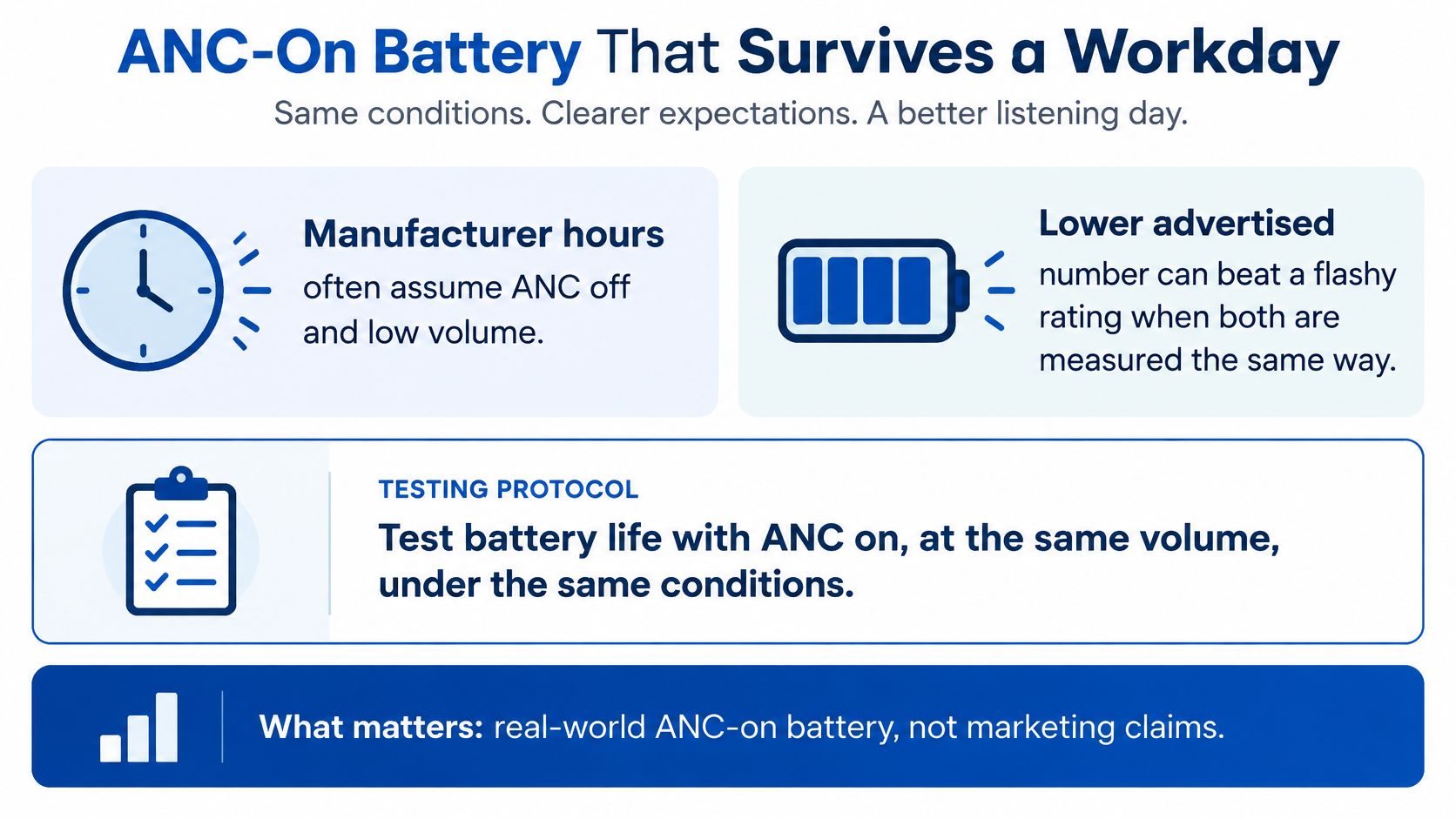
Use a repeatable test, not a louder playlist
For a useful comparison, keep ANC on and use the Bluetooth codec you expect to use. Listen at a consistent, comfortable level; a phone app without calibrated equipment cannot reliably reproduce a laboratory sound-pressure measurement.
Record whether multipoint is enabled. If calls are part of your workday, include them and log their duration. Otherwise, keep playback and microphone use as separate tests.
| Model | ANC-on runtime | Basis |
|---|---|---|
| JLab JBuds Lux ANC | Measured long-duration playback | Independent ANC-on test |
| Anker Soundcore Life Q30 | About 44 hours of continuous playback | RTINGS result |
| Soundcore Life Q20 2024 | About 49 hours with ANC enabled | RTINGS result |
| Razer Opus X | No established ANC-on figure | No equally specific ANC-on figure established here |
These figures are not a standardized lab ranking. The Q30's reported continuous-playback result and the Q20 2024's ANC-enabled figure have different descriptions, so compare them as reported rather than assuming identical test conditions. The Opus X has no established ANC-on runtime here.
Record what happens when power runs low
Total runtime is only part of a practical battery check:
- Short-charge recovery: Record the playback gained after a timed USB-C charge.
- Wired fallback: Check whether audio works through USB-C, an analog connection, or neither when the battery is depleted.
- Standby drain: Note the charge before storage and again the next morning.
- Connection conditions: Record multipoint, codec, and call use so another test can be compared.
A charging port proves the headphones can accept power. It does not prove they can play USB audio or operate with a dead battery.
For a smaller travel option, compare wireless earbuds by battery life, keeping earbud and over-ear runtimes separate. Set your pass-or-fail target around the workday or journey you need to finish. A maximum rating matters less than dependable runtime under your usual listening conditions.
Commute Office Travel and Gaming Picks
Match the headphones to the setting, then check the fit, controls, and fallback that matter there. A strong low-frequency result helps with steady transport rumble; comfort and easy awareness-mode access matter more during a long day indoors.
Bus and train commuting
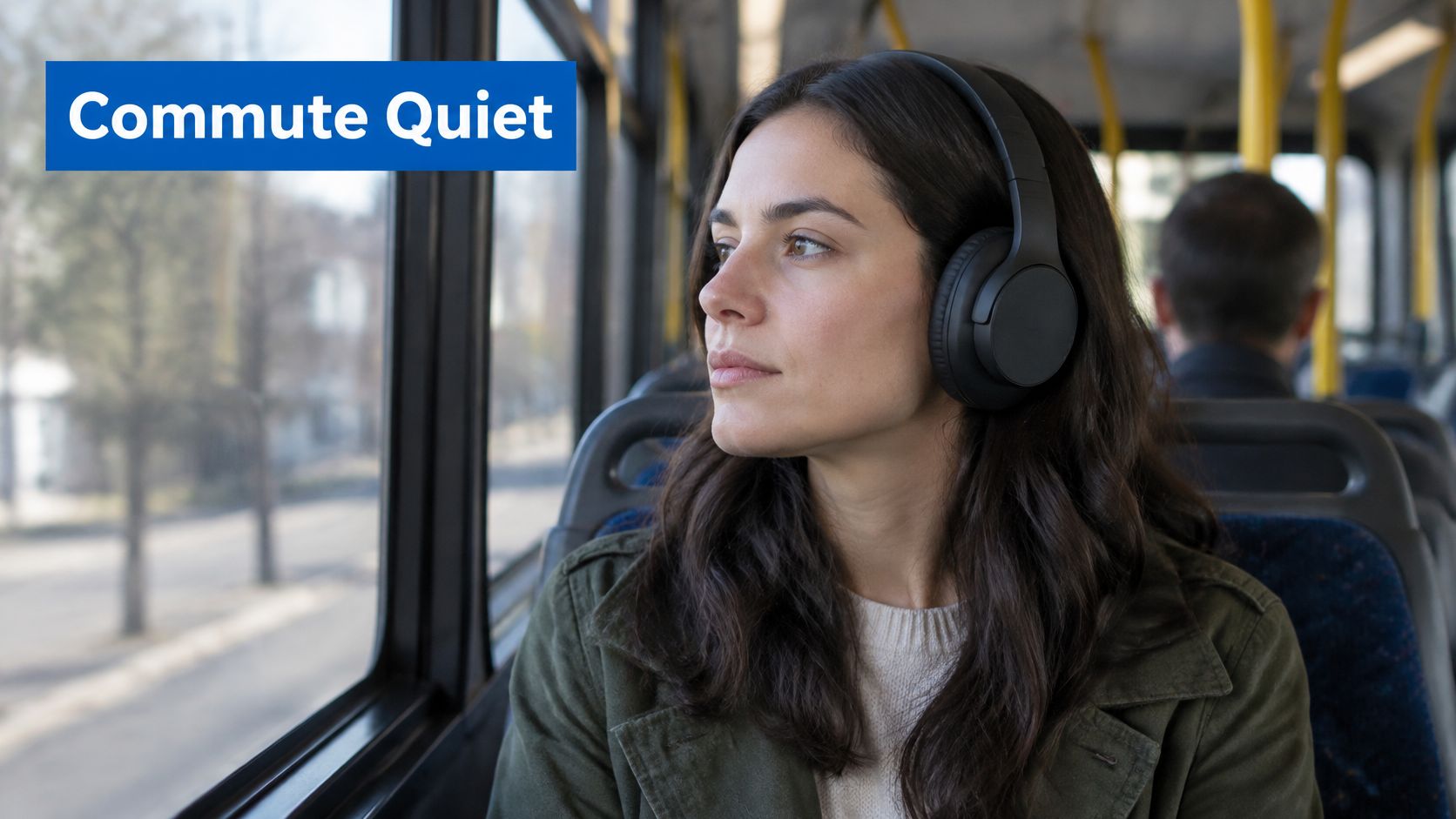
The JLab JBuds Lux ANC suits journeys dominated by persistent vehicle noise. Check the seal while seated and walking, with the glasses, hat, or bag you normally carry. A loose fit can weaken the benefit of ANC.
Home office and shared office
Consider the Life Q30 if it stays comfortable through your usual work routine. Reduced ventilation noise can help with concentration, but repeated pressure breaks undermine that benefit.
Check calls separately from music. ANC reduces environmental noise for the wearer; it does not establish how clearly your microphone carries your voice. For desk-focused priorities, compare comfort, call handling, and awareness in this office headphone guide.
Travel with uncertain charging
The Life Q20 2024 is a practical choice when endurance matters most. Confirm the exact version and test its wired fallback before you leave, using the same cable and connection you plan to pack.
Gaming and synchronized video
Choose the Razer Opus X if you need its low-latency mode. RTINGS' Bluetooth connection testing guide gives typical default SBC latency as approximately 150–250 milliseconds, which can make game audio feel out of sync.
Check that low-latency mode is enabled in the headphone controls or companion app. Then play a timing-sensitive game and a video in the apps you use. Video apps may compensate for delay differently, so a film that looks synchronized does not confirm that game audio will be.
The video provides another viewing reference.
Awareness Modes and Safe Listening Limits
A usable awareness mode can be more valuable than the deepest cancellation. If you regularly need announcements or conversation, the best headphone is one you can switch out of isolation without fighting its controls.
Don't assume transparency sounds like uncovered ears. Treat it as an electronically reproduced view of your surroundings, and judge whether speech remains understandable without becoming harsh, hollow, or distracting.
Awareness is a feature to test
Audiology guidance from the University of Colorado Anschutz Medical Campus explains that ANC can reduce the temptation to raise playback volume, but it isn't adequate protection against loud equipment such as lawnmowers or construction machinery.
That distinction matters outdoors. Hearing some environmental sound through microphones doesn't guarantee that you'll notice or correctly locate every hazard.
Test awareness in controlled situations:
- Conversation: Can you understand someone speaking normally without removing a cup?
- Announcements: Are words intelligible, not merely audible?
- Household signals: Can you notice the sounds you depend on at your normal playback level?
- Street use: If awareness feels uncertain, pause playback and remove the headphones before crossing.
Don't test alarm audibility by exposing yourself to dangerous sound. For hazardous equipment, use hearing protection appropriate to the task.
Volume and duration still count
The World Health Organization's safe-listening guidance states that an average exposure of 80 dB can be safe for up to 40 hours per week and recommends keeping device volume at no more than 60% of maximum, staying below an average of 80 dB when monitoring is available.
A volume percentage isn't a calibrated sound-level measurement across every device. Use exposure monitoring where available, keep playback comfortable, and take listening breaks.
Safety distinction: ANC may help you listen more quietly. It doesn't make loud playback harmless.
If controlling levels is difficult, review practical earbud volume-control settings and apply the relevant device controls before your next commute.
Choose the Pair for This Week
Choose the JLab JBuds Lux ANC for measured transport-noise reduction. Choose the Soundcore Life Q30 when long-wear comfort is the deciding factor.
Choose the Life Q20 2024 when charging opportunities are scarce. Choose the Razer Opus X when video or gaming timing outranks maximum isolation.
That's the decision. Adding more models won't help if you haven't identified which of those jobs matters most.
Check the listing before checkout
- Battery conditions: Look for an explicitly ANC-enabled runtime, not just a maximum playback claim.
- Connection features: Confirm the required low-latency mode, wired input, or USB audio support.
- Exact variant: Match the model name and version to the result you're using.
- Return terms: Allow yourself a realistic opportunity to assess fit and everyday use.
- Total price: Compare the checkout amount, not merely the headline discount.
For gaming-first buyers, check the low-latency wireless headset buying guide before treating an ordinary Bluetooth connection as a competitive gaming solution.
Reject the wrong compromise
Don't buy a model solely because its battery rating is longest. Don't pay for deeper isolation if you'll spend most of the day struggling to hear coworkers.
I'd also skip an ANC purchase when the listing leaves the relevant operating conditions unclear and there's no practical way to assess fit. A bargain that doesn't solve your main problem is still the wrong purchase.
Common Questions Before You Buy
Will budget ANC headphones protect my hearing on a train?
Not as certified hearing protection. They can make a noisy journey more comfortable and reduce the urge to overpower background noise with music, but playback level and listening duration still matter.
Choose a comfortable seal, keep exposure monitoring enabled where available, and avoid increasing volume just because some speech remains audible. For hazardous noise, use appropriate hearing protection rather than assuming consumer ANC is sufficient.
Will the advertised battery hours hold on a flight?
Don't assume so. Check whether the claim includes ANC and whether it describes playback rather than a mixture of playback and standby.
Start the journey fully charged and test your expected settings beforehand. Calls, connection choices, and your normal listening level make a more useful personal test than a maximum figure printed without conditions.
Can I keep listening when the battery dies?
Only if the headphone supports the relevant unpowered or wired playback mode. USB-C charging alone doesn't establish USB-C audio, and a wired input doesn't automatically mean ANC continues working.
Connect the headphone to your actual phone, laptop, or travel adapter before leaving. Confirm whether playback, volume controls, and the microphone behave as expected, because those functions may not all work through the same connection.
DigiDevice offers headphones, mobile accessories, chargers, adapters, and cables for everyday listening and travel setups. Visit DigiDevice to check price, confirm current availability and connection details, and buy the pair that matches your commute, desk, or gaming priorities.