

What Is Active Noise Cancellation and How Does It Work
A microphone hears the surrounding noise, a processor creates an opposite-pressure sound wave, and the two waves interfere so less noise reaches your ear. In practice, ANC is particularly effective against steady low-frequency rumble, while voices, sharp transients, wind, and other changing sounds can remain audible.
That sounds like a simple trick, but the engineering is more demanding than the familiar “180-degree phase inversion” explanation suggests. Microphone placement, processing delay, the speaker-to-ear acoustic path, and the choice between feedforward, feedback, and hybrid control determine whether headphones reduce an aircraft drone or merely add a faint electronic texture.
Updated for March 2026.
The Direct Answer on What Active Noise Cancellation Actually Does
A headphone can reduce the perceived drone of a jet engine by playing an opposite-pressure wave through its speaker. The microphones listen to the environment, a digital signal processor estimates the unwanted sound, and the driver produces anti-noise that meets the original wave near your ear.
A useful analogy is a stadium wave. If one wave of people rises while another wave approaches from the opposite direction at the right timing, the two movements can flatten each other. Sound behaves similarly as changing air pressure. ANC doesn't remove the engine, office fan, or train from the physical world. It creates a second pressure pattern that reduces the first at a carefully controlled listening point.
That distinction matters. The system works best when the incoming sound is relatively predictable, especially a low, sustained hum. It has less time to react to a baby crying, a hand clap, or a nearby voice because those sounds change quickly and contain more high-frequency detail.
What happens inside the headphones
The signal path is broadly:
- Microphones capture noise. Depending on the design, microphones may sit outside the ear cup, inside it, or in both locations.
- A processor analyzes the signal. The DSP estimates what will arrive at the ear and calculates a counter-signal.
- The driver emits anti-noise. This waveform has opposite pressure at the relevant moment.
- The listener hears the residual. The original noise and anti-noise combine, leaving less of the unwanted sound.
The timing must be precise. A small delay can make the counter-signal arrive too early or too late, reducing cancellation or creating an audible artifact. That's why a premium ANC system isn't defined only by the number of microphones. Its acoustic design and control algorithm matter just as much.
For a practical look at how noise reduction fits office listening, see this office headphone noise-cancellation guide. It helps connect the physics to the sounds people encounter during calls, focused work, and shared-room listening.
A Short History of Active Noise Cancellation
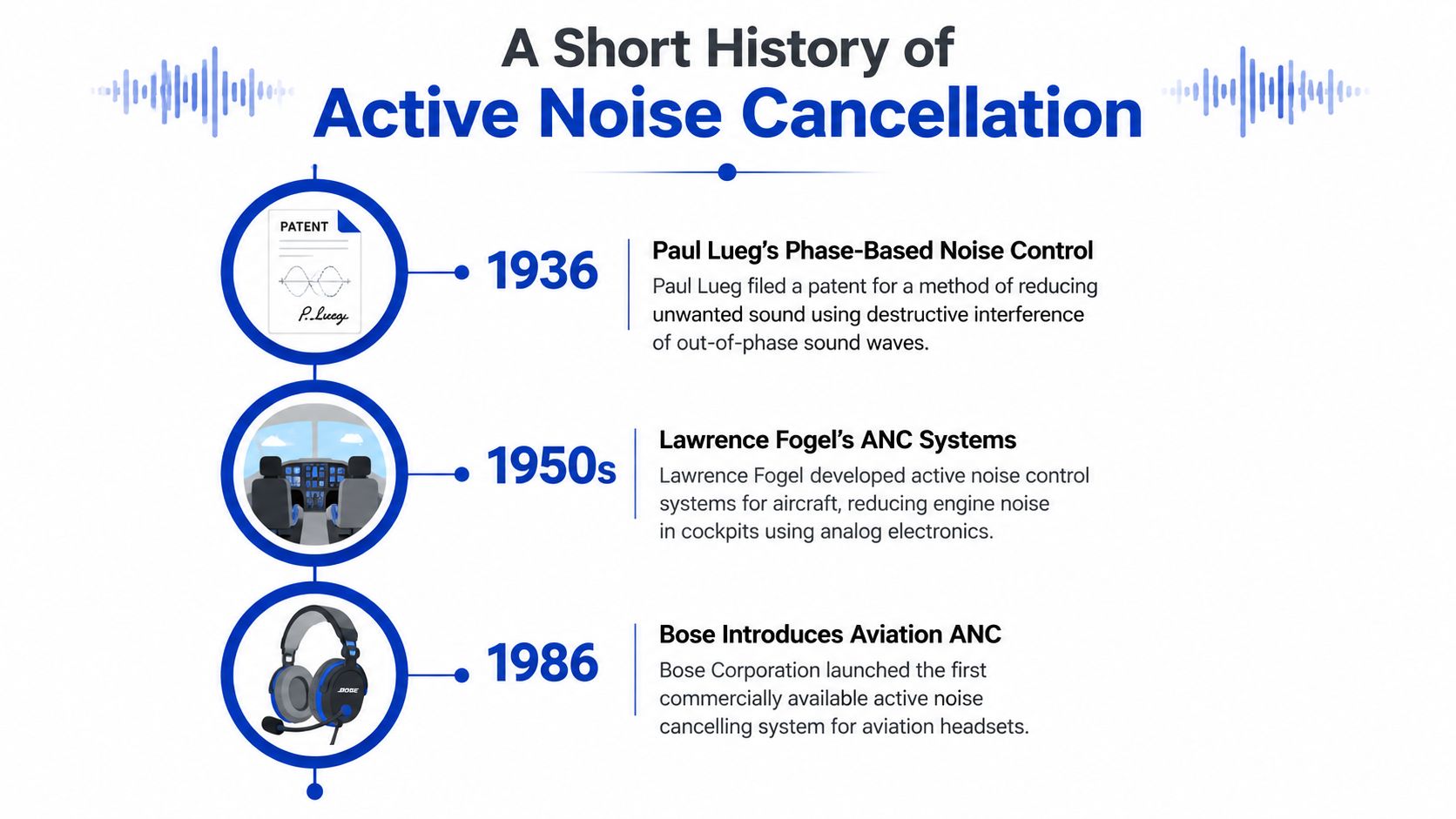
ANC began as an engineering idea long before wireless earbuds. German inventor Paul Lueg received U.S. patent 2,043,416 in 1936 for a noise-control system using phase advancement to cancel sinusoidal tones in ducts and polarity inversion to reduce sound around a loudspeaker, as documented in this history of active noise control.
The timeline then moved toward aviation. In the 1950s, Lawrence J. Fogel filed noise-cancellation patents for helicopter and airplane cockpits. In 1957, Willard Meeker built a working circumaural earmuff prototype with ANC. Its active attenuation bandwidth was about 50–500 Hz, with maximum attenuation of roughly 20 dB. Those figures reveal an important early truth: ANC was already most useful against low-frequency sound.
From aircraft equipment to consumer audio
Commercial adoption took time. The technology didn't reach consumers until the late 1980s, when the first active noise-reduction headsets became available. Aviation was a natural starting point because cockpit noise is persistent, powerful, and dominated by the kinds of frequencies active control can address.
As wireless headphones expanded globally, ANC shifted from niche aviation equipment into a major consumer-audio category. One market estimate places global noise-cancelling headphone revenue at about $13.1 billion in 2021 and projects $45.4 billion by 2031, with a projected 13.2% compound annual growth rate over that decade, as reported in this market overview. An independent estimate places the market at roughly $14.25 billion in 2024, showing the category's scale before the mid-2020s.
Today, DSP hardware can fit inside true-wireless earbuds, and the same control principles are appearing in products that keep the ear more open. The next design challenge isn't making silence deeper. It's balancing cancellation with awareness, comfort, speech intelligibility, and the visual information promised by future augmented reality.
How ANC Works and the Three Core Architectures
ANC starts with a control loop rather than a single sound effect. A microphone converts air pressure into an electrical signal. An analog-to-digital converter samples that signal, an adaptive filter estimates the required anti-noise, and a digital-to-analog converter sends the result to the headphone driver.
The filter must account for the secondary path, meaning the route from the driver through the ear cup, ear tip, and air space to the listener's eardrum. Engineers commonly use adaptive methods such as filtered-x least mean squares, or FXLMS, to keep the inverse signal aligned as the noise and acoustic conditions change.
The three microphone arrangements
| Architecture | Mic Placement | Strengths | Weaknesses | Example Products |
|---|---|---|---|---|
| Feedforward | Outside the cup or earbud | Hears incoming noise early and can respond quickly | Doesn't directly measure the final sound at the ear; exterior microphones can pick up wind | Many basic ANC earbuds and headphones |
| Feedback | Inside the cup or earbud | Measures residual sound near the listener and can correct the result | Has less time to react and can become unstable if poorly tuned | Some feedback-focused in-ear designs |
| Hybrid | Outside and inside | Combines early prediction with residual correction; can widen the useful control range | More complex tuning, power use, and feedback management | Premium adaptive over-ear headphones and earbuds |
Feedforward ANC behaves like a lookout standing outside the room. It hears the approaching bus or fan and begins preparing the counter-signal before that sound reaches the ear. This gives it useful reaction time, but it doesn't know precisely what remains after the ear cup, driver, and listener's fit alter the sound.
Feedback ANC places a microphone inside the acoustic enclosure. It measures the residual noise closer to the eardrum, which can improve correction, but the microphone has less advance warning. The internal speaker-to-microphone path also creates a control challenge.
Hybrid ANC combines both perspectives. Studies of headphone-focused hybrid structures report attenuation of more than 20 dB from 100 Hz to 400 Hz and roughly 5–15 dB from 500 Hz to 800 Hz when parameters were optimized, according to this evaluation of a decoupled feedforward-feedback hybrid structure. That doesn't mean every hybrid product delivers those results. It shows why combining microphones can help across a broader band.
For readers comparing ANC with voice-focused suppression, this echo-cancelling microphone explanation covers a related but different problem. Echo cancellation protects a call from feedback and reflected speech. ANC targets environmental noise reaching the listener.
Why ANC Excels at Low Frequencies and Stumbles Elsewhere
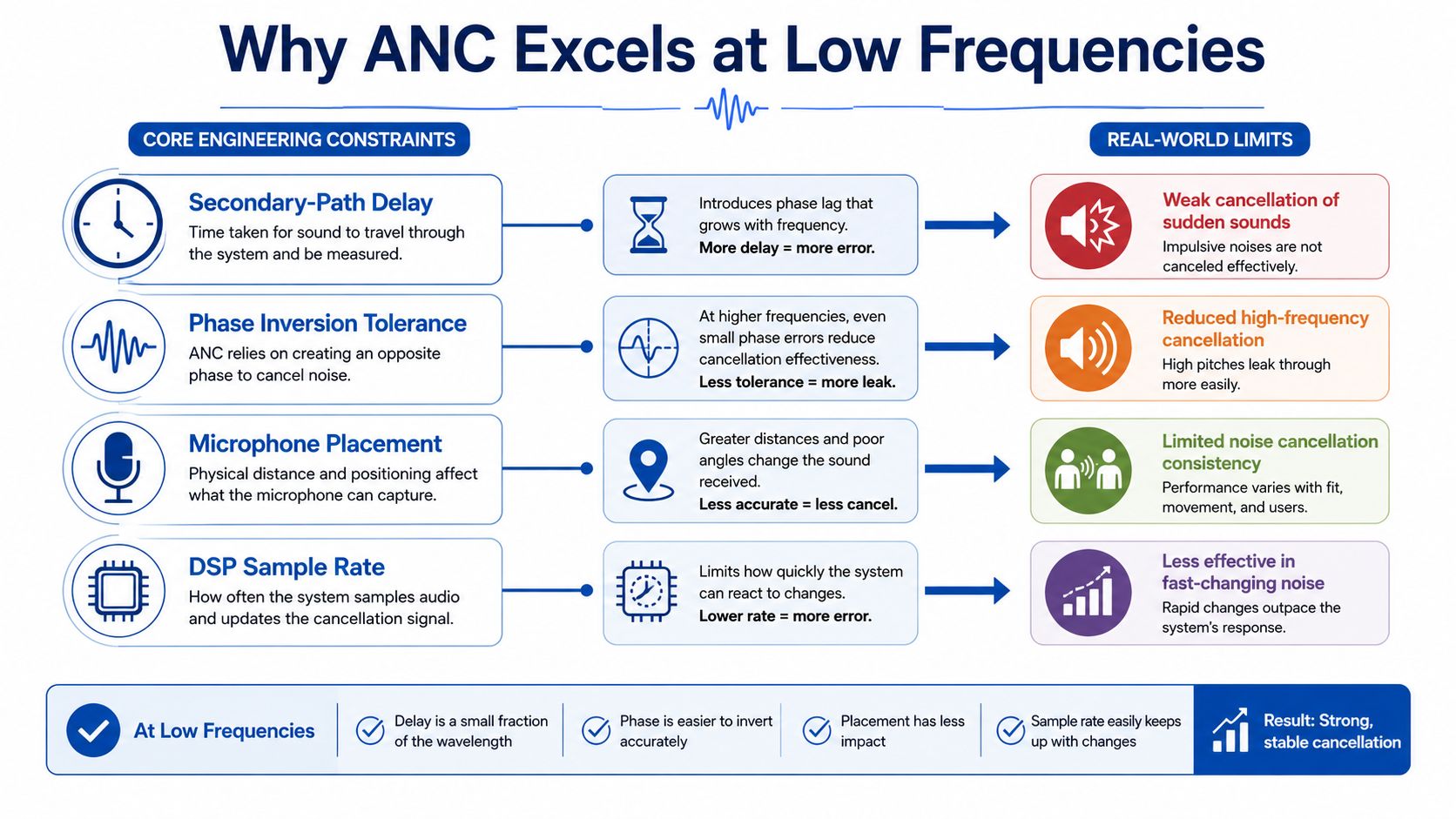
Low-frequency rumble gives the controller time. An airplane engine, HVAC system, or train produces pressure changes that are relatively slow and often persistent. The microphones can detect the pattern, the DSP can estimate the secondary path, and the driver can emit anti-noise before the unwanted pressure reaches the ear.
Higher-frequency sound changes more rapidly. Shorter acoustic cycles leave less timing tolerance, so microphone placement and processing delay become more consequential. A system may reduce the low growl of a bus while allowing the sharper hiss of tires, the consonants in speech, or a sudden clatter to pass through.
Four limits shape what you hear
- Secondary-path delay: The processor isn't controlling sound in empty space. It must account for the driver, enclosure, ear tip, ear cup, and listener's ear.
- Phase-inversion tolerance: The anti-noise must have the right polarity and arrive at the right time. A small mismatch reduces destructive interference.
- Microphone placement: An outside microphone gets earlier information, while an inside microphone measures the residual closer to the ear. Each position solves one problem and creates another.
- DSP sample rate: The processor needs enough temporal resolution to represent and control changing sound. Faster-changing noise is harder to track cleanly.
Experimental hybrid ANC results on hearing-protector earcups showed 5–30 dB active attenuation across 50–800 Hz for tonal noise and 18–27 dB for nonstationary cockpit-like noise, while low-frequency improvement below 100 Hz reached up to 15 dB over single-structure control, according to this hybrid active noise-control study.
Wind exposes these limits because it strikes exterior microphones directly. Feedback risk also restricts how aggressively a designer can raise cancellation. Some listeners notice a pressure-like sensation, even though ANC isn't physically sealing or compressing the ear in the way a change in air pressure would. The sensation often comes from the altered low-frequency sound balance and the brain's response to it.
The product's normal playback range is a separate specification. Some headphone specifications list a consumer audio frequency response of 20 Hz to 20 kHz, which describes playback rather than promising equal ANC performance throughout that range, as shown by this headphone frequency-response example.
Real World Use Cases From Earbuds to AR Glasses
Form factor changes the acoustic problem. An over-ear headphone can surround the ear with a substantial seal and house a larger driver and battery. An earbud depends on the tip, the shape of the listener's ear canal, and the stability of its fit. AR glasses have a different priority, because they must preserve awareness of the surrounding environment while adding useful audio and visual information.
| Form Factor | Passive Seal Strength | Typical Battery Life (ANC On) | Best Environment | Comfort for All-Day Wear |
|---|---|---|---|---|
| Earbuds | Depends heavily on tip fit | Varies by product | Commuting, workouts, mixed daily use | Light and portable, but fit varies |
| Over-ear | Usually stronger around the entire ear | Varies by product | Flights, offices, steady engine or HVAC noise | Comfortable for some listeners, warm or heavy for others |
| AR glasses | Often limited compared with sealed headphones | Varies by product | Commuting and situations requiring awareness | Potentially suitable for extended wear, depending on frame and audio design |
Match the device to the sound
For a long flight, over-ear ANC is often the practical choice. The passive ear-cup seal handles part of the work before the electronics begin, and the larger enclosure gives engineers room for microphones, drivers, and processing hardware.
Earbuds make more sense when portability and movement matter. They can perform impressively against steady noise, but a poorly fitted tip leaves an acoustic gap that no algorithm can fully repair. Try the supplied tip sizes and check the seal before judging the ANC.
AR glasses trade maximum attenuation for situational awareness. A commuter may prefer to hear an announcement, bicycle bell, or conversation rather than create an isolated bubble. That makes them a different solution, not a weaker version of an over-ear headphone.
Fit rule: If changing the ear tip changes the bass response, it can also change the listener's ANC experience. Seal quality is part of the system.
Transparency modes, call-noise processing, and sleep-oriented earbuds serve adjacent needs. Transparency deliberately feeds outside sound back to the listener. Call processing focuses on what the microphone sends to another person. Sleep earbuds prioritize low-profile comfort, so their acoustic design may differ from travel headphones.
For readers exploring visual productivity alongside audio, this AR glasses guide for productivity and virtual monitors is a useful comparison point. DigiDevice also lists the Nothing Ear (a) Bluetooth Earphone with 45 dB active noise cancelling, which is one product option to examine when compact ANC matters.
Testing ANC in Everyday Scenarios
You don't need laboratory equipment to learn how a pair of headphones behaves. You need repeatable sounds, consistent fit, and the willingness to test ANC with music paused as well as playing.
Four useful home checks
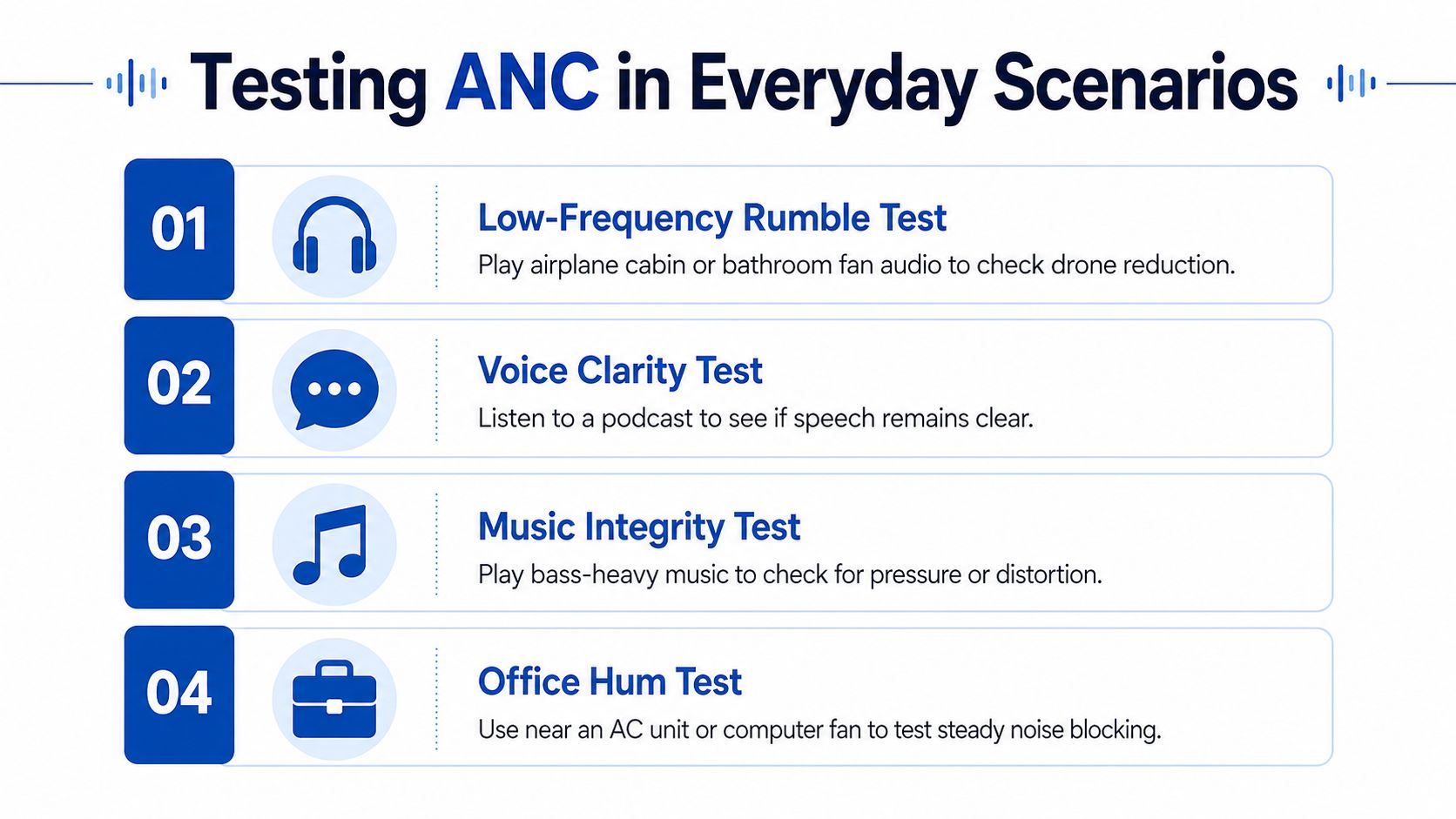
- Start with low-frequency rumble. Play airplane-cabin audio at a safe listening level, or sit near a bathroom fan. Switch ANC on and off without changing the fit. A strong design should make the continuous drone feel less prominent, even if the fan's higher-frequency texture remains.
- Try a voice test. Play a podcast through a separate speaker while wearing the headphones. Notice whether the voice remains intelligible. Speech contains changing frequencies and transients, so this test shows where the system's control range ends.
- Separate passive isolation from electronic cancellation. Sit in a noisy café or near a computer fan with ANC off. This tells you what the ear tips or ear cups accomplish by themselves. Turn ANC on afterward and compare the residual sound rather than relying on memory.
- Test wind handling. Face a fan or walk outside briefly. Exterior microphones can interpret wind turbulence as noise, producing a whoosh or unstable cancellation. A model that performs beautifully in a quiet room may behave differently in moving air.
Repeat the checks with music at low volume. That recreates normal listening more closely and reveals whether the ANC changes bass balance, introduces pressure, or creates distortion. Swap ear-tip sizes between tests, because a seal change can masquerade as an algorithm improvement.
A useful result isn't “everything disappeared.” Write down which sounds fell back, which remained, and whether the headphones stayed comfortable. That profile tells you more than a single manufacturer's headline claim.
A Practical Buying Checklist for ANC Headphones
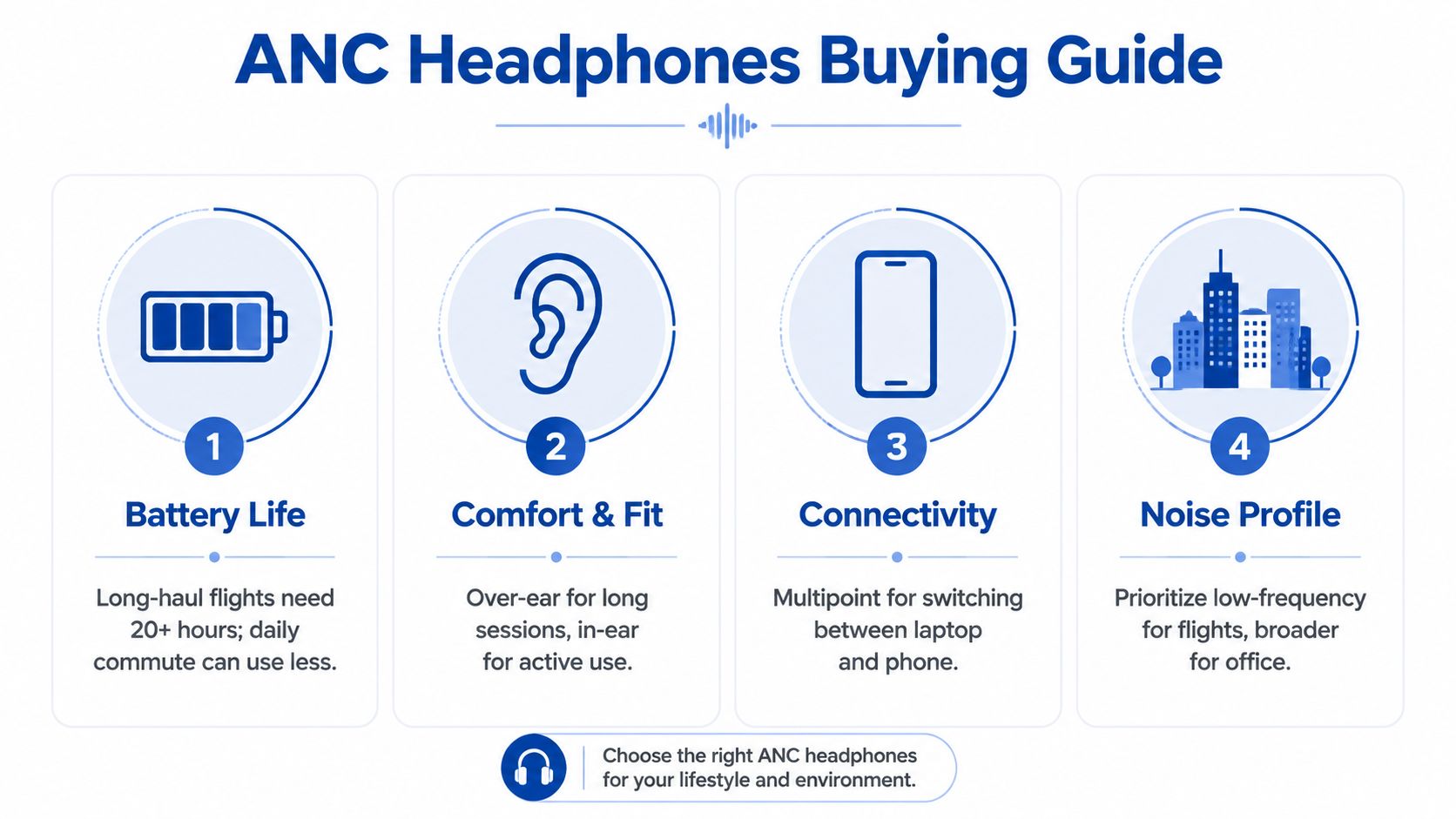
Buy for your noise profile first, then compare specifications. A traveler who mainly hears aircraft rumble needs a different balance from a remote worker who deals with voices, keyboard noise, and changing room acoustics.
Filter candidates by the way you listen
- Battery and charging: Match capacity to your routine. A long-haul traveler values extended ANC use, while a daily commuter may care more about quick charging and a compact case.
- Codec support: LDAC or aptX Adaptive can matter to listeners whose phones and source devices support them. AAC remains relevant for many iPhone users. Codec compatibility is a system question, not a badge to collect.
- Multipoint pairing: If you move between a laptop and phone, multipoint can reduce the friction of switching calls and media. Confirm that the feature works with the devices you use.
- Comfort and clamping: Glasses wearers should check whether the ear cups press against the temples. For earbuds, stability and tip comfort matter more than a long feature list.
- Ingress protection: Runners and outdoor users should look for an appropriate IP rating. Sweat and rain create a different ownership problem from an aircraft seat.
Use a simple architecture rule
Choose a hybrid adaptive design if you move from quiet rooms to noisy streets and want the headphones to adjust. Consider a feedforward-dominant design when low weight, simplicity, or price matters. Treat pure feedback designs as specialized choices unless their measured behavior matches your main environment.
A transparent manufacturer should publish attenuation curves or explain testing conditions rather than rely only on phrases such as “industry-leading.” For an additional comparison before you shortlist models, this guide to the best ANC headphones for commuting focuses on the demands of daily travel.
The value question is personal. A less expensive pair with a reliable seal may outperform a feature-heavy model that doesn't fit your ears. Conversely, a premium hybrid design can make sense if you spend long periods around steady machinery, aircraft, or office HVAC and care about comfort as much as raw reduction.
Common ANC Myths and Your Top Questions Answered
Myth one says ANC damages hearing
ANC doesn't make loud listening safe by itself. It changes the background sound reaching the ear, but the listener still controls playback volume and exposure. Recent neurophysiology research found that ANC reduced subjective listening effort and altered prefrontal activity without significantly improving accuracy or reaction time, suggesting the benefit may be comfort and cognitive load rather than better raw task performance, as reported in this clinical and neurophysiology research record.
Myth two says ANC creates total silence
It doesn't. Low, sustained sounds are the strongest target, while sharp transients, voices, wind, and higher-frequency content can remain. A 2026 clinical feasibility study found ANC reduced ambient noise by up to 20 dB, with stronger attenuation below 1,000 Hz, but also observed output instability in dynamic pure-tone noise and said complex real-world environments still need validation, according to this clinical ANC study.
Myth three says ANC is only marketing
The control mechanism is real, measurable, and constrained by acoustics. Independent experimental results have reported substantial attenuation in low-frequency ranges, but those results shouldn't be transferred blindly from a laboratory setup to every headphone, ear shape, seal, or environment.
Answers to common questions
Does ANC work without music? Yes. The cancellation circuit can operate while playback is paused, though the result depends on the headphone's design, fit, and sound environment.
Does ANC use battery when idle? Usually, active microphones and processing require power. Check the product's operating modes if battery conservation matters.
How is ANC different from passive isolation? Passive isolation comes from the physical seal and materials. ANC adds microphones, processing, and a driver-generated counter-signal. Effective headphones often use both.
Can transparency mode add latency? It can, because outside sound passes through microphones and processing before reaching the listener. The audibility of that delay depends on the product and the situation.
Verdict: ANC is a targeted control system, not a silence button. Choose it for the noises it can track, and judge the complete design rather than one specification.
DigiDevice offers headphones, true-wireless earbuds, AR smart glasses, microphones, and related electronics for people comparing practical ways to manage sound and focus. Visit DigiDevice to review available audio products, compare fit and features, and check price before choosing your next ANC setup.