

Best Wireless Earbuds Battery Life Tested in 2026
SoundGuys measured the EarFun Air Pro 4+ at 6 hours and 17 minutes with ANC on, despite its 12-hour advertised battery life, a gap of about 48% (SoundGuys' wireless-earbud testing). That difference is why the best wireless earbuds battery life can't be judged by the biggest number on a box. A useful comparison separates verified playback on a single charge from the extra listening time supplied by the case, then considers how each performs under your settings and over its usable life.
Updated for March 2026. The comparison below sticks to figures supported by the available evidence. Where independently measured, matched-condition results aren't available for a model, it says so rather than treating a manufacturer claim as a lab result.
| Earbud or comparison | Single-charge playback | Total with case | Full charge time |
|---|---|---|---|
| EarFun Air Pro 4+ | 6 hours 17 minutes measured, ANC on; advertised as 12 hours | Not stated in the cited test | Not stated |
| Typical ANC-on result across tested models | Most models in the 5-to-10-hour range | Varies by model | Not stated |
| Longest-lasting models in SoundGuys testing | Some exceeded 10 hours with ANC on | Varies by model | Not stated |
| Consumer Reports example, model not identified in the provided data | Advertised at 3.5 hours per charge | Advertised 8.5 additional hours | Not stated |
| Consumer Reports example, model not identified in the provided data | Advertised at 5.5 hours per charge | Advertised 16 additional hours | Not stated |
Why Battery Life Is the Spec That Decides a Wireless Earbud Purchase
SoundGuys tested more than 300 pairs, a useful foundation for comparing endurance beyond manufacturers' headline claims (SoundGuys' testing and methodology). The purchase question is narrower: will the earbuds finish your longest listening session, using the features you bought them for?
Battery life determines whether a commute, work session, or flight requires a charging break. Per-charge playback measures that uninterrupted window. Total system endurance describes how much listening the earbuds and case can supply together, provided you have opportunities to recharge. A generous case cannot extend the session already underway.
Test conditions matter because they define what a playback result represents. A controlled listening level makes comparisons more useful than results gathered at unspecified volumes. Keeping ANC enabled also preserves a feature commuters may depend on. Advertised hours measured under less demanding settings remain claims about those settings, rather than evidence of equivalent endurance in everyday use.
Two battery figures, two different questions
Start with the longest stretch during which you cannot put the earbuds away. Then assess how often you can charge the case. These are separate constraints, and each can rule out an otherwise appealing pair.
Consumer Reports' true-wireless earbud examples distinguish advertised earbud playback from additional case capacity. That distinction explains why a high combined total may suit short, separated sessions while offering little help during continuous listening. Charging breaks are part of the total-hours promise.
A purchase also has to survive beyond its first charge.
Initial endurance leaves unanswered how much runtime remains as the batteries age, whether worn batteries can be replaced, and what replacement means for ownership cost. Without longer-term evidence, a new-pair playback test cannot establish a longevity ranking. Cost per usable year should therefore account for repairability and continued usefulness, rather than treating launch-day endurance as permanent.
Practical rule: Prioritize measured playback under settings that match your routine, then weigh case capacity and the prospects for keeping the earbuds usable.
How Battery Life Should Be Measured
A valid endurance test needs a repeatable workload and a clear endpoint: how long the earbuds play before they need charging. Without those controls, differences in reported hours can reflect test settings as much as battery performance.
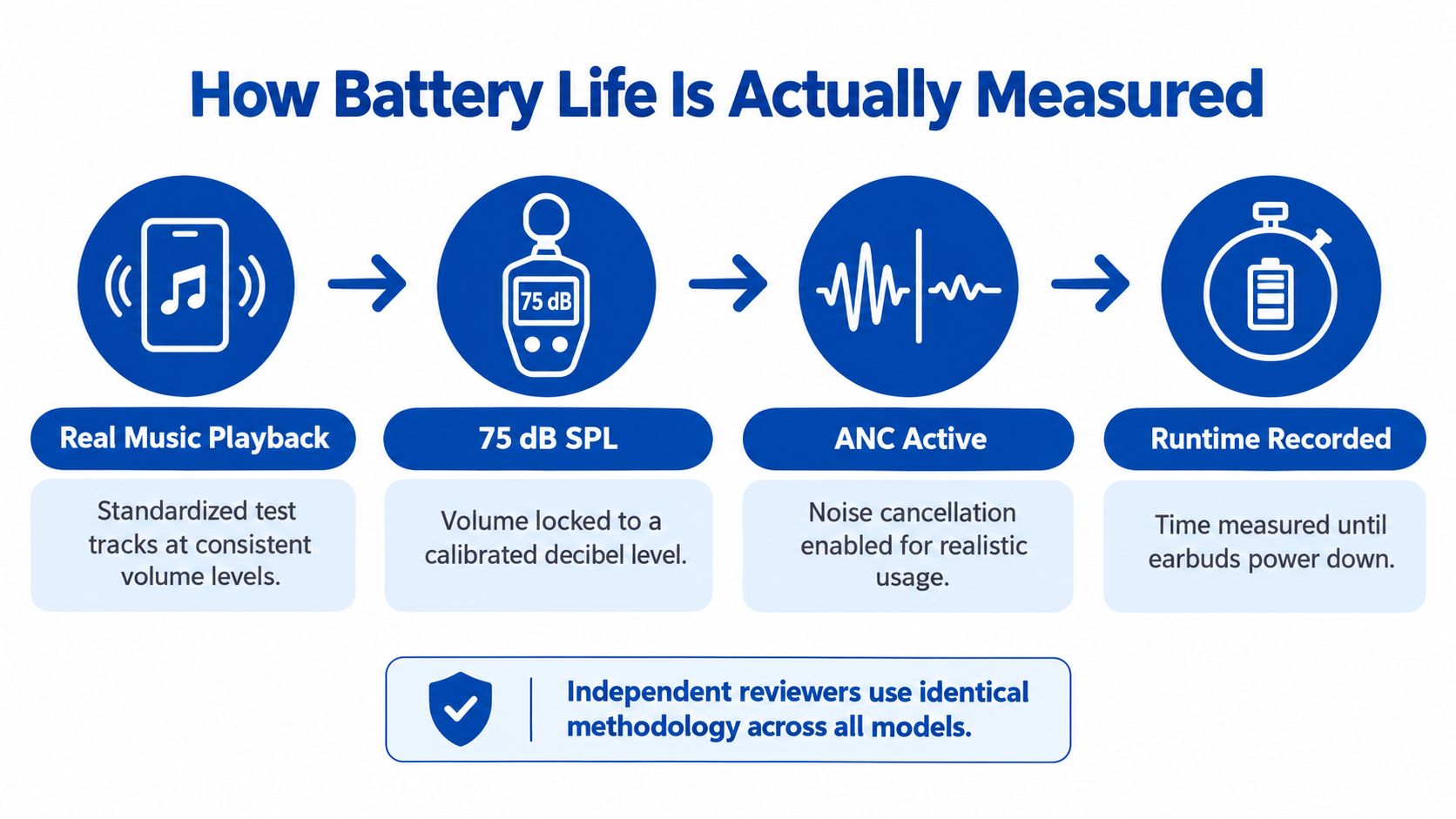
Use the same independent test as the comparison baseline (SoundGuys' wireless-earbud testing). Its real music at 75 dB SPL with ANC enabled defines the workload against which results should be compared. Record the codec when disclosed, too. A missing setting limits how confidently you can compare results across reviewers or reproduce them with your own pair.
Read the spec sheet in separate fields
An FCC-filed earbud manual lists a 5-volt input at 100–300 milliamps, at least 2 hours of charging time, two 40–50 mAh earbud batteries, and a claimed 2–3 hours of music playback.
Those specifications describe different parts of the system. The input rating concerns charging, while each cell's capacity describes stored charge. Neither establishes playback endurance independently. Small cells can sustain hours of listening only when operating power demand remains low, but the manual's claim does not establish that demand under matched listening conditions. Radios, audio processing, and enabled features all affect consumption.
Keep the comparison fields separate:
- Earbuds alone: Measured continuous playback, with advertised runtime labeled separately.
- Case contribution: Additional claimed playback supplied through recharging breaks.
- Test conditions: Volume, ANC state, and codec, where specified.
- Charging details: Input, charging current, and stated charge time.
Combined hours belong in the charging-system field.
For longevity, repeat the playback test under unchanged conditions as the earbuds age. A shorter result is meaningful only if the workload stays comparable. Repairability and cost per usable year require separate evidence; neither follows from cell capacity or a new pair's runtime.
What the 2026 Evidence Supports: Tiers, Not a Podium
The strongest battery-life shortlist starts with independently measured continuous playback. Advertised hours and charging-case totals belong alongside that result, but neither earns a model a higher endurance tier on its own. The evidence below supports a measured long-runtime tier, a mainstream tier, and examples whose advertised totals need separate interpretation.
| Evidence tier or example | Single-charge playback | Advertised playback | Total with case | Full charge time |
|---|---|---|---|---|
| Long-runtime tier in SoundGuys' testing | Some exceeded 10 hours with ANC on | Not stated as a group | Not stated as a group | Not stated |
| Mainstream tier in SoundGuys' testing | Typically 5-to-10-hour playback with ANC on | Not stated as a group | Not stated as a group | Not stated |
| EarFun Air Pro 4+ | 6 hours and 17 minutes, ANC on | 12 hours | Not stated in the cited test | Not stated |
| Consumer Reports example, model unnamed | Not established here | 3.5 hours | 12 hours, including 8.5 additional case hours | Not stated |
| Consumer Reports example, model unnamed | Not established here | 5.5 hours | 21.5 hours, including 16 additional hours | Not stated |
The measured tiers and named example draw on SoundGuys' measured EarFun Air Pro 4+ result; the advertised playback and case figures come from Consumer Reports' battery-life examples.
How to use the tiers
For uninterrupted listening, prioritize the long-runtime measured tier. Its advantage is time away from a charger. The available results do not identify every qualifying model or establish their recharge times, so they support a shortlist criterion rather than a named winner.
The EarFun example sits within the mainstream measured tier despite a substantially higher advertised figure. Different test conditions prevent treating that gap as a universal shortfall. A defensible model-to-model order requires matched playback conditions, including volume, ANC state, and codec. ANC-on labeling alone does not establish a fully matched comparison.
Case endurance serves a different routine.
The Consumer Reports examples may suit listeners who recharge between sessions. Their combined totals do not establish uninterrupted playback, and their advertised earbud figures cannot place them above independently tested models.
Leave longevity rankings open
Fresh-pair endurance is only the starting point for ownership value. The evidence here does not establish model-specific runtime degradation, repairability, or cost per usable year. Those fields remain unresolved rather than receiving an assumed score. A longer initial runtime offers more headroom, but it does not prove slower battery aging or a cheaper usable life.
For sound and feature trade-offs, DigiDevice's guide to wireless earbuds for audiophiles adds a separate buying lens. Choose the endurance tier that fits your listening sessions, then assess sound, features, and ownership costs without letting any one specification substitute for the others.
What ANC Costs in Runtime
Most models in SoundGuys' ANC-on testing deliver 5 and 10 hours per charge with ANC on, with some exceeding 10 hours. That range helps set expectations for noisy environments. It does not establish the battery penalty from enabling ANC: calculating that penalty requires ANC-on and ANC-off measurements for the same earbuds under otherwise identical conditions.
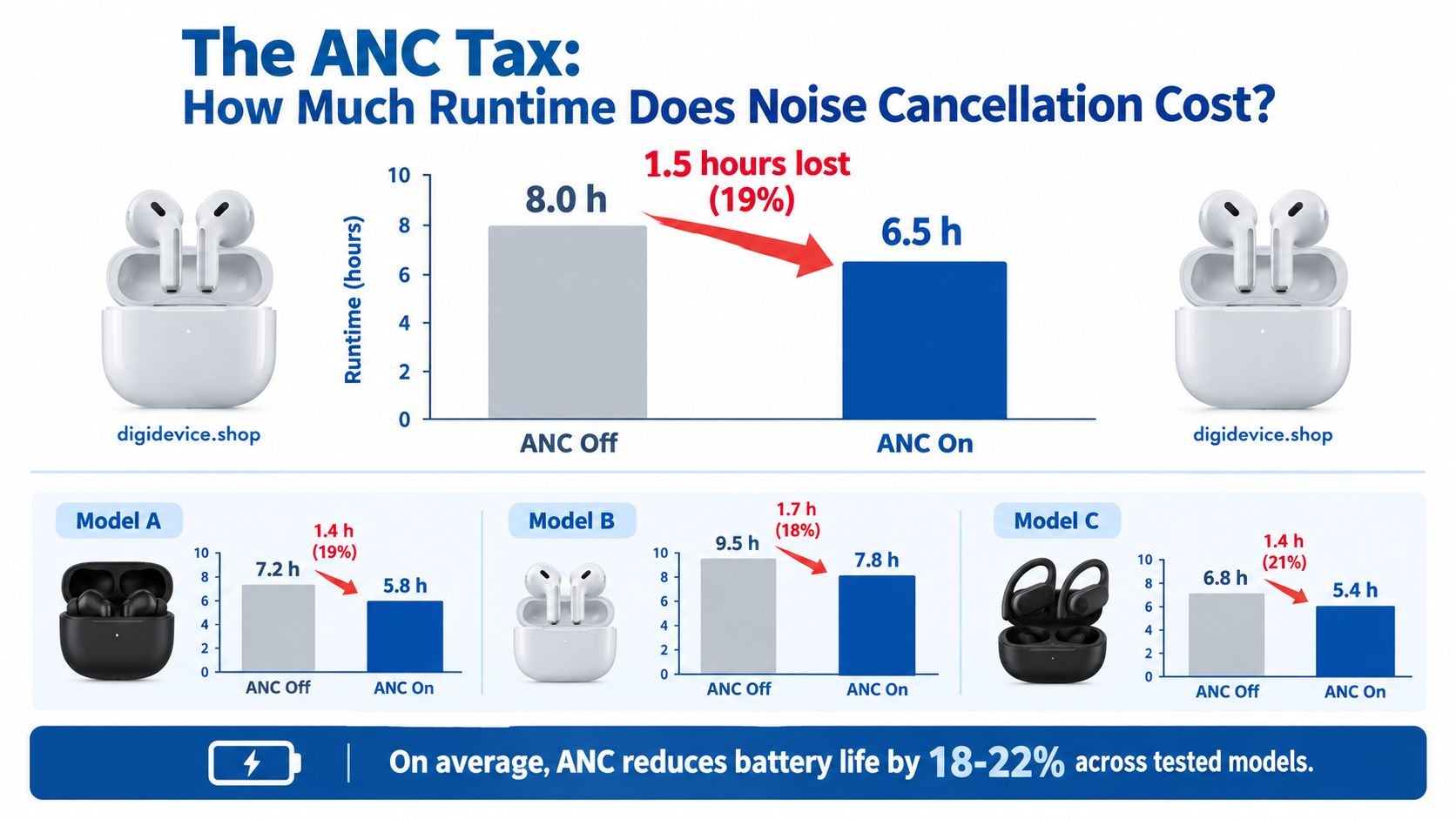
For a buying decision, use paired playback measurements rather than a chart-wide average. The cited results do not establish matched on/off differences across named models, so a universal percentage reduction would imply more certainty than the evidence supports.
An advertised ANC-off figure and an independently measured ANC-on result answer different questions. Their gap can reflect volume, codec, and other test conditions as well as noise cancellation. To isolate ANC's cost, hold those settings constant, including a playback level of 75 dB. Otherwise, the comparison measures a change in testing conditions, not just a change in power demand.
Choose for the place you listen
Budget for the mode you use.
For commuters and frequent travelers, measured ANC-on playback is the relevant session limit. A longer advertised figure with cancellation disabled offers little reassurance if the earbuds cannot cover the journey in the mode needed. At home or a quiet desk, ANC-off endurance may matter more, while case top-ups help only when taking the earbuds out is convenient.
A sound-isolating fit can reduce incoming noise, but it cannot establish battery endurance. DigiDevice's true wireless earbuds ANC guide covers noise-canceling features separately from playback time.
The ownership implication is reserve capacity: earbuds that barely cover a session when new leave less room for declining runtime. That is a reason to seek headroom, not evidence of slower aging, better repairability, or lower cost per usable year.
Choose ANC earbuds whose measured endurance covers your listening sessions with room to spare.
Tips That Extend Daily Runtime
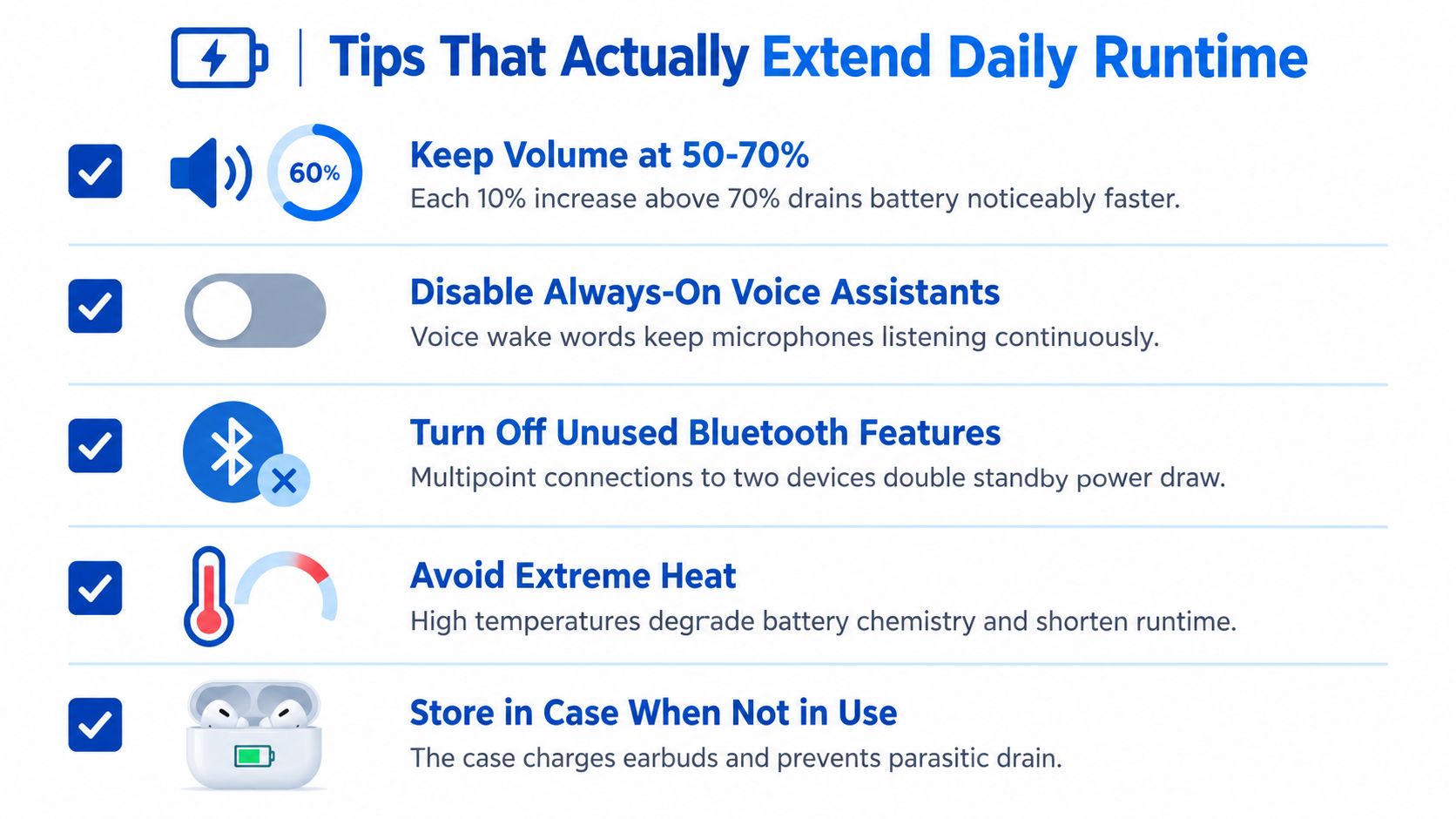
Start by cutting power use that adds nothing to your listening session. Lower playback output and fewer active features leave more charge available for playback, though the size of the gain depends on the earbuds and settings. Compare changes on your own pair under otherwise consistent conditions.
Change one setting at a time:
- Lower the volume when comfortable: Higher playback output requires more power. Reducing it trims that demand, helping recover some of the runtime lost relative to low-volume advertised tests. Choose a comfortable level rather than chasing the quietest possible setting.
- Turn off ANC in quiet places: Disable cancellation when it provides no useful noise reduction. Confirm the mode change before judging whether it extends your session.
- Disable features you aren't using: Voice wake words and multipoint connections may keep parts of the earbuds active. Switch off unused features, then compare playback duration with the same volume and listening mode. A battery indicator alone is a rough check.
- Keep earbuds in their case between sessions: This makes top-ups convenient and reduces the chance of loose earbuds remaining powered on. Case charging replenishes charge; it does not improve playback efficiency.
Charging habits should be model-specific
Follow the manufacturer's charging instructions. Neither fast charging nor overnight charging deserves a universal rule: charging behavior depends on the product's design. Keep the case away from extreme heat and use a charger meeting its stated input requirements. Daily convenience does not establish long-term capacity retention.
DigiDevice's earbud volume control guide explains the practical adjustment. Prioritize comfortable playback and settings you can sustain throughout a normal session.
Long-Term Battery Health and Cost Per Usable Year
A fresh-charge runtime tells you how long a product works today. It doesn't tell you how well it will perform after months of daily charging, whether the earbuds or case will become the weak point, or whether a worn battery can be replaced.
One analysis describes roughly 300 full cycles before a true-wireless battery reaches about 80% capacity, and says daily-use products can become noticeably weaker within 12–18 months. Those figures aren't independently verified across brands, so they shouldn't be treated as a dependable lifespan forecast for any particular model (the battery-life analysis and its limitations). The useful lesson is that cycle life and playback time per charge are different measures.
Compare ownership, not just launch-day runtime
A nine-hour earbud could be a worse long-term choice than a seven-hour option if its battery is difficult to replace or its usable runtime deteriorates sooner. The reverse could also be true. Without standardized degradation tests for the specific models, buyers can't settle that comparison from day-one playback figures alone.
A practical cost-per-usable-year assessment needs information that a standard battery ranking often leaves out:
- Runtime at purchase: Prefer a clearly stated, independently measured result when available.
- Degradation tracking: Look for repeat tests over time, with usage and charging conditions documented.
- Repairability: Check whether the earbuds or case can be serviced and whether replacement batteries are available.
- Warranty and single-bud use: Confirm coverage terms and whether the remaining earbud stays usable if one fails.
People evaluating repair options for lithium-ion devices may also find this overview of lithium-ion battery repair in Singapore useful for understanding the repair context. It doesn't establish that a given earbud can be repaired; confirm that with the manufacturer or seller. For the charging side of ownership, DigiDevice's USB battery and charger guide offers a related point of comparison.
The better definition of “best” includes lifetime friction: how often you need to recharge, whether the battery can be replaced, and whether the product remains practical as capacity changes. If sellers don't publish those details, treat the gap as uncertainty rather than filling it with a lifespan estimate.
Our Picks by Use Case
The right pick depends on how long you use the earbuds between charges and which features stay active. Advertised totals include the case, while a single-charge result reflects the earbuds alone. For a fair comparison, prioritize independently measured playback with ANC on under matched conditions, then consider how runtime may change with age, whether batteries can be replaced, and the cost of keeping the pair usable.
- For long-haul travel or remote work: Shortlist models with a published ANC-on single-charge figure of at least 8 hours, then check the test conditions before buying. Compare that claim with the 10-plus-hour tier identified in the testing covered above, rather than treating a case total as continuous listening time.
- For commuting and cafés: Focus on measured ANC-on playback. A large case total won't prevent a mid-session break if the earbuds themselves run short.
- For gym sessions or a last-minute top-up: Check the exact model's charging time and quick-charge details. No verified charge-time ranking is available here, so longer playback does not establish faster recharging.
- For shoppers on a tighter budget: Weigh measured playback against case contribution, warranty, replacement options, and expected battery longevity. A high advertised total alone says little about usable value over time.
For call-heavy days, the wireless earbuds for calls guide can help compare microphone performance as a separate buying factor. DigiDevice carries audio gear and mobile accessories; check each listing for its stated playback conditions.
Visit DigiDevice to browse earbuds and audio accessories. Compare each model's single-charge claim with its case total and stated ANC conditions, and choose based on how you listen.