

Noise Cancelling Headphones for Office: 2026 Guide
You're halfway through a video call when a colleague starts talking nearby, a ventilation system begins humming, and your laptop microphone picks up enough room noise to make everyone ask you to repeat yourself. Noise cancelling headphones for office work can make that environment feel calmer, but ANC alone won't erase speech, guarantee higher productivity, or replace a good call microphone.
The practical choice is a headset that balances low-frequency cancellation, passive fit, masking audio, microphone performance, multipoint connectivity, and long-wear comfort. Updated for March 2026, this guide separates what measured testing supports from what office headphone marketing tends to imply.
The Reality of Office Noise and Productivity
Open-plan offices create a difficult mix of sound. Air conditioning and computer fans produce steady low-frequency noise, while colleagues' conversations change constantly in volume, direction, and pitch. At home, the equivalent might be a partner on a call, a delivery at the door, or household equipment running in the next room.
ANC helps most with the predictable part of that soundscape. It can make the desk feel less aggressive and more comfortable, which matters when irritation itself keeps pulling your attention away from a task. But a more pleasant listening experience isn't the same as a measurable improvement in cognitive performance.

What the office research actually supports
A 2024 office-context study found that active noise-cancelling headphones didn't improve cognitive performance or heart-rate-variability stress measures. Participants did rate the environment as more pleasant with ANC, and they felt less likely to be disturbed when ANC was combined with masking sound. The research also concluded that headphones shouldn't be treated as the only answer to speech distraction in offices. The office-context findings are available in the Building and Environment abstract.
That distinction is important. ANC can reduce annoyance without making complex work measurably faster. In practice, that subjective benefit may still be valuable, especially for people who find unpredictable background sound exhausting, but buyers should judge it as a comfort and concentration aid, not a guaranteed productivity device.
Practical rule: If nearby speech is your main problem, buy for a combination of ANC and masking playback, not ANC alone.
A 2016 office-noise experiment found that wearing headphones without masking didn't protect serial short-term memory from background speech, while masking with nature sound reduced the impairment. The quiet condition produced the lowest perceived workload, and the other sound conditions felt more demanding. The experiment is documented by Work.
For broader workspace changes, the guide to reduce office noise in 2026 is useful because headphones work better when paired with room-level measures such as layout, absorption, and speech control.
Active vs Passive Noise Cancellation Explained
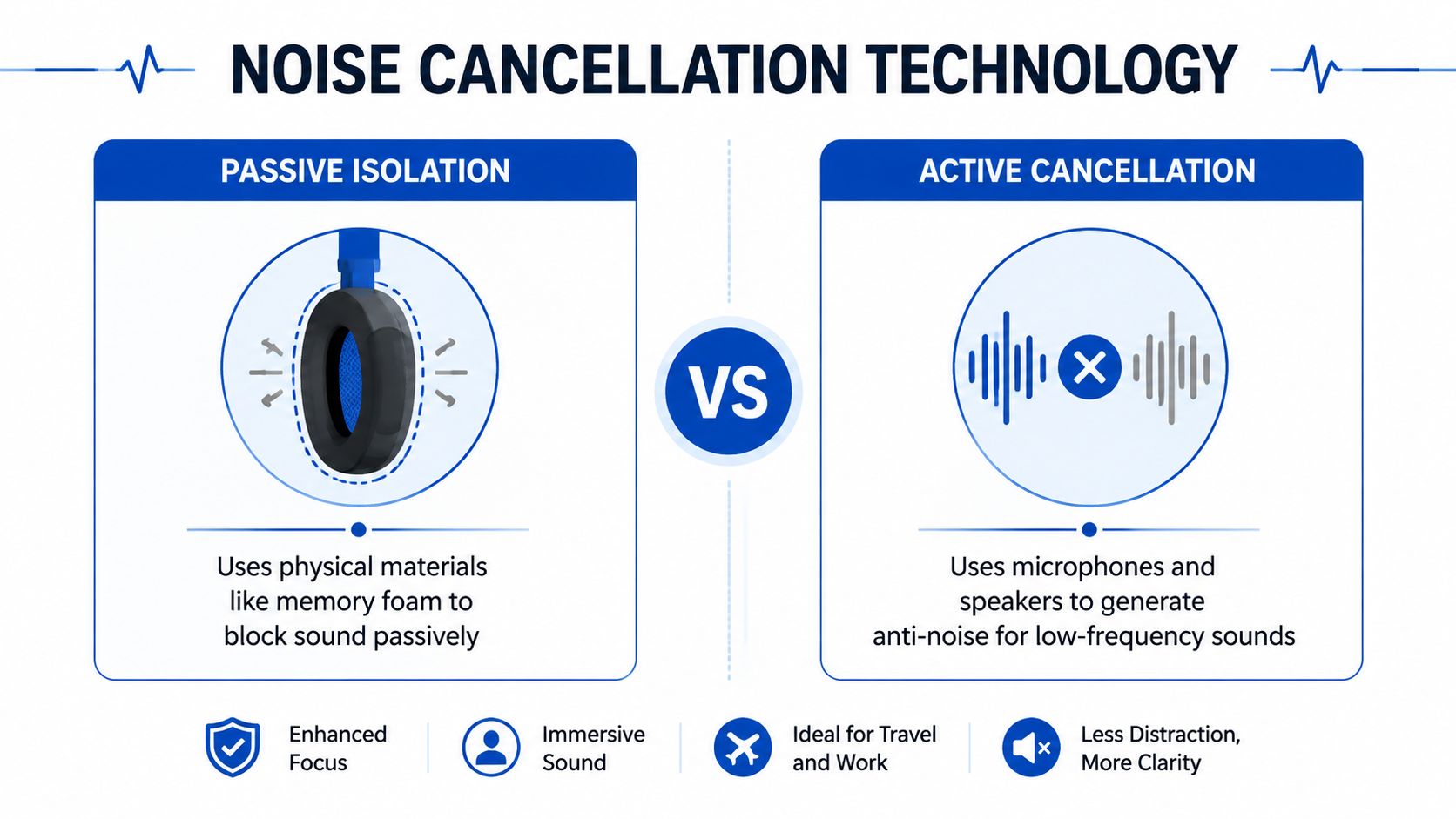
A headset uses two different defenses against unwanted sound. Passive isolation comes from the physical design, while active noise cancellation uses electronics to counter external sound. The strongest office result usually comes from both working together.
Passive isolation is similar to closing a room's door. Over-ear cups surround the ear with foam and a shell, while in-ear models depend on a correctly sized tip sealing the ear canal. That seal reduces sound before the headset's electronics process anything. If the pads leak around glasses, hair, or an imperfect fit, ANC has less to work with.
ANC is closer to adding an opposing signal to a steady disturbance. External microphones listen to the environment, the headset processes that signal, and its speakers produce anti-noise designed to reduce the perceived level of the unwanted sound. This approach is particularly effective when the noise is consistent, such as an HVAC system, desk fan, engine, or train.
Why speech remains audible
Human conversation is a moving target. A talker changes words, pitch, distance, and direction from moment to moment, so the headset can't create one stable cancellation pattern that removes every part of the voice. Passive sealing can soften speech, but it rarely makes a nearby colleague disappear.
Workplace acoustics research found that ANC technologies weren't particularly successful at suppressing ambient speech, and some conditions increased speech intelligibility compared with passive mode. That result explains a common office complaint: the HVAC hum vanishes, but the person discussing a project two desks away remains understandable. The workplace acoustics project is described by BAuA.
Masking works differently. Instead of trying to cancel every syllable, it adds a controlled background sound that makes speech less distinct. Nature sound, low-level broadband audio, or another carefully selected track can reduce the perceived prominence of conversations, though you'll need to choose a level that doesn't become its own distraction.
For software-based voice cleanup during meetings, consult this comparison of the best noise reduction software in 2026. It addresses a separate problem from ANC: what your microphone sends to other people.
Your listening preferences also matter. A headphone's tonal balance can make low-level masking sound comfortable or fatiguing, so check this headphone frequency response guide before choosing a model for continuous playback.
Measuring Silence, Top Contenders by the Numbers
Marketing labels such as “premium ANC” do not reveal how much external sound a headset reduces. A measured decibel figure offers a clearer comparison, although it still cannot predict exactly how the device will perform beside a talkative coworker.
The following figures come from a 2026 Wirecutter measurement of average noise cancellation. They cover two over-ear models and two in-ear models, making the table useful for comparing both cancellation results and form-factor trade-offs.
| Model | ANC Reduction (dB) | Form Factor |
|---|---|---|
| Sony WF-1000XM6 | 30.4 dB | In-ear earbuds |
| Apple AirPods Max 2 | 27 dB | Over-ear headphones |
| Bose QuietComfort Ultra Headphones, 2nd Gen | 26.9 dB | Over-ear headphones |
| Sony WH-1000XM6 | 26.2 dB | Over-ear headphones |
Wirecutter's 2026 noise-cancelling headphone review provides these measurements and makes the comparison concrete. The Sony WF-1000XM6 records the highest average reduction in this group, while the over-ear models create a larger physical barrier around the ear.
What these measurements mean in practice
A higher average reduction does not automatically make a headset better for office work. The result reflects a test method and an average, not your desk, fit, glasses, music level, or nearby voices. Speech remains difficult for ANC systems even when the headline figure is strong.
Over-ear headphones can be the more practical choice for a broad passive seal, stable positioning, and comfortable masking playback. Larger earcups may distribute pressure more evenly, but head shape, clamp force, pad material, and heat often matter more than the category label.
Earbuds take up less space and are easier to carry between home, office, and travel. They can create an excellent seal when the tips fit correctly. An imperfect fit can weaken both bass response and isolation. For a closer look at one premium over-ear option, see this Bose QuietComfort Ultra review.
Use these figures as a starting point. Then check for masking audio, reliable transparency mode, clear calls, multipoint switching, and tolerable long-session comfort. ANC reduces steady background noise, while those additional features determine whether conversations become manageable and whether the headset fits a hybrid workday.
The Hybrid Worker's Dilemma, Calls and Connectivity
Silence on your side of a call doesn't help if your microphone transmits every keyboard strike and nearby conversation. A true office headset needs to manage two separate audio paths: what you hear and what other people hear from you.
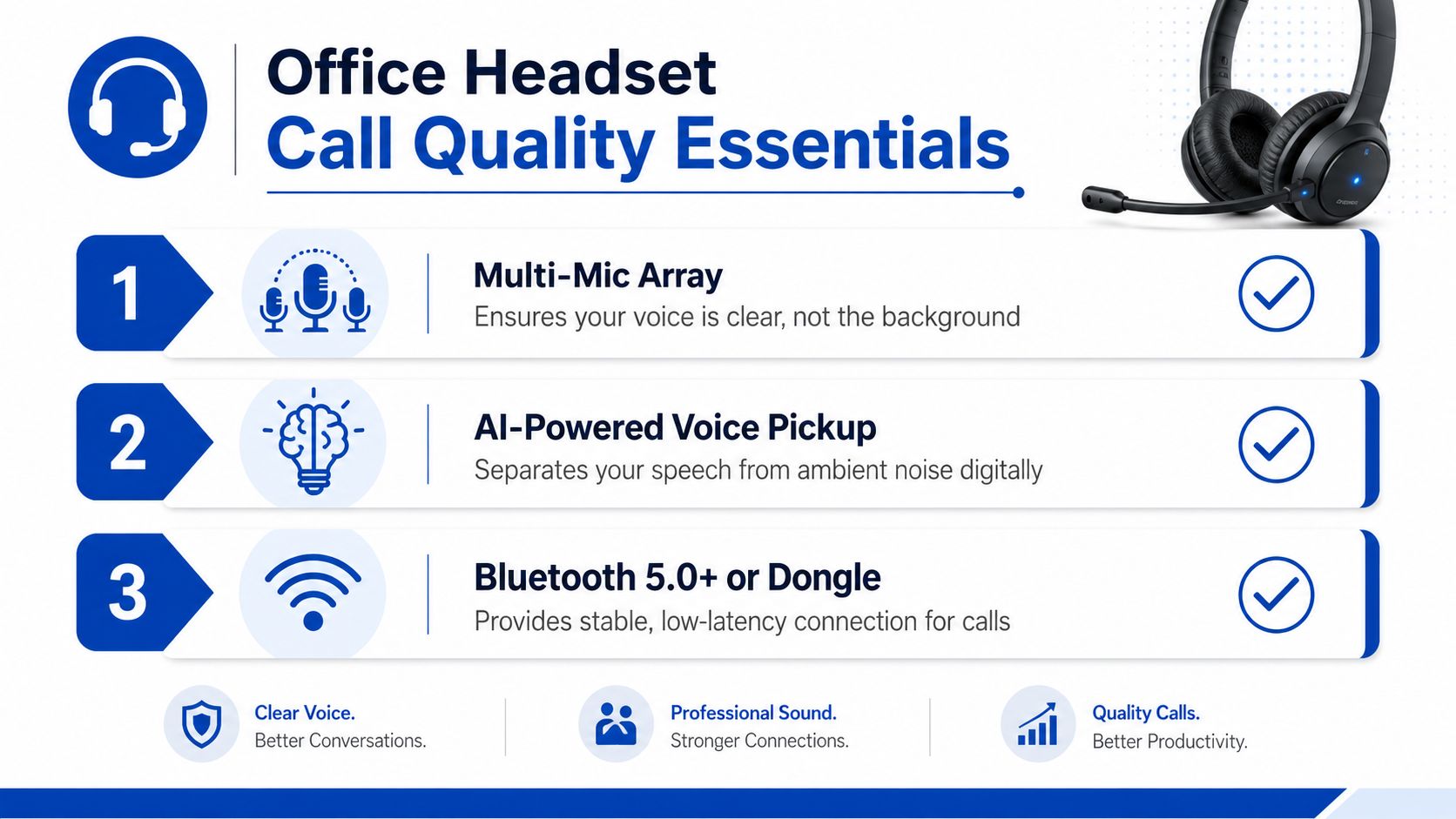
The first path is listening-side ANC. It reduces external sound for the wearer. The second is microphone noise suppression, which processes the captured voice before it reaches Zoom, Microsoft Teams, or a phone call. A headset can be excellent at one and mediocre at the other.
The features that change daily call handling
Multipoint Bluetooth lets a headset maintain connections with more than one device, commonly a laptop and a phone. That's useful when a mobile call interrupts a desktop meeting, though implementation quality varies. Some models switch smoothly, while others require manual reconnection or pause unexpectedly.
A dedicated boom microphone usually places the capsule closer to your mouth than the hidden microphones in lifestyle headphones. That position can improve voice pickup and give the headset's processing a cleaner signal, especially in a busy room. A retractable or removable boom also gives you flexibility when you want to use the headset for music.
Multi-mic arrays and digital voice processing can separate speech from surrounding sound, but don't assume the presence of “AI” in a product description guarantees natural voice quality. Listen for compression, clipped consonants, pumping background reduction, and inconsistent volume. Ask a colleague to judge your call audio from the other end, not just from a local recording.
Enterprise-focused models may carry Teams or Zoom optimization and Unified Communications compatibility. Look for dedicated call controls, mute feedback, platform integration, and an included USB dongle when Bluetooth reliability is uncertain. A dongle can also simplify deployment on computers with crowded Bluetooth environments.
If calls dominate your schedule, compare microphone behavior separately from listening-side ANC in this wireless earbuds guide for calls.
Room design still matters. If your office permits environmental changes, circular office furniture pods can provide another layer of speech separation, reducing the amount of work your headset and microphone need to perform.
Ergonomics and Battery Life for the Long Haul
A headset that sounds impressive for a short demo can become unusable once the headband creates a pressure point or the ear pads trap heat. For an all-day office setup, fit is a performance feature because discomfort leads to frequent removal, lower listening volume, and inconsistent use.
Start with clamp. Too little pressure allows leakage and makes the headset shift when you move. Too much pressure creates discomfort around the temples and jaw. Glasses add another variable because their arms can break the ear-cup seal and create a pressure point.
What to inspect before buying
- Weight distribution: A slightly heavier headset can still feel comfortable when the headband spreads the load and the cups sit centrally over the ears.
- Pad material: Protein leather tends to create a closer seal, while velour can feel cooler but may allow more leakage. Neither is universally better.
- Ear-cup depth: Your ears shouldn't press against the internal grille. Shallow cups become irritating long before the battery runs low.
- Controls: Physical buttons are easier to use without opening an app, particularly when you need to mute or activate transparency quickly.
Battery life matters because hybrid workers may move from a commute to a desk session and then into evening calls. Recent office-focused coverage highlights battery figures above 30 hours for leading premium models, but that figure generally refers to listening conditions and can change with ANC, calls, codec selection, and volume. The RTINGS office headphone roundup treats battery endurance and microphone quality as separate buying criteria.
USB-C charging reduces friction, especially when the same cable already powers your laptop, phone, and accessories. Fast charging is useful before a meeting, but check whether the headset supports wired audio when its battery is empty.
For a value-oriented over-ear option with a listed 120-hour playtime and 46 dB noise cancelling, review the Baseus Bowie H1s wireless headphones. Treat the listed specification as one part of the decision, alongside fit and call performance.
Strategic Buying Checklist for Every Office Type
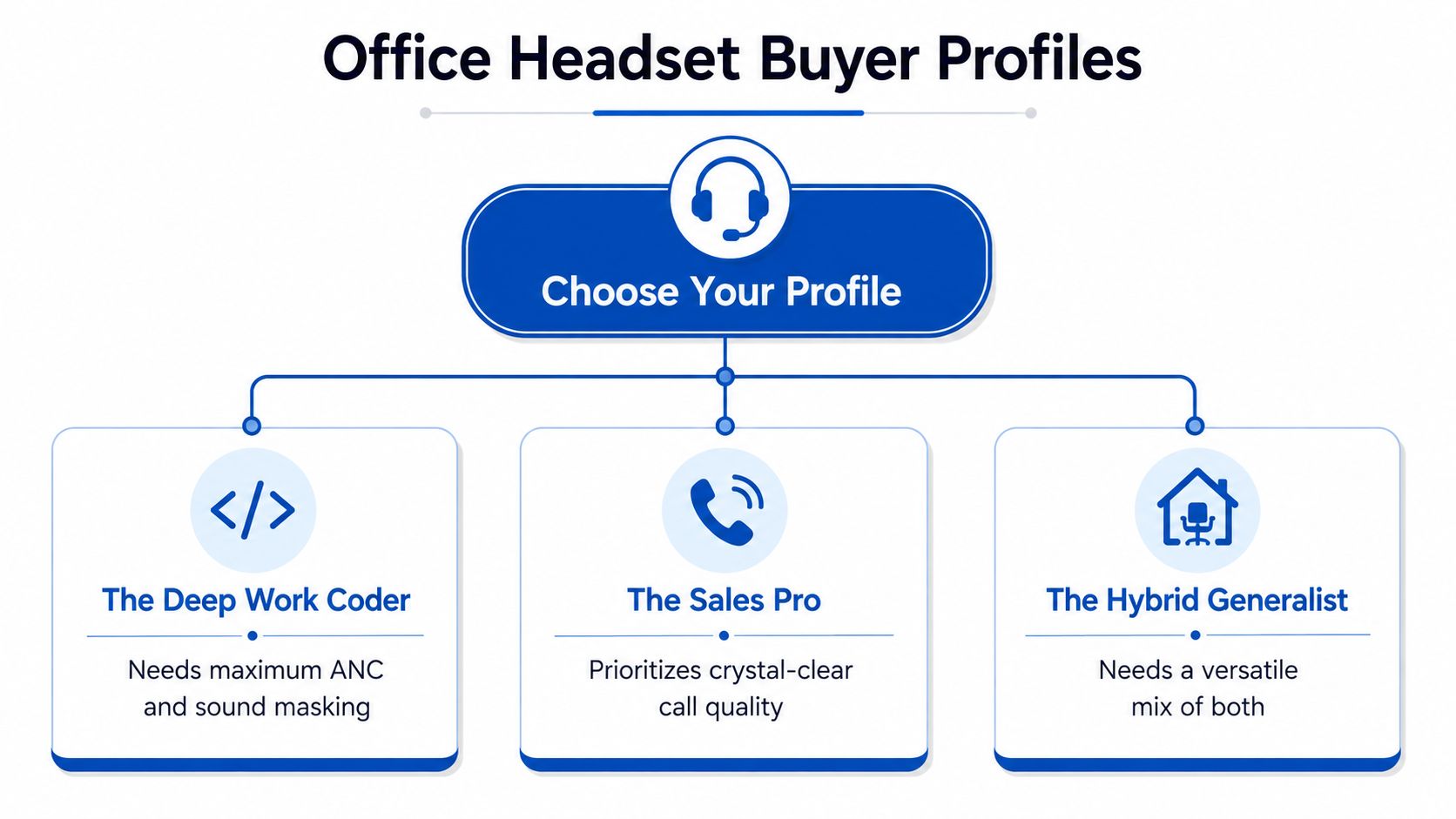
The right office headset depends on the sound you face and the work you perform. Start by identifying whether your priority is sustained focus, frequent calls, or movement between locations.
Match the headset to your working pattern
The Deep Work Coder needs low-frequency ANC, a reliable seal, and support for masking audio. If nearby conversations are the main distraction, prioritize a comfortable over-ear design or well-fitting earbuds that can play nature sound or another masking track. Don't pay for ANC alone and expect it to remove voices.
The Sales Pro should start with the microphone. Look for a boom or strong multi-mic array, microphone mute controls, multipoint Bluetooth, and clear compatibility with the platforms used for customer calls. Listening-side ANC is still useful, but a caller who hears the room clearly won't care how quiet your own desk feels.
The Hybrid Generalist needs balance. Transparency mode helps when a colleague speaks to you, multipoint reduces device juggling, and a foldable or compact design makes the headset easier to carry. Comfort and battery consistency may matter more than the last increment of measured cancellation.
Use this quick decision sequence:
- Name the dominant noise. Steady HVAC and fans favor ANC. Nearby voices require passive sealing plus masking.
- Count your call hours. More calls make microphone placement, mute controls, and pad comfort increasingly important.
- Check your devices. Confirm laptop, phone, Bluetooth, dongle, and platform compatibility before ordering.
- Decide how available you must remain. Choose transparency mode or a one-ear workflow if colleagues need to reach you.
- Review the return policy. No specification sheet can predict how a headband will feel on your head.
The guide to headphones for working from home is a useful companion when your office is a spare room rather than an open-plan floor.
Maintenance and Hygiene Best Practices
Ear pads collect skin oils, dust, and moisture during regular use. Wipe smooth surfaces with a soft, lightly dampened cloth, then let them dry fully before storing the headset. Avoid saturating the pads, controls, microphone openings, or charging port.
Microphone grilles need a gentle approach. Use a dry, soft brush to remove loose particles, and don't push debris into the capsule. Never spray cleaner directly onto the headset, and don't use sharp tools near ANC microphones or pressure vents.
Protect the seal and the electronics
Replaceable ear pads are worth considering because worn foam changes comfort and can weaken passive isolation. Store over-ear headphones on a stand or in their case rather than crushing the cups inside a crowded bag. Keep the headband in its natural position instead of stretching it over a wide object for long periods.
The common “burn-in” idea shouldn't drive your purchase. Your ears may adapt to a new sound signature, and software equalization can change presentation, but careful cleaning, correct fit, and sensible storage have a more direct effect on everyday ownership.
Inspect firmware updates through the manufacturer's app, but don't update immediately before an important meeting. Test mute behavior, multipoint switching, transparency mode, and microphone quality afterward so you know whether the update changed your routine.
If speech still breaks through after cleaning and refitting, add masking audio or change your seating position. ANC hardware can't compensate for every acoustic problem.
DigiDevice offers office-focused electronics including headphones, earbuds, mobile accessories, and related productivity gear, so you can compare practical features such as ANC, fit, connectivity, and call use in one store. Visit DigiDevice to review the available options, then choose the model that fits your workspace and daily workflow.