

True Wireless Earbuds ANC Explained for Real Life
A subway car rattles, someone nearby takes a phone call, and the steady motor noise makes your podcast harder to follow. True wireless earbuds with active noise cancellation, or ANC, use microphones and electronic anti-noise to reduce outside sound, especially steady low-frequency noise. They won't erase every voice, sudden clatter, or gust of wind, and their real performance depends heavily on fit, battery power, and the environment.
Introduction to True Wireless Earbuds ANC in Everyday Noise
You leave the subway for an office where keyboards click, conversations overlap, and ventilation hums overhead. Earbuds that seemed impressively quiet underground can respond differently outdoors, especially when wind reaches their microphones or movement loosens the seal.
ANC has moved from a feature once associated mainly with premium earbuds above US$200 into the US$50 to US$100 mid-range, according to market data on true wireless stereo earbuds. The same report says 78% of newly launched TWS models integrate ANC, so shoppers increasingly treat true wireless earbuds ANC as a baseline feature rather than a rare upgrade.
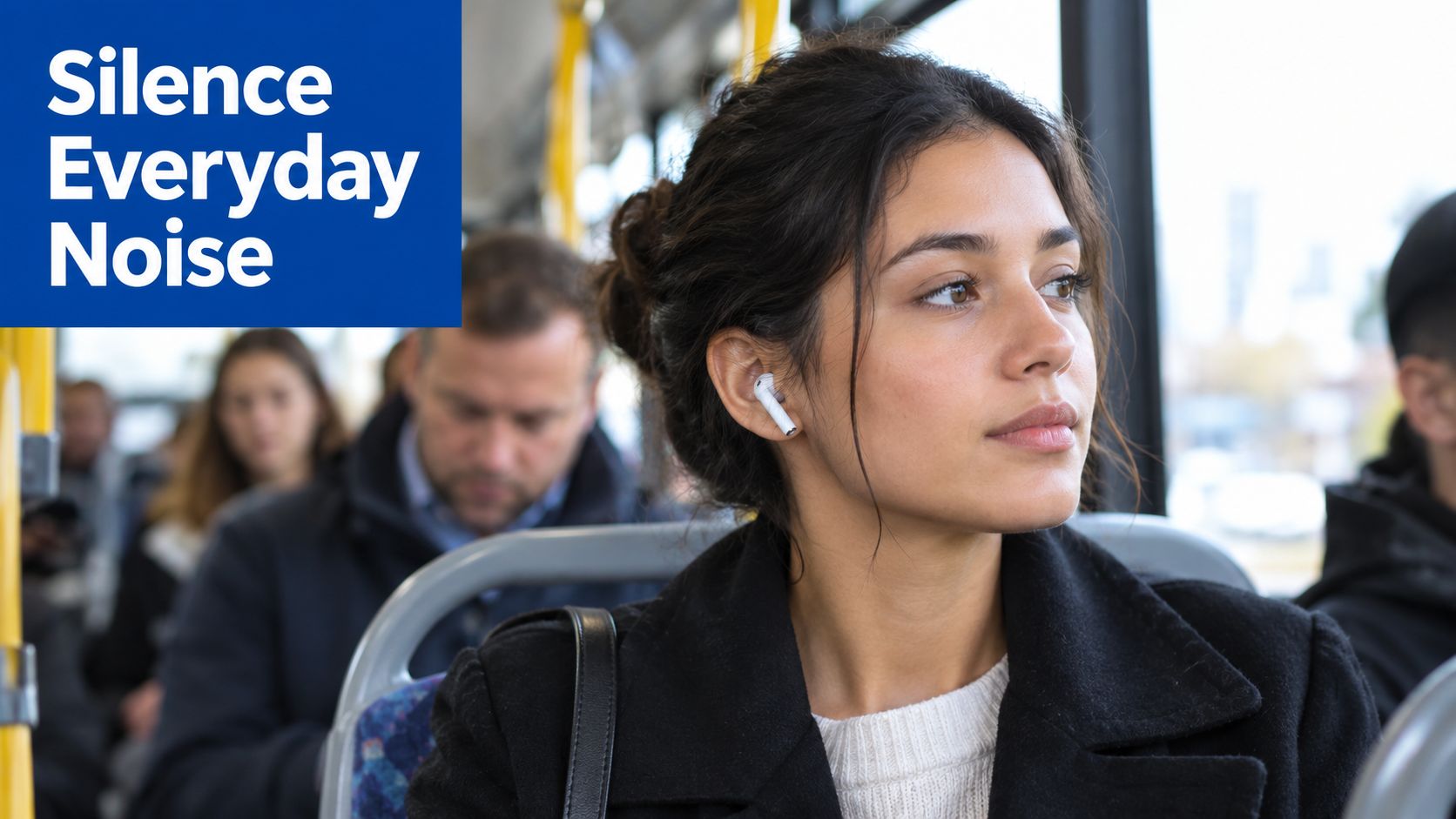
Direct answer: ANC performs best against continuous low sounds, including train engines, aircraft cabin rumble, and HVAC hum. The ear-tip seal still carries much of the workload. Speech, sharp clatter, wind, and sudden high-frequency sounds usually remain audible.
This guide uses a practical, scenario-based assessment. It covers the ANC mechanism, passive isolation and transparency, then compares battery impact, latency in ms, codec choices, microphone behavior, wind handling, and fit.
Hybrid ANC can improve coverage by combining outside and in-ear microphones, while open-ear designs trade a more natural awareness of surroundings for less physical sealing. For a broader explanation, read what active noise cancellation does. DigiDevice's wireless audio selection also lets shoppers compare earbud formats and related gear.
Practical expectation: The best ANC pair is not simply the one with the quietest laboratory demo. It is the pair that stays comfortable, sealed, and predictable throughout the commute you actually take.
How ANC Works Inside True Wireless Earbuds
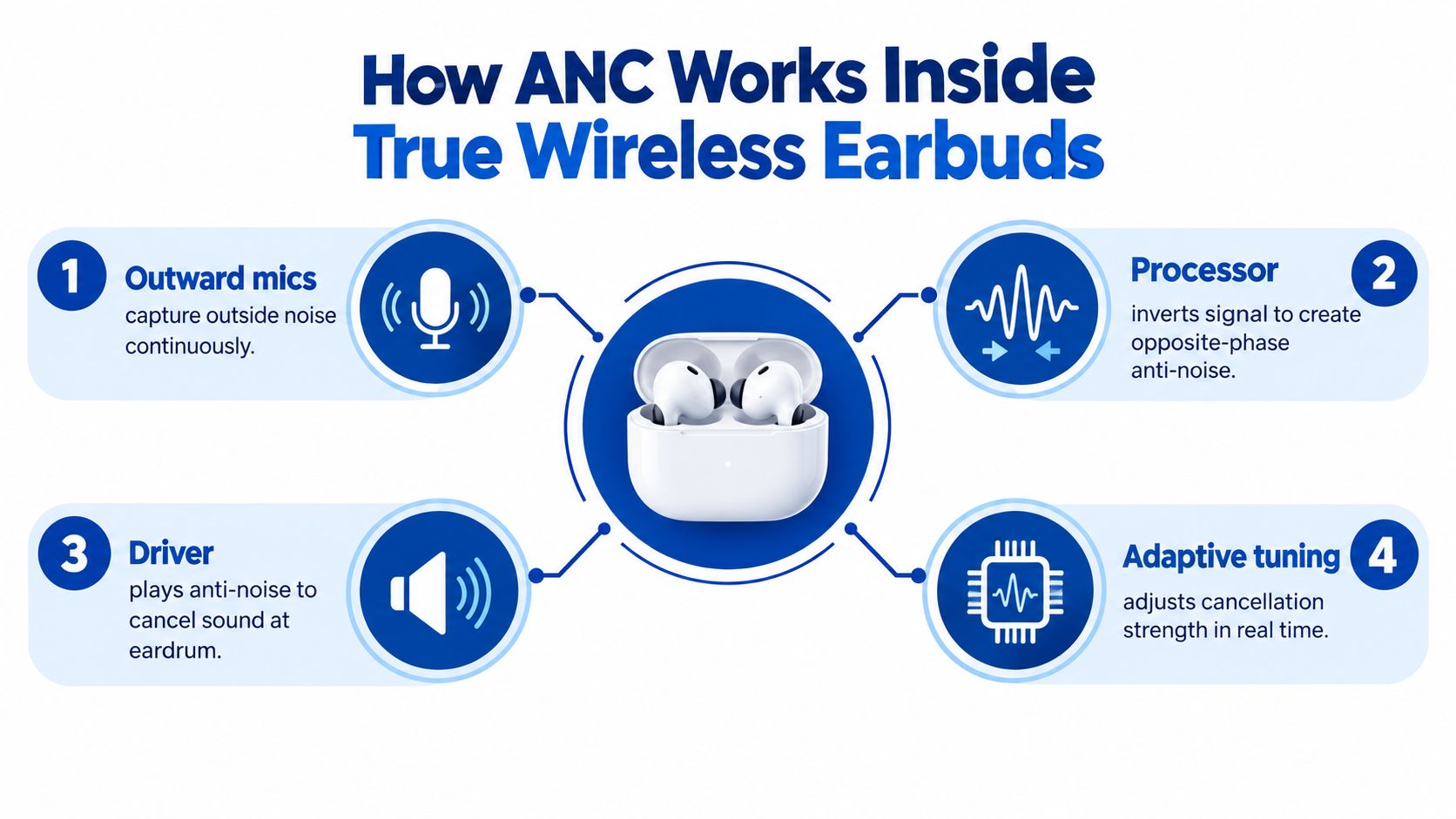
ANC is easier to understand as a sound-control loop.
- Microphones listen. External or internal microphones detect incoming noise.
- The processor analyzes it. The earbud chipset identifies the sound's waveform and timing.
- The driver creates anti-noise. The speaker produces an opposite-phase signal.
- The waves interfere. The original noise and anti-noise partially cancel before reaching your eardrum.
Active noise cancellation uses this destructive-interference principle, as explained in this overview of true wireless earbud features.
Core idea: ANC doesn't build a wall around your ears. It listens to noise and generates a carefully timed counter-signal.
Feedforward feedback and hybrid designs
Feedforward ANC places a microphone on the outside of the earbud. It hears environmental noise before that sound reaches the ear, which gives the processor time to react. The trade-off is that the external microphone can be affected by wind and may not know exactly what the listener is hearing.
Feedback ANC uses a microphone inside the ear canal. It monitors the sound that remains after the driver plays audio and anti-noise. This can help the system correct for fit and playback differences, but the microphone has less advance warning of outside noise.
Hybrid ANC combines outward-facing and inward-facing microphones. One listens to the environment, while the other checks the result inside the ear. That dual perspective makes hybrid designs well suited to adaptive tuning, where the earbuds adjust cancellation as the surroundings or seal change.
Adaptive ANC can respond to movement, changing noise, and fit conditions. AI-driven tuning is increasingly associated with premium and mid-range TWS designs, but the label alone doesn't tell you how well the system handles wind or voices.
The processor also affects the listening experience beyond noise reduction. Frequency response, driver behavior, and tuning influence whether music remains balanced after ANC changes, so this headphone frequency response guide is useful when ANC is only one part of your decision.
What hybrid ANC means for fit
Hybrid electronics can't compensate for a loose or badly sized ear tip. The outward microphone may detect a train, but sound can still enter through the physical gap around the earbud.
That's why a hybrid ANC design still needs a stable seal. The electronics handle part of the problem, while the ear tip and housing prevent sound from leaking around the ear canal.
For a visual explanation of the signal path, watch the embedded demonstration below.
Passive Isolation vs Active Cancellation and Transparency Mode
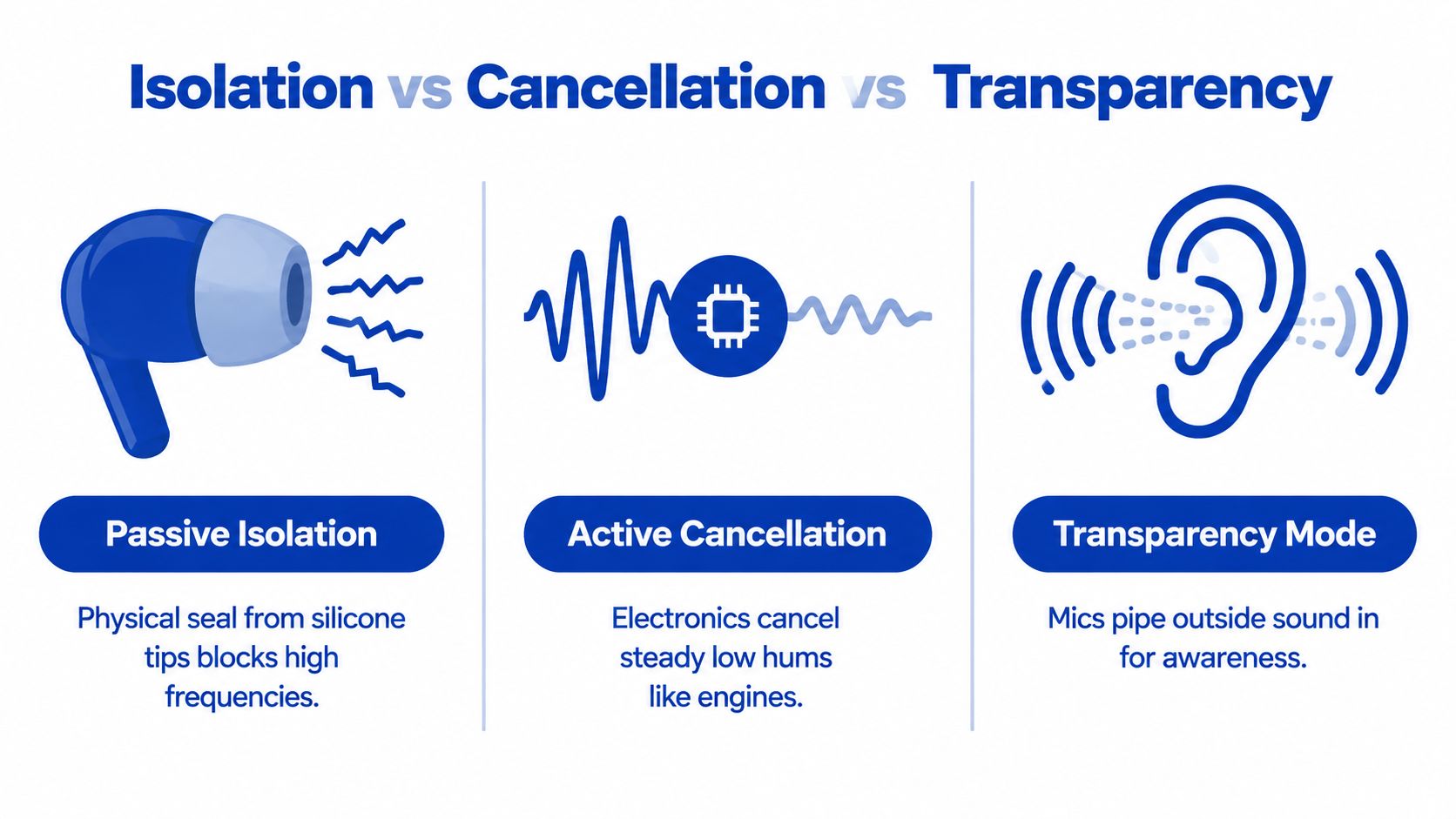
On a windy commute, the earbud's fit decides what reaches your ear before electronics begin working. Product listings often group passive isolation, active cancellation, and transparency mode together, but each handles a different part of the sound problem.
Passive isolation comes from the ear tip and housing forming a physical seal. Like closing a door around a noisy room, the seal reduces outside sound before any processing occurs, especially higher-frequency leakage. It also keeps bass from escaping through gaps. A loose tip can therefore make music thinner and ANC less convincing.
Active cancellation combines microphones, processing, and anti-noise. It works most consistently against steady, low-frequency sound, such as engine drone, ventilation, and train rumble. Independent explainers place its useful range roughly from 20 Hz to 1,000 Hz, while speech, wind turbulence, and sudden sounds are harder to reduce, as described in this explanation of what ANC blocks.
Transparency mode, also called ambient mode, reverses the listening goal. External microphones capture surrounding sound and play it through the earbuds, so you can hear announcements, colleagues, or nearby traffic without removing them. Transparency latency and ambient fidelity deserve separate attention because passing sound through naturally is a different task from canceling it, as explained in this earbud buying guide.
Match the mode to the situation
On a train, use a stable seal with ANC to reduce mechanical rumble. In an office, transparency is more convenient when a coworker may speak to you. Near traffic or while waiting for announcements, ambient mode preserves awareness better than maximum isolation. No mode replaces attention to surroundings.
| Mode | Main mechanism | Best use | Limitation |
|---|---|---|---|
| Passive isolation | Ear tip and housing create a seal | Blocking leakage and preserving bass | Depends on fit |
| ANC | Microphones and anti-noise reduce external sound | Engines, trains, HVAC, and steady hum | Less effective on speech and sudden noise |
| Transparency | Microphones pipe outside sound into the earbuds | Conversations and awareness | Quality depends on latency and microphone tuning |
A sealed earbud also reduces how much room noise reaches your ear while you record or take calls, which is why fit matters beyond music. For microphone cleanup, cut room echo and keyboard clicks provides practical background-noise guidance.
Tip selection is the simplest hardware adjustment to test first. The Final Audio Silicone Type E ear tips kit shows why replacement tips can matter, provided the bore and mounting fit your earbuds.
Battery Life Latency Codecs and Microphone Trade Offs
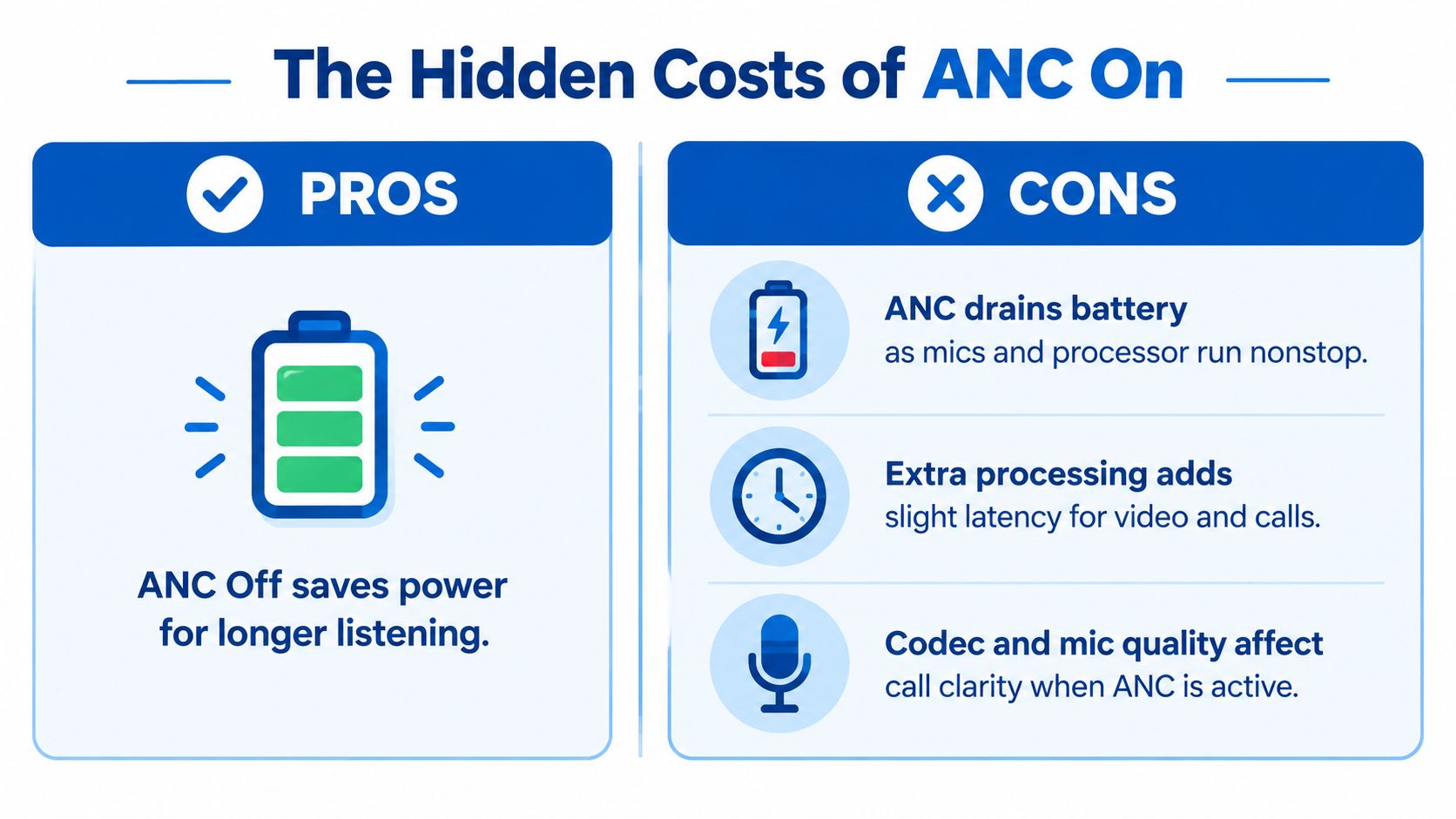
During a windy commute, ANC can make the ride quieter while draining the earbuds faster. The microphones remain active, the processor analyzes incoming sound, and the drivers play an anti-noise signal. PCMag's true wireless noise-canceling guide explains that ANC depends on battery-powered electronics, whereas passive isolation comes from the physical seal.
Independent reviews commonly place ANC-on battery life for many true wireless earbuds around 5 to 8 hours. RTINGS describes more than 10 hours with ANC as exceptional in its wireless earbud testing guide. Treat those figures as a range, not a promise. Codec choice, listening volume, radio conditions, spatial audio, microphone activity, and adaptive processing can all shorten endurance. A sealed fit may also let you listen at a lower volume, while open-ear designs avoid a deep seal but usually provide less passive isolation.
Latency and codec choices
Latency is the delay between an event at the source and the sound reaching your ears. Music often hides it. Games and video calls reveal it through delayed effects, mismatched mouth movement, or slow control feedback.
Codec names such as SBC, AAC, aptX Adaptive, LDAC, and LC3 describe how Bluetooth audio is encoded and transmitted. They do not guarantee a fixed latency result. Your phone, earbud chipset, operating system, connection mode, and application all affect the final delay.
A low-latency gaming mode can reduce buffering, but it may trade away some range, stability, or audio quality. Bluetooth 5.3 supports newer chipset designs and power strategies, yet the version alone does not show measured delay. Look for a latency figure in milliseconds and confirm that the mode works with your phone and game.
Competitive players should favor a stable connection and documented low latency over a high-resolution codec that adds buffering. This low-latency wireless headset guide for competitive FPS applies when reaction timing matters more than maximum codec bandwidth.
Microphones and call quality
ANC microphones and call microphones share limited space, but they solve different problems. ANC monitors surrounding sound. Calls must separate your voice from wind, traffic, keyboards, and nearby speakers.
Beamforming combines multiple microphones to focus on your voice. Strong noise suppression can clean up a call, while excessive processing may remove speech details or create clipped, artificial audio. Test calls where you expect to use the earbuds, especially outdoors or near transit.
GaN technology belongs to chargers, not earbud signal processing. A compact GaN charger can make it easier to keep the case topped up, but it does not reduce ANC latency or improve the microphones.
Real World ANC Performance and How to Test It
A quiet-room demo can make nearly any ANC system seem effective. The useful test begins on a windy platform, inside a moving bus, or when jaw movement breaks the ear-tip seal. These conditions show whether the earbuds keep cancelling noise instead of performing only in a controlled room.
Wind is particularly revealing. Turbulent air can strike the microphones and create a rushing sound that ANC cannot remove cleanly. During a subway ride, listen for the low engine and rail rumble, then notice whether cancellation stays steady as the train enters a tunnel. Some systems remain calm, while others pulse or change pressure as the sound shifts.
Sudden high-frequency sounds need a different standard. A bicycle bell, nearby voice, dropped object, or sharp brake squeal may still pass through because ANC responds less effectively to rapidly changing sound. Sealed earbuds can reduce the background while still allowing some short warning sounds through. Open-ear designs preserve more environmental awareness, but they give up much of the isolation that helps ANC with continuous noise.
A practical home test
Use the same track and listening volume for every pair. Test first with audio paused, then repeat with a familiar podcast or song. Keep the fit consistent, because a loose seal can make a capable ANC system appear weak.
- Start with steady noise. Run a fan or air conditioner, then switch ANC on and off. A clear difference suggests that fit and low-frequency cancellation are working together.
- Test speech. Ask someone to speak from a normal distance. Check whether the voice becomes quieter without producing pressure, pumping, or distracting artifacts.
- Add movement. Walk, turn your head, and open your mouth. Listen for bass loss, clicking, or a sudden change in isolation when the seal shifts.
- Check wind carefully. Use a gentle outdoor breeze. Do not create unsafe conditions near traffic or while riding.
- Try transparency. Listen for delayed awareness, hollow voices, echo, or a volume mismatch between the outside world and the microphones.
| Scenario | Noise Type | What Good ANC Does | Common Failure Sign |
|---|---|---|---|
| Subway or bus | Continuous engine and rail rumble | Reduces low drone without pumping | Rumble returns when the vehicle accelerates |
| Windy commute | Turbulent air | Limits microphone roar and remains stable | Loud rushing, crackle, or pressure changes |
| Office | Speech, keyboards, HVAC | Reduces ventilation and soft background noise | Voices remain prominent, which is normal |
| Bike ride | Wind and sudden traffic sounds | Maintains stable audio while preserving safe awareness | Wind overwhelms microphones or isolation hides hazards |
| Home fan test | Predictable low-frequency hum | Produces an obvious ANC difference | Little change, suggesting fit or weak cancellation |
| Transparency check | Speech and environmental cues | Sounds natural with low delay | Hollow voices, echo, or delayed awareness |
Repeat the same checks after the case has been used for a while. ANC, transparency, codec processing, and low-latency modes all draw power, so battery behavior can affect longer commutes. For video or games, record whether sound remains synchronized. A mode labelled low latency should be judged by its measured delay in ms, not by the marketing label alone, and codec changes can alter buffering and stability.
The practical question is not which earbuds look strongest on a quiet-room chart. It is which pair keeps its seal, handles wind, reduces transit rumble, preserves usable transparency, and maintains acceptable battery and latency performance while you move through changing noise.
Choosing True Wireless Earbuds ANC for Commuting Office Travel and Gaming
Start with the job, not the feature list.
Commuting and travel
Choose sealed earbuds with a consistent fit, strong low-frequency cancellation, and sensible wind handling. A subway rider benefits from reduced engine rumble, but a traveler also needs transparency for platform announcements and staff conversations.
Adaptive ANC can be useful when the environment changes, provided the transitions don't distract you. A secure tip is more valuable than a dramatic specification that only works while sitting still.
Office work
Office listeners should weigh comfort and ambient quality heavily. If you move between music and conversation, a natural transparency mode may save more friction than maximum isolation.
Microphone behavior matters during calls. Listen for whether your voice stays clear when keyboards, ventilation, or nearby conversations are present. The best office earbud is often the one you can wear for long periods without repeatedly adjusting it.
Gaming
Competitive gaming puts latency and connection stability first. Check whether the earbuds offer a genuine low-latency mode, whether it works on your platform, and whether the microphone remains intelligible while game audio plays.
ANC can help with a steady PC fan, but it won't fix poor Bluetooth buffering or an unstable wireless link. For broader model comparisons, use this best wireless earbuds guide alongside measured latency and codec information.
Sealed versus open-ear ANC
The market is developing two valid philosophies.
Sealed hybrid ANC aims for maximum isolation. It combines an ear-canal seal with microphones and processing, making it a logical fit for aircraft, trains, and loud offices.
Open-ear or semi-open designs aim for maximum wearability and awareness. They may reduce the pressure and occlusion some users dislike, but shoppers should ask whether the design cancels enough sound to justify its price and how it behaves in wind.
Open-ear ANC claims deserve scenario testing rather than automatic acceptance. A comfortable design that leaves too much transit noise audible may suit an office but disappoint on a train. Conversely, a sealed model may deliver stronger isolation while causing fatigue for someone who dislikes in-ear pressure.
Setup Optimization Maintenance and Buyer Checklist for True Wireless Earbuds ANC
Begin with the ear tips. Try each supplied size, insert the earbuds consistently, and run the manufacturer's fit test if the companion app offers one. A weak seal can sound like poor ANC when the problem is the interface between the ear tip and your ear.
Use adaptive ANC only after checking fixed ANC modes. Some listeners prefer a constant setting because automatic changes can feel distracting. Update firmware, re-pair Bluetooth if connection behavior becomes erratic, and test the codec that your phone and earbuds support together.
Clean the ear tips and microphone openings with the method recommended by the manufacturer. Keep moisture away from charging contacts, and don't assume water resistance makes earbuds suitable for swimming or showering.
If you hear pressure, reduce ANC intensity or try another tip size. If wind causes roaring, switch to a lower ANC setting or transparency mode when awareness matters. If battery drain feels excessive, disable spatial processing, high-power codecs, or adaptive features when you don't need them.
For a compact charging option, browse DigiDevice's USB-C and GaN charger collection and match the charger to the case's input requirements.
Buyer checklist
- Seal: Does the ear tip stay stable while walking and talking?
- ANC architecture: Is it feedforward, feedback, or hybrid?
- ANC battery: Is the stated runtime specifically measured with ANC enabled?
- Latency: Is a low-latency mode available, and is its delay published in milliseconds?
- Codec support: Does it match your phone, tablet, or gaming device?
- Microphones: Does voice pickup remain clear in wind and office noise?
- Transparency: Do voices sound natural, without obvious delay or echo?
- Comfort philosophy: Do you want maximum isolation from sealed earbuds or maximum awareness from an open design?
People Also Ask
Does ANC block all outside noise?
No. ANC is strongest against steady, low-frequency sounds such as engine rumble and HVAC hum. Speech, wind, and sudden high-frequency sounds can remain audible, while passive isolation and fit affect the final result.
Is hybrid ANC better than regular ANC?
Hybrid ANC uses outward- and inward-facing microphones, giving the system information about both the environment and the sound inside your ear. It can be more adaptable, but fit, tuning, wind control, and processing quality still determine everyday performance.
Does ANC reduce earbud battery life?
Yes. ANC requires microphones, processing, and anti-noise playback, so it uses more power than passive isolation alone. Many true wireless earbuds cluster around 5 to 8 hours with ANC enabled, while runtimes above 10 hours with ANC are considered exceptional in independent testing, according to RTINGS' wireless earbud guide.
DigiDevice offers true wireless earbuds, replacement ear tips, chargers, and related audio accessories for shoppers comparing ANC, fit, codecs, and daily comfort. Visit DigiDevice to check current product details and choose the setup that fits your commute, office, travel, or gaming routine.