

Phone Cases for iPhone 15 Pro Max: 2026 Buyer Guide
Titanium doesn't make the iPhone 15 Pro Max indestructible. The phone still has a Ceramic Shield front, a textured matte glass back, and a large camera plateau, so the right case depends on where you're willing to accept risk. This guide compares thin, MagSafe-focused, and rugged designs by their actual trade-offs, including fit, heat, grip, lens clearance, and pocket comfort.
Updated for March 2026
The iPhone 15 Pro Max measures 159.9 mm high, 76.7 mm wide, and 8.25 mm deep, and weighs 221 g, according to Apple's technical specifications. Those dimensions make exact-model compatibility essential. A case for the iPhone 15 Pro, iPhone 15 Plus, or iPhone 14 Pro Max isn't a safe substitute, even if a product page loosely says it fits the “iPhone 15 series.”
The case market gives shoppers plenty of choice, from discreet aramid shells to thick TPU and polycarbonate hybrids. One 2025 market report estimates the global phone case market at US$39.3 billion in 2024, with a projection of US$53.9 billion by 2030 (Global Industry Analysts market report). The useful question isn't whether there's demand for a case. It's whether the case's added weight, heat retention, and bulk solve the kind of damage you're most likely to cause.
Why the Titanium Frame Is Not the Protection Layer
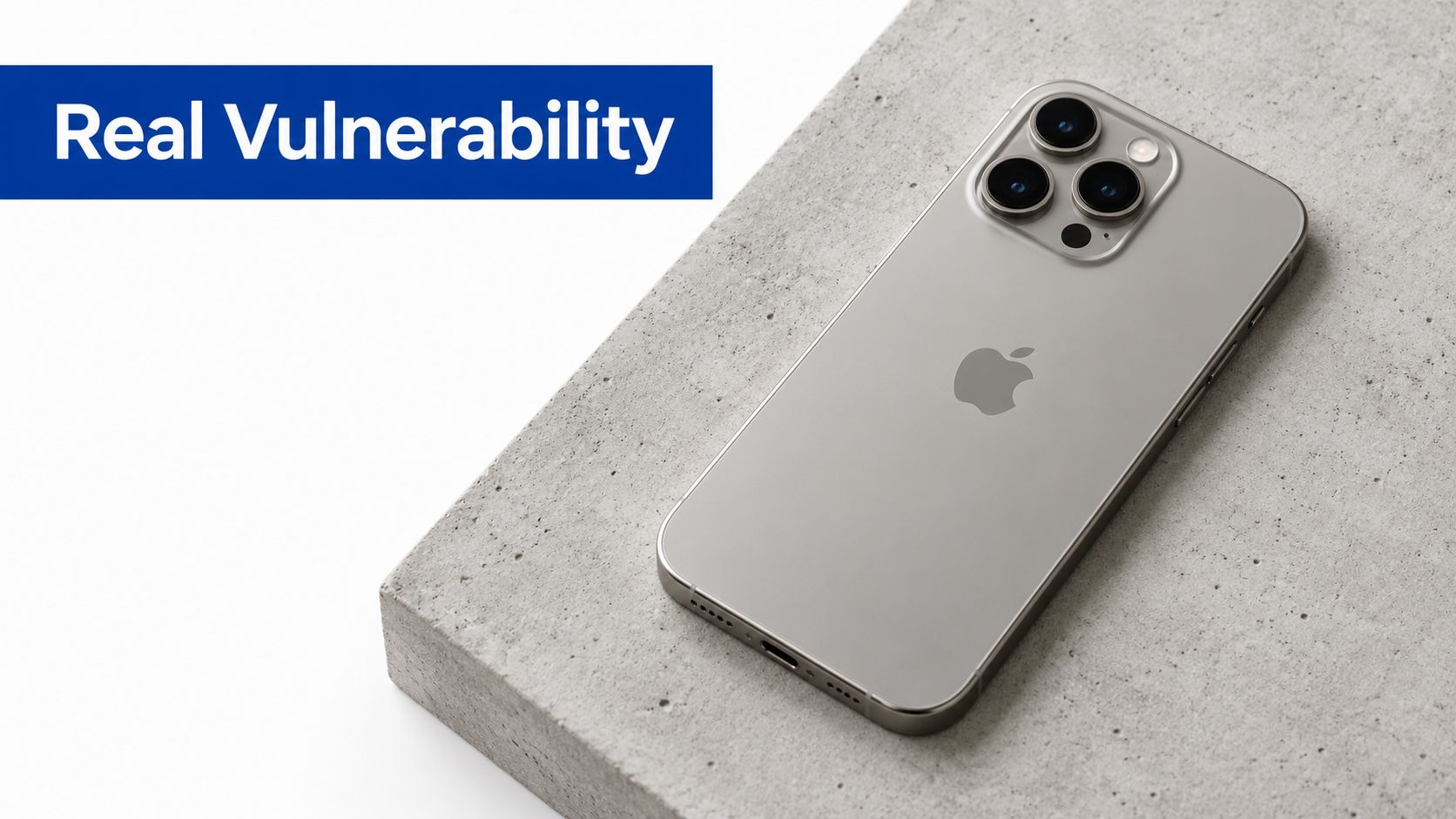
Titanium is strong, but it does not make the iPhone 15 Pro Max indestructible. The frame can improve structural rigidity and reduce weight compared with earlier Pro Max generations, while the front and back remain glass surfaces that can crack on impact.
The phone launched on September 22, 2023, with a titanium frame, Ceramic Shield front, and textured matte glass back, as documented in the iPhone 15 Pro Max specifications from GSMArena. A flat landing on the face or back still sends impact energy into those panels. The titanium may remain intact while the glass fails.
Why the dimensions matter
At 221 g, the iPhone 15 Pro Max is a substantial handset. Its 159.9 mm by 76.7 mm footprint creates a broad impact surface and a long lever around the corners. During a drop, that combination can damage glass or concentrate force around the camera plateau even when the titanium frame looks untouched.
A case needs to keep both glass panels away from flat surfaces and spread corner impact across a wider area. Raised edges, flexible sidewalls, and reinforced corners do more for this outcome than a titanium-style appearance.
Practical rule: Treat the titanium as structural material, not as a substitute for protection around the glass.
A slim case suits scratch resistance, grip, and modest edge clearance. It offers less impact margin than a design with flexible shock-absorbing walls and reinforced corners, and greater protection usually means more bulk and heat retention. For a textured rigid option, compare the matte natural titanium-style grating case for compatible iPhone models, and select the iPhone 15 Pro Max variant at checkout.
The camera housing needs its own protection. Side coverage alone can leave the lenses touching a table, pavement, or grit-covered surface. Choose a raised camera border that surrounds the full plateau without entering the lens view. That extra clearance can protect the protruding camera assembly, though it also adds thickness where the phone already feels top-heavy.
Material Science and Drop Protection Standards
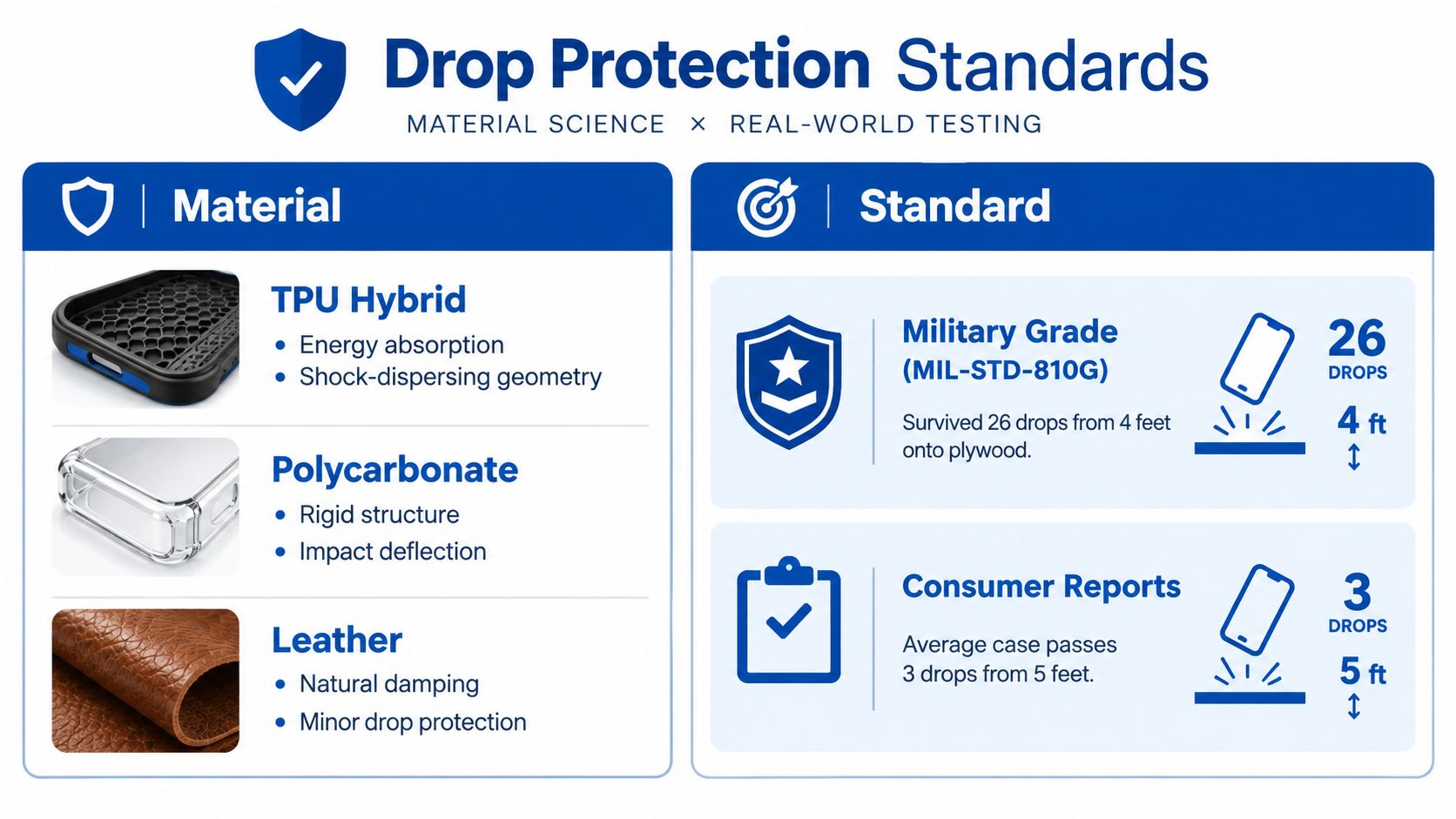
Thin cosmetic shells and protective cases solve different problems. A soft, thin cover can improve grip and resist everyday scuffs, but it has limited room to slow a hard impact. A TPU and polycarbonate hybrid has more useful geometry: flexible TPU can deform and rebound, while rigid polycarbonate helps spread force across a wider area.
A convergent impact study found that smartphone models with cases had greater mass than bare phones, and that the added mass helped reduce deformation and stress by absorbing impact energy rather than transmitting it directly to the handset. The practical interpretation for this phone is covered in the case protection guide from DigiDevice. Added bulk isn't automatically waste. It can provide space for damping structures to work.
What actually absorbs a corner impact
Corner-first drops are especially difficult because the force enters through a small area. That can transfer stress toward the frame, the glass edges, and the camera plateau instead of distributing it across the back.
The most useful design details include:
- Flexible TPU walls: These deform under impact and provide elastic rebound.
- Rigid polycarbonate panels: These resist bending and help deflect force across the back.
- Air-cushion corners: These create additional deformation space where corner impacts begin.
- Raised front and camera lips: These keep glass and lenses from making first contact with a flat surface.
- Textured side rails: These reduce the chance of a drop in the first place by improving grip.
A leather exterior may feel refined and offer some natural damping, but it usually doesn't provide the same engineered corner structure as a thick hybrid case. An ultra-thin aramid case can be excellent for pocket comfort and scratch resistance, yet it shouldn't be treated as equivalent to a rugged shell.
How to read drop-test language
“Military grade” is not a complete description of protection. The useful information is the test method, the drop surface, the drop height, the number of drops, and whether the phone remained functional afterward. A label alone doesn't tell you how the case behaves during a corner impact, nor does it guarantee protection from every angle.
The sensible buying process is to inspect the case's construction rather than trusting a badge:
- Check for reinforced corners.
- Look for a continuous raised rim around the screen.
- Confirm that the camera border sits above the lens glass.
- See whether the interior has ribs, a soft lining, or air-cushion pockets.
- Decide whether that structure is acceptable in your pocket.
The strongest protection usually costs you some slimness. That's a real trade, not a design failure.
MagSafe Compatibility and Thermal Management
The iPhone 15 Pro Max supports MagSafe wireless charging up to 15W, according to Apple's iPhone comparison specifications. A case must preserve the magnetic ring area and keep the phone's charging coil aligned with the charger. “MagSafe compatible” should mean more than a magnet placed somewhere near the center.
Material choice matters. TPU, polycarbonate, and aramid fiber are generally more suitable around wireless charging hardware than metal-heavy constructions. A thick decorative panel or poorly positioned metal insert can interfere with alignment, weaken accessory attachment, or hold heat close to the phone during a long charging session.
A practical MagSafe check
Before keeping a case, test it with the accessories you use.
- Magnetic alignment: The charger should center itself without sliding away.
- Accessory retention: A wallet or mount shouldn't detach during normal handling.
- Charging stability: Charging should start consistently rather than requiring repeated repositioning.
- Heat behavior: Stop using the setup if the phone becomes uncomfortably hot, especially during navigation or video capture.
- Port access: The case opening should leave enough room for your cable connector.
The phone itself can generate extra heat while recording video, using navigation, or searching for a weak signal. A thick case doesn't necessarily cause the heat, but it can make it harder for that heat to escape. Metal-heavy designs can create additional complications around both charging and antenna behavior. Commentary from Environmental Working Group on phone case design and antenna exposure discusses how poorly designed cases may partially block antennas and force the phone to work harder in some conditions.
For a lower-bulk magnetic option, compare the DigiDevice guide to MagSafe phone cases. The point isn't to choose the thinnest case automatically. It's to choose a design that gives the magnetic ring a clear path and doesn't trap unnecessary heat around the charging area.
Camera Lens Protection and Ergonomic Fit
The iPhone 15 Pro Max requires its own case because its chassis, button placement, and camera arrangement differ from the smaller iPhone 15 Pro and from older Pro Max models. Wildflower Cases' compatibility guide also warns that cases aren't interchangeable across those models.
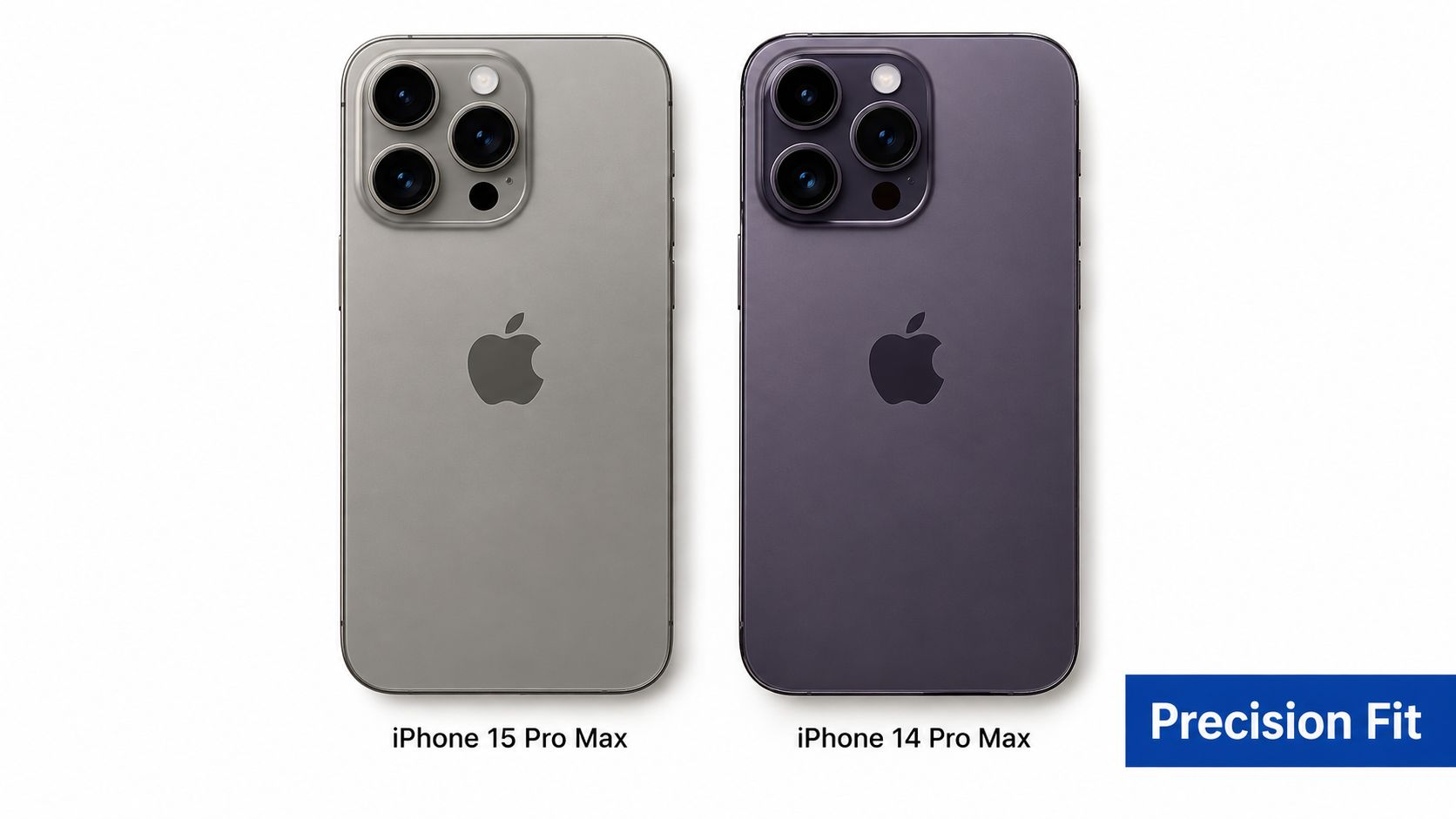
A near-fit can be worse than an obvious mismatch. If the side buttons don't align, the tactile response becomes muddy. If the Action Button opening is poorly positioned, access can feel awkward. If the camera cutout is too close to a lens, the case may introduce glare or obstruct the field of view.
Raised borders versus lens covers
A raised TPU or polycarbonate lip is usually the cleaner first choice. It adds physical clearance around the camera plateau while leaving the lenses uncovered, which avoids putting an extra optical surface in front of the camera.
Individual lens protectors offer a different compromise. They can add a sacrificial layer over the glass, but any cover must be precisely made and kept clean. Dust, adhesive misalignment, scratches, or reflections can reduce image quality. A metal-ring protector may also add thickness around the camera opening, so check that the case's cutout has enough room.
The tempered-glass camera lens protector for compatible iPhone models is an example of the lens-cover approach. Confirm the product's exact fit before buying, because the iPhone 15 Pro Max camera plateau is not interchangeable with every model listed in a broad compatibility title.
This video offers a useful visual reference for case and device fit:
A good case should also feel stable in one hand. Deep side textures improve grip, but aggressive ridges can catch on pockets. Smooth leather feels comfortable and slides easily, while soft-touch TPU tends to stay planted on desks and car consoles. Choose the surface according to how you carry the phone, not just how it looks in a product photograph.
Matching Case Styles to Your Daily Use Case
The right case is a risk-management decision. A commuter who drops a phone on concrete needs different engineering from a professional who mainly wants a better grip and protection against desk scratches. Treating both buyers to the same “maximum protection” recommendation usually produces a case that one person won't carry.
Case style comparison matrix
| Case Style | Avg Weight Added | Drop Protection | MagSafe Strength |
|---|---|---|---|
| Rugged hybrid | Not standardized by the manufacturer | Highest among the three when reinforced corners, damping, and raised edges are present | Strong when the magnetic ring is accurately aligned |
| Slim aramid or thin shell | Not standardized by the manufacturer | Limited, mainly focused on scratches and light impacts | Usually strong when the case uses a properly aligned non-metallic design |
| Leather or wallet case | Not standardized by the manufacturer | Moderate, depending on the inner shell and edge coverage | Varies with the ring construction and wallet layout |
The table avoids invented averages because case weight, testing, and magnet strength vary by product. Manufacturers don't use one universal measurement system for these categories, so compare construction details and return policies instead of treating a marketing label as a laboratory result.
The rugged commuter
Choose a TPU and polycarbonate hybrid if the phone travels in a bag with keys, moves between vehicles, or is frequently handled outdoors. Prioritize corner reinforcement, a grippy rail, a raised screen rim, and a camera border that remains higher than the lenses when the phone rests on a table.
The cost is clear. Your phone becomes thicker and less comfortable in a tight pocket. A rugged case can also make the 221 g handset feel more substantial during one-handed use.
The minimalist professional
An aramid fiber or slim non-metallic shell suits someone who rarely drops the phone and values easy pocket access. It can reduce scratches, improve grip, and preserve the original silhouette better than a rugged case.
Don't buy this category expecting the same corner protection as an air-cushion hybrid. If the phone regularly lands on hard floors, the slim case is a compromise, not a substitute for impact-focused construction.
The travel creator
A creator who uses a MagSafe tripod, wallet, car mount, or battery pack should prioritize reliable alignment and accessory retention. A clean camera opening matters because an oversized rim can interfere with gimbals, grips, or lens attachments.
For a broader selection, browse DigiDevice's mobile accessories collection and filter for exact iPhone 15 Pro Max compatibility. Check whether a lanyard loop or wallet attachment adds bulk where you hold the phone.
Eco-Friendly Options and Case Maintenance
A case's environmental cost is tied to how long it remains protective. Replace it after a serious impact if the shell has a permanent corner split, stretched button cover, loose magnetic ring, or warped camera lip. A phone may look unharmed while the case has already lost the structure that manages the next drop.
Apple's environmental progress report for the iPhone 15 Pro Max documents 100% recycled aluminum in the internal structural frame and 100% recycled copper foil in the main logic board and MagSafe inductive charger. Those materials do not make every third-party case sustainable. They do give buyers a useful standard: ask which material is recycled, where it is used, and how the manufacturer defines the claim.
How to maintain common case materials
- Clear TPU: Remove it regularly, wash it with mild soap and water, and dry it fully before reinstalling it. Harsh solvents can cloud the plastic.
- Leather: Wipe surface dirt with a soft cloth. Use only a conditioner made for that leather finish, since excess moisture can distort the material.
- Aramid fiber: Clean it with a dry or lightly damp microfiber cloth. Abrasive cleaners can alter its surface texture.
- Biopolymer cases: Follow the manufacturer's care instructions. Heat, prolonged moisture, and aggressive cleaning products can speed surface wear.
“Biodegradable” still requires inspection. Check the named material, disposal conditions, and whether a rigid insert changes the disposal route. A custom biodegradable iPhone case with PLA, PBAT, and bamboo fiber provides the kind of material detail that a broad eco label does not.
Clean the case before reinstalling it. Grit trapped between the shell and phone can abrade the finish, while moisture left around openings can affect the case and accessories. Remove the case periodically to check for trapped debris, yellowing, stretched ports, or a ring that no longer sits securely.
End-of-life handling matters for the phone as well as the accessory. Guidance on mobile IT asset disposition helps businesses and individuals account for reusable or regulated components instead of treating the entire device as ordinary waste.
Frequently Asked Questions About iPhone 15 Pro Max Cases
Does a raised case lip make a screen protector unnecessary?
No. A raised lip helps keep the display from touching a flat surface, but it can't stop every scratch, edge impact, or object that lands directly on the screen. A screen protector adds a sacrificial surface, while the case manages edge and corner contact.
The two parts should be compatible. A protector that extends too close to the edge can lift when the case presses against it. Install the protector first, then fit the case slowly and check for bubbling or separation around the perimeter.
How should I remove a tight polycarbonate case?
Don't pull the phone out by the camera bump or lever a hard tool against the titanium frame. Start at a bottom corner, flex the case outward with your fingers, and work around the side until the phone releases gradually.
Remove accessories first and place the phone face down on a soft, clean surface. If the shell uses rigid clips, patience matters more than force. A sudden release can send the handset onto a hard table.
Can third-party MagSafe accessories scratch the back glass?
They can if grit becomes trapped between the accessory and the case, or if the accessory shifts against an exposed area. The magnet itself isn't the only concern. Dust, a hard edge, and repeated movement create the abrasion risk.
Keep the magnetic ring and accessory contact surfaces clean. A case with a properly integrated ring also creates separation between the accessory and the textured matte glass back. If you notice grit, remove the accessory and wipe both surfaces before using them again.
For buyers comparing phone cases for iPhone 15 Pro Max, the rational choice is the least bulky design that addresses your real failure mode. Choose a rugged hybrid for repeated drop exposure, a slim aramid shell for pocket comfort and light protection, or a MagSafe-focused leather and TPU design when charging and accessory alignment matter most.
DigiDevice offers phone cases, magnetic accessories, lens protection, and other mobile hardware for shoppers who want to match protection with daily use rather than buy on branding alone. Visit DigiDevice to compare compatible options, check current prices, and choose the iPhone 15 Pro Max case that fits your protection and MagSafe priorities.