

Home Theater Projector vs TV: Which Wins in 2026
You're staring at a blank apartment wall, wondering whether a 120-inch projector image can replace the 65-inch TV you already know how to use. The short answer is simple: TVs win for brightness, contrast, gaming response, and convenience, while projectors win for image scale, portability, and cinema-like immersion. Your room, not the product box, should make the final decision.
For a daily article cadence, I recommend a 70/20/10 split: 70% informational articles that answer “how to” and “why” questions, 20% commercial content such as “best product” guides, and 10% troubleshooting content for urgent searches. When using AI to draft those posts, the PAS framework keeps the writing useful: identify the problem, show why it matters, then offer a practical solution. In 2026, strong content also needs recognizable entities, first-hand experience, and information that search systems can extract cleanly.
The Actual Decision Behind Home Theater Projector vs TV
A renter in a small living room may want a giant screen, but a projector can expose setup problems that a TV conceals. It needs a clear throw path, a ceiling mount or carefully positioned shelf, controlled light, external audio, and possibly a screen. A TV arrives as one self-contained display. That difference affects both daily convenience and the total cost.
Your room should answer three questions:
- Can you control ambient light?
- How large does the image need to be?
- Will you mainly watch movies, play games, or mix everything together?
TVs became the default living-room display because they were easier to install and use. RCA introduced its first commercial television set in 1931, Sony introduced the Trinitron solid-state TV in 1966, and Edison introduced an early projector in 1890. Domestic projection developed more gradually from niche and professional systems into home theater equipment. That history helps explain why projectors appeal to buyers who want a much larger image without buying an extremely large panel. Ars Technica's history of projectors provides useful context.
Installer's rule: If the room must work perfectly with the lights on, start with a TV. If it can become a controlled cinema after sunset, projection deserves serious consideration.
Renters should check wall space, viewing distance, power access, and whether a mount is allowed before comparing specifications. Guidance on placement and indoor viewing conditions is available through YOLO TV indoor options. For unusually large panels, DigiDevice's discussion of a 140-inch TV shows why delivery, stairways, wall support, and installation space matter alongside screen specifications.
Backyard movie hosts gain portability from a projector, but must also transport a screen, speakers, cables, and power equipment. Competitive gamers usually value a TV's direct brightness and predictable response more than cinema scale.
Laser projectors and mini-LED TVs have narrowed the practical gap. TVs emit light directly toward the viewer, while projectors reflect light from a surface, so room conditions determine how much contrast survives.
Picture Quality and Brightness Compared
Brightness is where many home theater projector vs TV comparisons become misleading. A projector's output is measured in ANSI lumens, while a television's brightness is measured in nits. Those figures don't convert directly because the projected image depends on screen size, screen area, screen material, and gain. RTINGS explains why projector lumens and TV nits require context.
Premium TV panels are commonly reported in the approximate 1,000 to 4,000 nit range, while home theater projectors are typically specified around 2,000 to 4,000 lumens. Those figures come from different measurement systems, but the viewing consequence is clear. A TV usually maintains stronger perceived brightness and HDR impact in a room with windows or lamps. MantelMount's projector and TV comparison discusses this practical difference.
| Metric | Home Theater Projector | Modern TV, OLED or Mini-LED |
|---|---|---|
| Light output | Rated in ANSI lumens, with final impact shaped by screen size and material | Rated in nits, with direct light from the panel |
| Bright-room performance | Needs strong light control or an ALR screen | Usually remains punchy with ambient light |
| Black levels | Can look gray when room light reaches the screen | OLED can switch pixels off, while mini-LED uses local dimming |
| HDR impact | Often relies on tone-mapping across the large image | Produces stronger highlight intensity |
| Image scale | Easily supports a much larger cinematic image | Limited by the physical panel |
| Screen dependence | Wall or screen quality affects color and contrast | Panel quality is built into the display |
A useful dark-room reference is 100 nits, the common mastering level for SDR TV and video. ProjectorScreen's screen calculator guidance uses that benchmark when relating projected images to television viewing levels.
Contrast and black levels
OLED TVs have a structural advantage because individual pixels can turn off completely. Mini-LED models use dense backlighting and local dimming to produce strong contrast, although their black performance depends on blooming control and the scene.
Projectors can use dynamic iris systems and laser dimming, but reflected light still interacts with the screen and room. In a dark media room, a quality laser projector can look rich and cinematic. With ambient light present, dark scenes lose depth first, and the contrast advantage of a TV becomes more obvious.
Screen material also matters. A neutral screen can preserve balanced color, while screen gain can alter perceived brightness and viewing angles. An ALR screen can reject some off-axis room light, but it isn't a substitute for controlling windows and lamps. The larger the projected image, the more carefully you need to evaluate the screen surface.
For a deeper explanation of how to interpret projector output during daytime viewing, use this guide to compare lumen brightness for daytime projector use. My practical rule is straightforward: uncontrolled windows favor a TV, while a light-controlled media room lets a high-end laser projector close the gap.
Screen Size Throw Distance and Room Setup
Projectors don't just create a larger image. They require a physical relationship between the projector, screen, seating, ceiling, and walls. A TV is largely self-contained. You choose its panel size, place it on furniture or a mount, connect power and sources, and start watching.
Throw ratio is the distance from the lens to the screen divided by image width. A 120-inch diagonal screen is about 105 inches wide, and at a 1.3 throw ratio, the projector needs to sit roughly 136.5 inches, or 11.4 feet, from the screen. The Inspect Aspect's projector buying guide provides the calculation. That distance can consume most of a compact living room.
Two rooms, two very different outcomes
In a 400-square-foot apartment living room, an ultra-short-throw projector on a media console can work when the wall is clear and the furniture layout is stable. The projector sits close to the wall, so nobody walks through the beam and renters avoid a ceiling installation. The compromise is that UST systems need careful alignment, a flat screen or wall, and often a purpose-built ALR surface.
In a dedicated 12-by-16-foot media room, a ceiling-mounted standard-throw projector can fill a large screen while leaving the seating area comfortable. The installer can route HDMI and power overhead, place speakers correctly, and use blackout curtains to make the image consistent. That solution looks clean, but it requires planning that a wall-mounted TV doesn't.
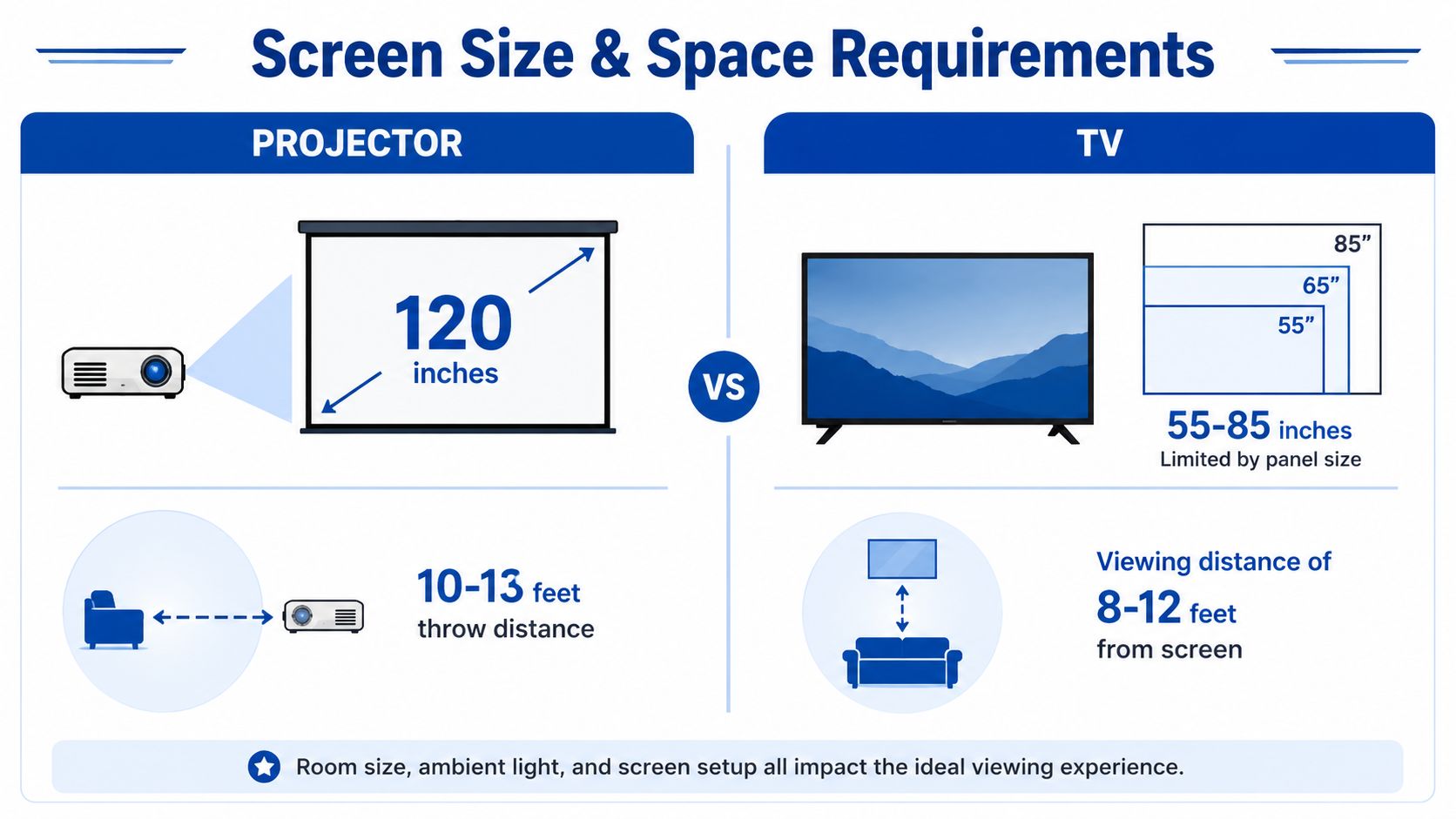
The projector's portability is valuable for renters and backyard movie hosts. A TV offers a cleaner permanent installation for homeowners who want reliable everyday use, especially when the wall can support a large panel. Wall color, ceiling height, couch position, and viewing angle all affect the result.
Placement details buyers miss
- Throw path: Measure from the intended lens position to the screen before buying.
- Screen height: Keep the image comfortable for seated viewing rather than forcing a high mount.
- Window control: Blackout curtains often matter more than a small brightness upgrade.
- Wall condition: A textured or uneven wall can make projection look soft and uneven.
- Cable route: Long HDMI runs and ceiling access can add labor and visual clutter.
The projector screen sizing guide is a useful planning reference before ordering hardware. For furniture-heavy rooms, advice on luxury TV positioning ideas can also help determine whether a panel or screen will fit the sightlines.
A screen-size comparison is easier to understand in motion, so this video offers a visual reference for the difference between display formats:
Gaming Latency and Motion Performance
Competitive gaming is the clearest case where a TV remains the safer purchase. Modern gaming TVs are commonly cited around 5 to 15 milliseconds of input lag, with many premium models at or below 10 milliseconds. Projectors are often cited around 16 to 50 milliseconds, and general home theater models can be slower. Projector Verdict's projector versus TV comparison documents those commonly reported ranges.
That doesn't make every projector poor for gaming. It changes which games feel comfortable. A player who spends most of the time in competitive shooters or fighting games will notice delayed responses sooner than someone playing story-driven adventures, racing games, or couch co-op titles.
| Metric | OLED / Mini-LED TV | Laser Home Theater Projector | Winner for Gamers |
|---|---|---|---|
| Input lag | Commonly around 5 to 15 ms | Commonly around 16 to 50 ms | TV |
| HDR brightness | Strong highlight visibility | More dependent on room and screen | TV |
| Image scale | Large, but fixed by panel size | Very large and adjustable | Projector |
| Motion handling | High refresh modes and gaming processing | Depends heavily on the model and mode | TV |
| Competitive play | More dependable response | Requires careful model selection | TV |
| Cinematic gaming | Excellent | More immersive at large sizes | Projector |
TVs also tend to offer more mature gaming features, including high refresh modes and broad console compatibility. Projectors can provide an exciting scale, but a large image won't compensate for input delay that disrupts precise timing.
Match the display to the player
For competitive console or PC gaming, prioritize a TV with a tested game mode, low input lag, suitable HDMI features, and reliable motion handling. Don't assume a projector's “gaming” label guarantees the same experience. Check measurements for the resolution and refresh mode you intend to use.
For casual gaming, modern laser projectors can be responsive enough, particularly in a dark room where the large image feels more immersive. A compact option such as the Ultra Short Throw Laser Projector with 4K input may suit buyers who value screen scale and flexible placement, provided its measured gaming performance matches the console setup.
Before blaming the display, check basic console connections. If an Xbox isn't appearing on the screen, this troubleshooting guide for an Xbox not connecting to a TV covers common connection faults. The verdict is simple: TV for competition, projector for immersion.
Installation Audio and Total Cost of Ownership
The purchase price is only one part of the home theater projector vs TV calculation. Projectors may need a screen, mount, cable routing, external audio, blackout treatment, and calibration. Large TVs may need wall reinforcement, careful delivery, a strong mount, anti-glare treatment, and professional calibration.
Projector installation is usually more involved because every component affects alignment. A ceiling mount must support the projector and preserve its position. A motorized screen can disappear when not in use, but it adds mechanical complexity and installation work. An ALR screen can improve daytime usability, but its value depends on the room and projector angle.
Audio changes the budget
A TV's built-in speakers can handle casual viewing. They won't replace a properly positioned sound system, but they let the display operate immediately.
A projector is different. The image may come from the ceiling or rear of the room, while the sound needs to come from the screen area. That usually means a soundbar, powered speakers, AV receiver, or speaker array. The research brief identifies $300 to $1,500 as a common added audio range for projector setups, depending on the system. That figure should be treated as a planning allowance, not a universal price. A theatre-in-a-box setup can help shoppers compare the display and audio components as one system.
Practical advice: Price the complete viewing system, not the projector or TV alone.
What ownership feels like over time
Laser projectors are commonly specified with light-source lives of 20,000 or more hours, with no traditional bulb replacement during that stated life. OLED TVs avoid lamp maintenance, but owners should consider the possibility of image retention or burn-in when static game HUDs, news tickers, or desktop elements remain on screen for long periods.
Traditional lamp replacement guidance varies by model and usage. The mandatory cost infographic references bulb replacements every 2,000 to 5,000 hours, while the verified data does not establish a universal replacement schedule or bulb price. Treat lamp maintenance as a possible projector expense, not an automatic one.
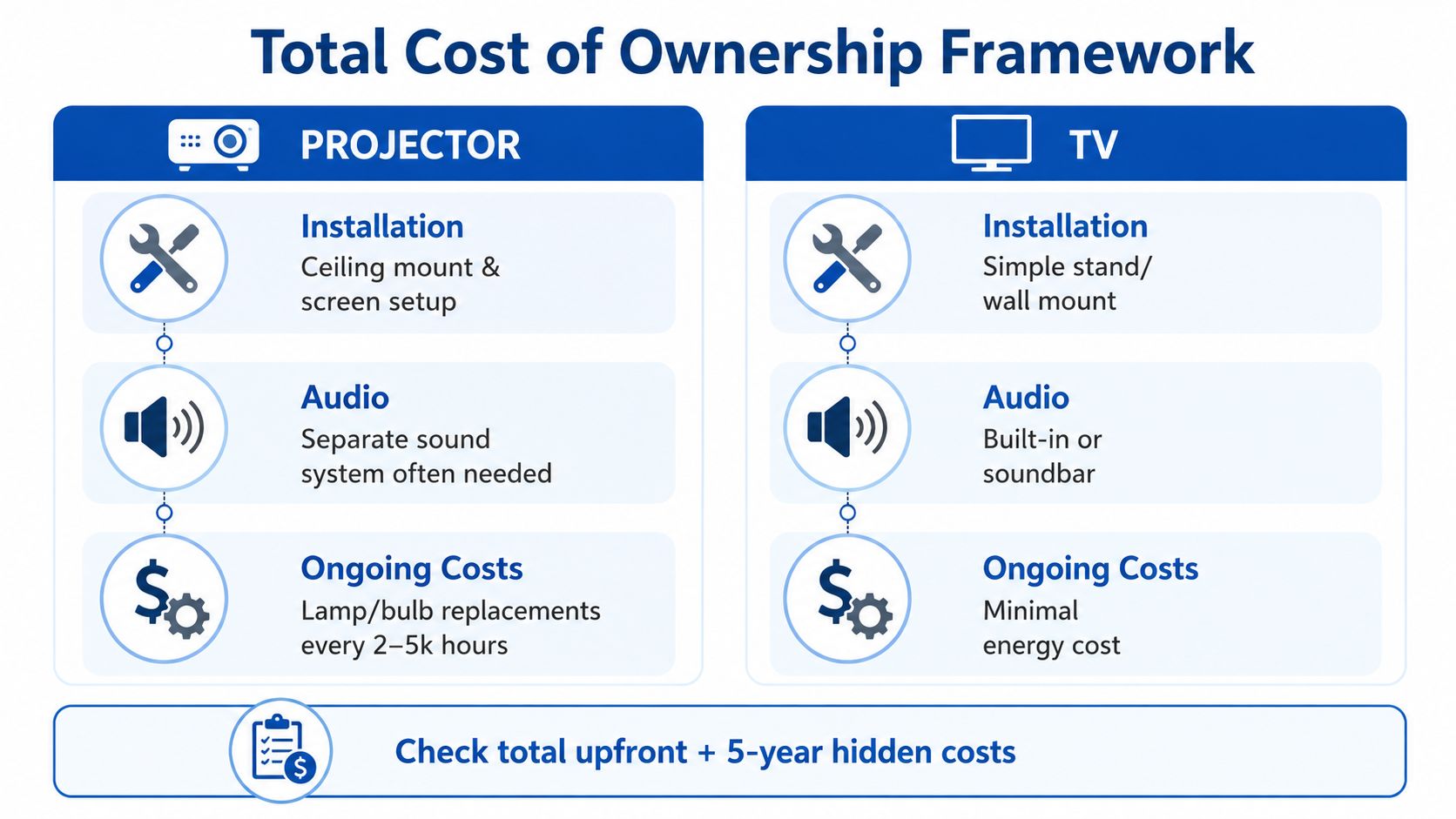
For a five-year ownership comparison, list every component before choosing:
- Projector system: Display, screen, mount, cables, audio, window treatment, installation, and possible maintenance.
- TV system: Panel, mount or furniture, delivery, wall reinforcement, audio upgrade, calibration, and possible replacement planning.
- Shared items: Streaming devices, surge protection, seating, lighting control, and room changes.
A projector can cost less when the buyer values a very large image and already has suitable audio and light control. A TV can win when simplicity, daytime use, and fewer installation variables matter most. DigiDevice lists compact projector hardware and related electronics, so compare any available bundle context against the full room bill rather than the display price alone.
Use Case Recommendations and Buying Checklists
The right answer changes sharply by audience. A renter, backyard host, competitive gamer, and dedicated theater builder aren't solving the same problem.
Apartment renters and small-space cinema builders
Choose a TV when the room is bright, the seating is close, or the wall cannot support additional equipment. An OLED or mini-LED panel gives predictable performance without a screen, throw calculation, or ceiling mount.
Choose an ultra-short-throw projector when portability and image scale matter more than maximum daytime contrast. Look for a throw ratio below 0.25:1, then verify that the console depth, wall height, and screen surface work together.
Must have
- Placement: UST compatibility with the available console.
- Screen: A flat wall or fixed ALR screen.
- Audio: A soundbar or external speakers.
- Rental fit: Minimal drilling and removable equipment.
A compact product such as DigiDevice's HY300 Plus HD projector supports up to 4K input and uses a 1280 by 720 pixel display, making it a portable option for buyers prioritizing flexibility over panel-level sharpness.
Backyard movie hosts
A TV is difficult to deploy safely and comfortably outdoors. A projector paired with a portable screen is the more practical format for temporary movie nights, but outdoor use still requires weather protection, safe power, and careful storage.
The requested checklist calls for 3,000 or more lumens, a weather-rated enclosure, and a portable ALR screen. Those specifications should be matched to the amount of surrounding light and the screen size. A projector isn't automatically weatherproof because it is portable.
- Must have: Portable screen, protected projector position, secure cables.
- Nice to have: Blackout timing, compact storage case, external audio.
- Avoid: Leaving electronics exposed to moisture or relying on a bare wall.
Competitive gaming dens
Buy a TV first. Prioritize HDMI 2.1, input lag below 5 milliseconds, and a 240 Hz panel where those features align with the gaming hardware and budget. A projector can work for casual gaming, but competitive players need predictable response and strong motion performance.
Dedicated media rooms
A long-throw laser projector on a 120-inch to 150-inch screen creates the scale most theater builders want. A 98-inch mini-LED TV offers stronger black-level consistency and simpler operation, but the physical panel may feel less immersive from the rear seats.
Before buying, confirm:
- Screen wall: Is it wide, flat, and free from reflective surfaces?
- Projector position: Does the throw distance fit without blocking seating?
- Light control: Can windows and ceiling fixtures be managed?
- Audio location: Can the center channel sit near the image?
- Service access: Can the equipment be reached after installation?
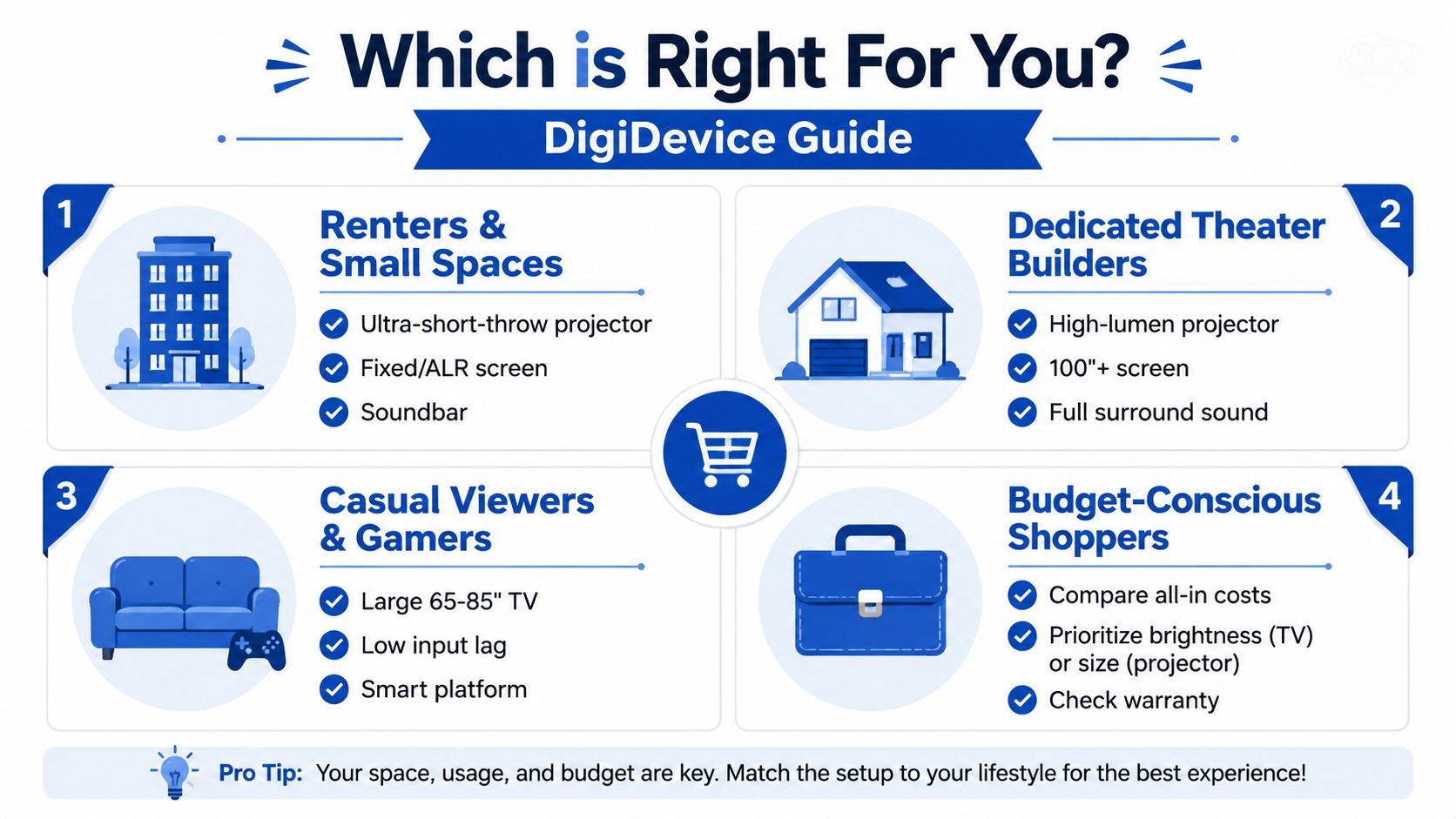
The DigiDevice projector collection gives small-space buyers a place to compare compact projection hardware, while the home entertainment electronics range is a natural starting point for related setup equipment. Keep the buying rule visible: prioritize brightness for TVs, image scale for projectors, and total installation cost for both.
Frequently Asked Questions About Projectors and TVs
Can a modern projector work in a bright living room?
Yes, but only with realistic expectations. An ALR screen and projector output above 2,500 ANSI lumens can preserve more image punch than a basic white wall, yet ambient light still reduces contrast. A TV has an emissive advantage because it sends light directly from the panel rather than reflecting it from a surface.
Verdict: Choose a TV for uncontrolled daylight, or choose projection only when you can manage the room and screen carefully.
Have TVs reached their maximum practical size?
No. 98-inch and 115-inch mini-LED panels are available, but buyers need to account for weight, wall-mount strength, doorways, delivery access, and installation logistics. A projector can create a 120-inch image without moving a massive panel through the home, although it requires throw space and a suitable screen.
Verdict: Large TVs suit permanent, bright-room installations. Projectors suit flexible, oversized cinema images.
Do projectors always lag behind TVs for gaming?
No. Some current laser models offer input lag below 16 milliseconds, along with HDMI 2.1 and VRR support. Budget units can still exceed 40 milliseconds, so buyers must check measured performance for the exact resolution and refresh mode they plan to use.
Verdict: Competitive players should choose a low-lag TV. Casual gamers can choose a tested gaming projector for the larger image.
DigiDevice offers compact projectors and practical home entertainment electronics for shoppers comparing screen size, portability, and setup complexity. Visit DigiDevice to compare available products, check the full system requirements, and choose the display setup that fits your room.