

Headphones Comparison Guide 2026: Find Your Best Pair
The most popular headphone-buying advice is backwards. The biggest driver, deepest active noise cancellation, longest advertised battery, and longest codec list do not tell you whether a pair will still be useful after the battery weakens, the ear pads flatten, or the firmware stops receiving attention. A useful headphones comparison has to judge the entire ownership experience, not just the first listening session.
Direct answer: choose active noise-cancelling over-ears for commuting, open-back headphones for serious home listening, a wired or purpose-built low-latency headset for competitive gaming, and true wireless earbuds when portability matters most. For a 2026 purchase, put battery serviceability, replacement parts, codec compatibility, latency, comfort, and listening safety beside sound quality.
Updated for March 2026.
| Category | Best use | Main advantage | Main compromise | Ownership priority |
|---|---|---|---|---|
| ANC over-ear | Trains, flights, noisy offices | Isolation and relaxed listening | Bulky, battery-dependent | Replaceable pads and battery support |
| Open-back audiophile | Quiet home listening | Natural spacious presentation | No isolation, sound leakage | Wired durability and repairable parts |
| Wireless over-ear | Mixed daily use | Convenience and versatility | Firmware and battery dependency | Long support horizon |
| True wireless earbuds | Walking, calls, travel | Smallest format | Small batteries and fit variation | Case, bud, and battery service options |
Why Most Headphones Comparisons Miss the Point
Most buying guides treat a headphone as a sealed box of specifications. They compare driver diameter, Bluetooth version, active noise cancellation, and advertised play time, then declare a winner. That approach is convenient, but it ignores the failure that usually ends the relationship with a wireless product: the battery ages, and the rest of the headphone may still be perfectly good.
The better question is not “Which pair has the strongest spec sheet?” It's “Which pair fits the way I listen, and how long do I expect to keep it?” A headphone that sounds excellent but creates pressure after twenty minutes is a poor commuter choice. A model with impressive wireless features can be a frustrating gaming headset if its actual audio delay is distracting. A premium pair with a sealed battery can be a worse long-term purchase than a less glamorous model with available replacement parts.
The ownership horizon changes the winner
Think in terms of two years, five years, and beyond. Over a short horizon, comfort, sound, microphone quality, and noise control dominate. Over a longer horizon, ear-pad availability, headband durability, battery replacement, charging-port reliability, firmware support, and repair documentation become just as important.
The European Union's 2025 ecodesign rules for smartphones and slate tablets offer a useful direction for this kind of evaluation. The rules address spare-part availability, battery endurance disclosures, repairability, and recyclability for covered products, although they don't automatically apply to every headphone. Read the European Commission ecodesign guidance as a framework, not as a blanket headphone regulation.
Practical rule: If a product page tells you everything about playback time but nothing about battery replacement, pads, firmware, or recycling, the comparison is incomplete.
The design itself also matters. Headphones evolved from electrically transmitted sound delivered directly to the ear into portable, private listening devices. That history explains why today's comparison has to distinguish over-ear, on-ear, and in-ear designs, along with wired and wireless transmission. Modern features such as active noise cancellation, transparency modes, Bluetooth, and spatial audio are extensions of that same goal, private and portable listening.
Browse our full headphone lineup only after deciding which ownership horizon you want. The right category matters more than chasing one impressive number.
The Four Flagship Categories Explained
There are four practical buckets worth using before you compare individual models. Each solves a different problem, and none is universally best.
Active noise-cancelling over-ears
These are the obvious choice for commuters, frequent travellers, and people who work beside unpredictable noise. Large ear cups create physical isolation, while active noise cancellation reduces steady low-frequency sounds such as engines and train rumble.
They're usually the most comfortable format for long sessions because the pads surround the ear rather than pressing directly on it. The drawbacks are weight, heat, and dependence on an internal battery for wireless features. If the battery fails, a wired fallback only helps if the product supports passive listening properly.
Open-back audiophile headphones
Open-back models are for quiet rooms, not public transport. Their ventilated ear cups allow air and sound to pass through, creating a more spacious presentation that many listeners prefer for acoustic music, classical recordings, mixing, and critical listening.
They leak sound in both directions, so they're a bad choice beside a sleeping partner or in an office. They're also commonly wired, which removes battery ageing from the main ownership equation. Start with this guide to the best over-ear headphones for audiophiles if natural home listening is your priority.
Wireless over-ears
Wireless over-ears are the broadest all-rounders. They combine portability, microphones, convenience, and often ANC, transparency, multipoint pairing, and app-based equalisation.
That flexibility comes with more failure points. Firmware can affect features, codec negotiation varies by source device, and the battery eventually becomes the central question. Buy this category when convenience matters every day, but check whether the model can still work through a cable.
True wireless earbuds
True wireless earbuds win on pocketability. They're ideal for walking, quick calls, gym sessions, and listeners who don't want a headband.
The compromises are more personal. Fit determines bass response and isolation, small batteries age within a compact sealed enclosure, and the charging case becomes part of the ownership story. ANC can be useful, but the seal in your ear matters just as much as the software.
| Category | Best for | Isolation | Portability | Typical price |
|---|---|---|---|---|
| ANC over-ear | Commuting and focused work | Strong | Moderate | Premium |
| Open-back | Home reference listening | Minimal | Low | Mid to premium |
| Wireless over-ear | Mixed daily use | Moderate to strong | Moderate | Budget to premium |
| True wireless earbuds | Mobile-first listening | Variable to strong | Excellent | Budget to premium |
Use the table as a filter, not a final verdict. A commuter should start with ANC over-ears. A home listener should start with open-back headphones. A mobile-first buyer should inspect fit, case durability, and replacement options before obsessing over codec names.
What the Specs Actually Mean in Real Use
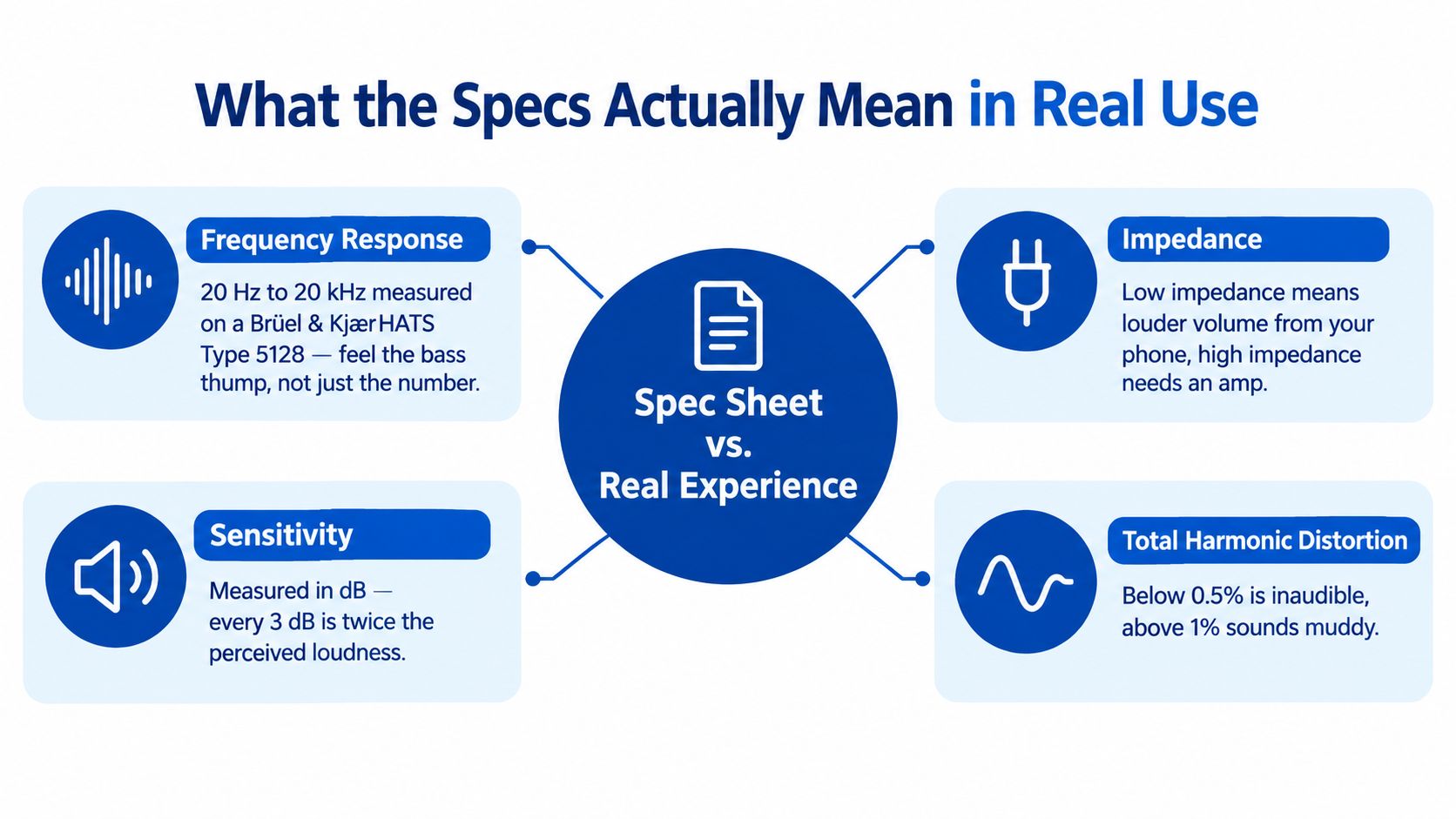
A specification only matters if it predicts something you'll notice. Frequency response, impedance, sensitivity, distortion, channel matching, codec support, and latency all have value, but they don't deserve equal weight.
Frequency response is a map, not a guarantee
Independent testing commonly measures raw frequency response from 20 Hz to 20 kHz using a Brüel & Kjær HATS Type 5128 head-and-torso simulator. Test levels may be normalised to 94 dB SPL with a 500 Hz test tone, which makes competing measurements easier to compare under defined conditions. See the RTINGS headphone testing methodology for the test approach.
A frequency-response graph shows tonal balance. It can reveal boosted bass, recessed mids, or sharp treble peaks. It can't guarantee that the same headphone will sound identical on your head, because fit, seal, ear shape, and personal preference change the result.
Compare deviations against a preferred target curve, then check distortion and left-right matching. A smoother response with closer channel agreement is generally easier to equalise than a model with narrow peaks or noticeable channel mismatch. Manufacturer graphs can be useful, but don't treat them as independent evidence.
Drivers, impedance, and sensitivity
Driver size is not a quality score. A larger driver may change how a manufacturer approaches bass, distortion, and enclosure design, but it doesn't automatically produce better sound.
Impedance tells you how demanding the headphone may be for a source. Low-impedance headphones are usually easier to drive from a phone, while high-impedance models may benefit from a dedicated amplifier. Sensitivity indicates how much output a headphone can produce from a given input, so it helps explain why two models with similar impedance can reach different listening levels.
For setup questions, keep the supporting gear in mind. A good place to compare cables, adapters, and DACs is alongside the headphone, not after you discover that your source struggles to drive it.
Codec labels don't equal real-world speed
Bluetooth's LC3 codec was introduced in September 2020 as part of the LE Audio specifications. The Bluetooth organization describes LC3 as offering higher quality at the same bit rates as SBC, or comparable quality at a lower data rate. Codec support still depends on the transmitter, operating system, firmware, and selected mode.
Latency is a separate issue. Measure end-to-end acoustic latency, not a codec's advertised delay. A controlled method uses two synchronised recording paths, one bypassing the headphones and one passing through them, then compares the waveform offset. That captures Bluetooth transmission, codec buffering, operating-system processing, and headphone DSP.
For gaming, test the exact phone, laptop, console, and headphone mode you'll use. Wired and USB modes can bypass Bluetooth buffering, but they can introduce their own audio-interface delay. The headphone frequency response guide is useful for tonal analysis, while the RTINGS latency research explains why nominal codec latency isn't the same as delay you experience.
Which Category Wins for Your Real Scenario
The cleanest headphones comparison starts with the day you'll have. Specs become useful only after you know whether the enemy is train noise, a missed audio cue, or a tiring fit.

The daily commuter
Choose ANC over-ear headphones if you spend your mornings beside engines, wheels, conversations, or platform announcements. A good pair lets you listen at a more reasonable level because you're not fighting the surrounding noise.
Comfort matters more than a dramatic bass shelf. Check whether the pads create a stable seal without squeezing your glasses, whether transparency mode sounds natural, and whether the controls work with gloves or a coat sleeve. A wired fallback is useful when battery anxiety matters.
Commuter verdict: Choose ANC over-ears with comfortable pads, usable transparency, and a serviceable ownership plan. Don't buy on cancellation claims alone.
For a more portable commute, true wireless earbuds can work well when their seal is consistent. They're easier to carry, but the smaller enclosure makes battery replacement and long-term repair more important.
The competitive gamer
Competitive gaming changes the priority order. Stable fit, microphone clarity, positional cues, and end-to-end delay matter more than a lush music signature.
Bluetooth can be acceptable for casual gaming, but competitive players should test the exact connection mode. A low-latency gaming mode may reduce delay, but it doesn't turn every Bluetooth combination into a perfect real-time link. Wired or USB operation deserves separate testing.
Choose a lightweight competitive gaming headset if you play shooters, rhythm games, or anything where an audiovisual mismatch distracts you. Keep the headset light enough that the clamp and headband don't become the reason you stop playing.
Here's a useful test sequence:
- Play a visual click or metronome.
- Compare the visible event with the sound.
- Repeat over Bluetooth, low-latency mode, USB, and wired connection.
- Test with the device you use, not a different phone or laptop.
The following video can help you think about practical listening and headphone selection before you test your own setup.
The work-from-home audiophile
For a quiet home office, open-back audiophile headphones are the strongest choice when you want an expansive, detailed presentation and don't need privacy from nearby people. They're also a sensible long-term format because a wired design removes the internal wireless battery from the main failure chain.
If your room is shared, switch to a closed-back wired model or a wireless over-ear with a dependable passive mode. The best setup is the one you'll wear without adjusting it every few minutes. This guide to the best headphones for working from home is a useful starting point for balancing calls, music, and comfort.
Home-listening verdict: Choose open-back for a quiet private room, closed-back for shared space, and wireless only when convenience outweighs battery dependence.
Battery, Repairability, and the Ownership Horizon
A 60-hour battery that cannot be serviced can be worse value than a 30-hour battery that can be replaced. Advertised runtime describes the honeymoon period. It doesn't tell you what happens after the cell loses capacity.
The European Union's 2025 ecodesign rules for smartphones and slate tablets point toward a more useful way to judge consumer electronics. Covered devices must address spare parts, battery endurance information, repairability, and recyclability. Headphones aren't automatically covered by those rules, but buyers can apply the same questions now.
Five questions for every product page
- Can the battery be replaced? Look for an explicit service procedure, not a vague promise that the product is durable.
- Are ear pads and headbands available? These parts wear through ordinary use and often determine whether a headphone remains comfortable.
- How long will firmware support last? Wireless features can depend on software, app compatibility, and security maintenance.
- Does wired mode work without power? This can turn a wireless failure into a manageable inconvenience instead of a dead product.
- What happens at end of life? Check the manufacturer's recycling route and local electronic waste options.
A product can have excellent sound and still be a poor long-term choice if the pads are glued shut, the battery is inaccessible, or the charging case becomes impossible to replace. The same logic applies to true wireless earbuds, where the buds and case form a tightly linked system. This true wireless earbuds with ANC guide is worth reading with repairability in mind, not just isolation.
Serviceability is part of performance
For technicians and serious optimisers, repair information matters more than another decorative app feature. A repair bench needs appropriate tools, documentation, and replacement components. That's why mobile diagnostic instruments belong in the wider ownership conversation.
When a pair finally reaches end of life, don't put it in general rubbish. Battery-containing electronics need responsible handling, and resources such as sustainable recycling with Reworx explain how recycling systems and recovery practices can reduce unnecessary waste.
Ownership verdict: Rank headphones by the years they remain usable, not by the hours printed on the box.
The model with the longest initial runtime isn't automatically the better purchase. A shorter-runtime headphone with available pads, a replaceable cell, a working wired mode, and clear repair information can remain useful far longer.
How to Test Before You Commit
A five-minute demo tells you almost nothing. Test the headphone with your own device, in a realistic environment, and in the connection mode you will use every day. That is how you catch comfort problems, unstable pairing, delay, and controls that become irritating after repeated use.
Start with physical fit
Wear it long enough for pressure points to show up. Check the crown of your head, the area behind your ears, the jaw hinge, and how glasses press against the pads. If the headphone feels fine for only a few minutes, it is the wrong daily choice.
For earbuds, move your head, speak, walk, and test the seal with low bass. A sharp bass change when you press an earbud indicates an unstable fit. A weak seal makes a capable earbud sound thin and can push you toward unsafe volume levels.
Verify the connection you'll actually use
Pair the headphone with your own phone or laptop and check the negotiated codec. Support for AAC, aptX, LDAC, or LC3 does not guarantee that the device will use it. The transmitter, operating system, firmware, and listening mode determine the result.
For gaming and video, compare Bluetooth with USB and wired operation. If you need supporting hardware, review our USB-C audio gear and this guide to how to get studio-quality audio on a smartphone before choosing a headphone that relies on an awkward adapter.
Use the exact device pairing intended for daily work. A headset that feels immediate on one laptop can feel noticeably late on another operating system or firmware version.
Measure delay instead of guessing
A practical latency test compares a visible click with the sound. For a more rigorous result, record two paths at the same time, one direct and one routed through the headphone, then measure the waveform offset. This exposes buffering and DSP delays that codec labels do not reveal.
Protect your hearing while testing
Loud demos make bass and detail seem more exciting, which can distort your judgement. The World Health Organization and International Telecommunication Union reference 80 dB for up to 40 hours per week for adults, and 75 dB for 40 hours per week for children or other sensitive users. The WHO safe-listening toolkit gives the practical example that listening at 100 dB for 16 minutes can create an equivalent weekly exposure to listening at 80 dB for 40 hours.
A WHO meta-analysis estimated that approximately 48.97% of people aged 12 to 34 encounter potentially unsafe sound levels through personal listening devices or other recreational noise, with a 95% confidence interval of 40.28% to 57.70%. Personal devices may produce roughly 75 to 105 dB(A), while inserted earphones may reach maximum outputs between 88 and 113 dB(A), depending on the device. The evidence is summarised in this WHO-based headphone volume guide.
Keep volume-limit controls and exposure tracking enabled when available. Isolation reduces the need to overpower background noise, but it does not make high volume safe.
Our Final Picks and Where to Buy
A useful ranking depends on the listener, not a universal champion.
- Best for commuters: Choose an ANC over-ear model with comfortable pads, a convincing transparency mode, passive or wired fallback, and a clear replacement-parts policy.
- Best for home audiophiles: Choose an open-back wired headphone if your room is quiet and sound leakage is acceptable. It's the cleanest route to long-term ownership without battery dependence.
- Best for competitive gamers: Choose a lightweight wired or USB headset, or a wireless model with a tested low-latency mode. Measure the complete chain rather than trusting a codec label.
- Best for mobile-first listeners: Choose true wireless earbuds with a stable seal, reliable microphones, practical controls, and a charging case that can be serviced or replaced.
- Best future-facing option: Look for verified LE Audio and Auracast support, but treat it as conditional compatibility. Both transmitter and receiver need the relevant profiles, and public infrastructure remains uneven. Bluetooth's LE Audio specification overview explains the standard, while its 2024 and 2025 technology outlook places Auracast in the broader accessibility and shared-audio direction.
The most future-ready pair isn't necessarily the one with the longest feature list. It's the model that sounds right, fits your routine, supports the connections you use, and remains serviceable after the battery is no longer new.
DigiDevice brings together headphones, true wireless earbuds, gaming audio, cables, adapters, and other practical electronics for people who care about real-world performance. Visit DigiDevice to compare your next pair with the supporting gear and ownership priorities that matter.