

Phone Screen Protector Glass Guide for Power Users
You've just paid premium-phone money, slipped the device into your pocket, and heard the small, sickening scrape of grit against the display. The phone may still look perfect, but that's exactly where a good phone screen protector glass earns its keep, by taking visible wear and some impact risk instead of asking the original screen to do everything.
A protector isn't an invincible shield. It's a replaceable surface with trade-offs involving touch response, coatings, case fit, privacy, and curved displays. Updated for March 2026, this guide breaks down what glass does, which material suits your phone, how to read hardness and thickness claims, and how to install, clean, and replace the protector without guesswork.
Introduction to Phone Screen Protector Glass Today
A premium phone often spends its life in less-than-premium surroundings. It rides in a pocket beside keys, rests on café tables, gets pushed across a desk, and sometimes lands face-down before you can react. The original display is engineered for everyday use, but a thin sacrificial layer can take the scratches, edge chips, and minor impact damage that would otherwise become an expensive repair problem.
In our testing, the best protectors disappear into normal use. Your finger should glide rather than drag, text should remain crisp, and the protector should sit beneath a case without lifting at the corners. The useful question isn't whether glass is “unbreakable.” It's whether the protector fails first in a way that leaves the phone's actual display usable.
Tempered-glass protectors became mainstream alongside large-capacity touchscreen phones during the 2010s, when buyers moved away from basic plastic films and wanted a harder, clearer surface. The category remains significant. One glass-specific estimate places the global market at USD 4.5 billion in 2024, with a projection of USD 6.57 billion by 2031 at a 5.6% CAGR. Another estimate places it at USD 1.9 billion in 2024, rising to USD 2.7 billion by 2032 at a 5.6% CAGR. The differing totals reflect different market definitions, but both forecasts point to steady expansion rather than a passing accessory fad, as detailed in this glass screen protector market analysis.
Broader smartphone screen-protection research estimated that market at USD 55.98 billion in 2024 and projected USD 84.96 billion by 2030, with a 7.1% CAGR. The same source placed North America at more than 40% of global revenue in 2024 and Europe at more than 30%, reinforcing how protectors have become a routine part of phone ownership in major markets, according to Cognitive Market Research's screen protector report.
Practical rule: Buy the protector for your phone's shape and your daily risks, not for the largest hardness number printed on the box.
If you're comparing installation methods or repair advice, the CTF Mobile Phones glass screen protector resource is a useful companion. You can also pair the protector decision with this guide to choosing phone cases for protection, because the case and protector share the job of keeping the display away from impact surfaces.
What Glass Screen Protectors Actually Do
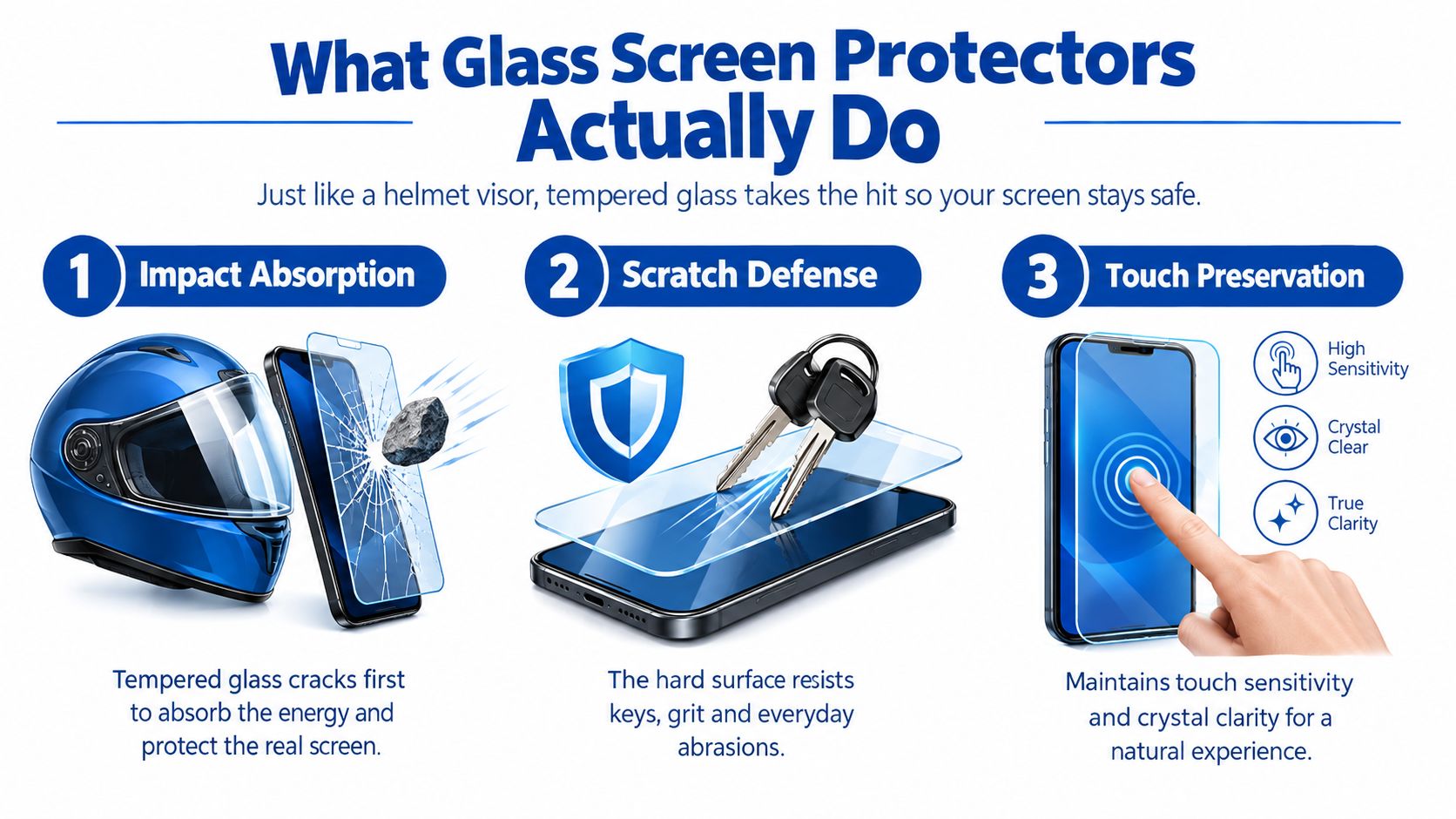
Think of tempered glass as a helmet visor, not a force field. A visor can take scratches and absorb some impact, but it can still crack when the hit is severe. A screen protector works similarly. It creates a rigid, replaceable layer between your finger and the phone's ultra-thin display, and it may crack first when impact concentrates on the surface.
The protective mechanism matters. The glass doesn't need to remain perfect to be useful. When it fractures, the crack can consume energy and reduce the amount transferred to the original display. That's why a protector with a visible spiderweb pattern may still have done its job, even though it now needs replacement.
Scratch resistance is not impact protection
The popular 9H label describes a pencil-hardness test, not a mineral-hardness rating and not a drop test. Independent explanations distinguish that pencil test from the Mohs scale, placing typical tempered protector glass around Mohs 6–7, as explained by Android Police's explanation of 9H glass hardness.
That distinction explains a common pocket mystery. Keys and coins usually won't mark the protector, while quartz-rich grit can. A beach bag, dusty work pocket, or sandy car console can create micro-abrasions even when the protector has a reassuring 9H claim. The protector may look worn while the phone beneath it remains protected from that particular type of surface damage.
Impact shape changes the outcome
Stiff glass performs well against sharp, concentrated impacts because it resists deformation and can distribute the force through the protector. A university-based impact study found glass protectors offered superior protection against sharp impacts, while plastic performed relatively better against blunt impacts. The researchers measured fracture behavior using drop tests with different punch-tip diameters, showing that protector geometry and impact concentration affect how cracks begin and spread. Read the impact testing study for mobile-device screen protectors for the technical context.
A flat drop onto a small stone is a different event from a phone landing across its whole face on a wooden desk. Glass may crack first in the sharp-impact example, while flexible material may deform more effectively in a broad blunt event.
For a model-specific option, see this privacy screen protector for Samsung Galaxy phones. The choice should still begin with display shape and use case, not the word “privacy” alone.
Types of Glass Protectors and When Each Makes Sense
The familiar clear tempered protector is only one option. Power users also encounter chemically strengthened glass, privacy filters, matte surfaces, and flexible hybrids. Each changes the experience in a way you'll notice during commuting, gaming, outdoor navigation, or desk work.
Match the surface to the environment
Standard tempered glass is the sensible default for a flat display. It usually offers the clearest image and the most glass-like glide, while acting as a sacrificial scratch and impact layer.
Chemically strengthened glass can be made thin while retaining a premium feel. It's attractive when you want low added bulk, but the product's edge treatment, adhesive, and coating still matter more than the label alone.
Privacy glass narrows the usable viewing angle. That helps on trains, in open offices, or anywhere a nearby passenger might see sensitive messages. The trade-off is reduced off-axis visibility, and some designs can make the screen feel dimmer or less open when viewed from the side.
Matte anti-glare glass reduces reflections from windows and overhead lights. It's useful for navigation, outdoor work, and bright desks, but the etched surface can soften fine text and alter the smoothness of swipes.
Curved-edge hybrids combine a rigid center with flexible material around difficult edges, or use flexible film as the primary layer. They're often more practical than rigid glass on curved screens because flexible material can follow the contour instead of lifting and creating a visible halo.
Folding phones make the limitation clearer. A rigid sheet that works beautifully on a flat slab may interfere with folding movement or create stress at the crease. Current market research identifies ultra-thin hybrid film, self-healing coatings, flexible materials, and recyclable designs as responses to foldable and curved-phone requirements, as discussed in this smartphone screen protector market overview.
| Protector Type | Clarity and Touch Feel | Key Trade Off | Best For |
|---|---|---|---|
| Standard tempered glass | Clear, smooth, glass-like | Rigid edges can conflict with some cases | Flat-screen daily use |
| Chemically strengthened glass | Clear and slim | Premium construction doesn't remove fit concerns | Thin, polished setups |
| Privacy glass | Clear from the front, restricted from the side | Narrower viewing angle | Commuting and open offices |
| Matte anti-glare | Less reflective, controlled glide | Can soften fine detail | Outdoor and bright-room use |
| Curved-edge hybrid | Flexible coverage on difficult contours | Usually less glass-like than rigid glass | Curved phones and foldables |
A short visual demonstration can help you compare how these surfaces change handling and reflections.
For a flat Samsung display, this four-pack of tempered glass protectors for Samsung Galaxy models makes more sense than forcing a rigid protector onto a phone designed to bend.
Key Specs That Matter for Touch and Clarity
Product listings often lead with numbers because numbers look decisive. Your daily experience depends on how those specifications interact. A thin protector with a poor adhesive can feel worse than a slightly thicker one that sits flat, preserves touch response, and keeps its coating intact.
Thickness sets the physical compromise
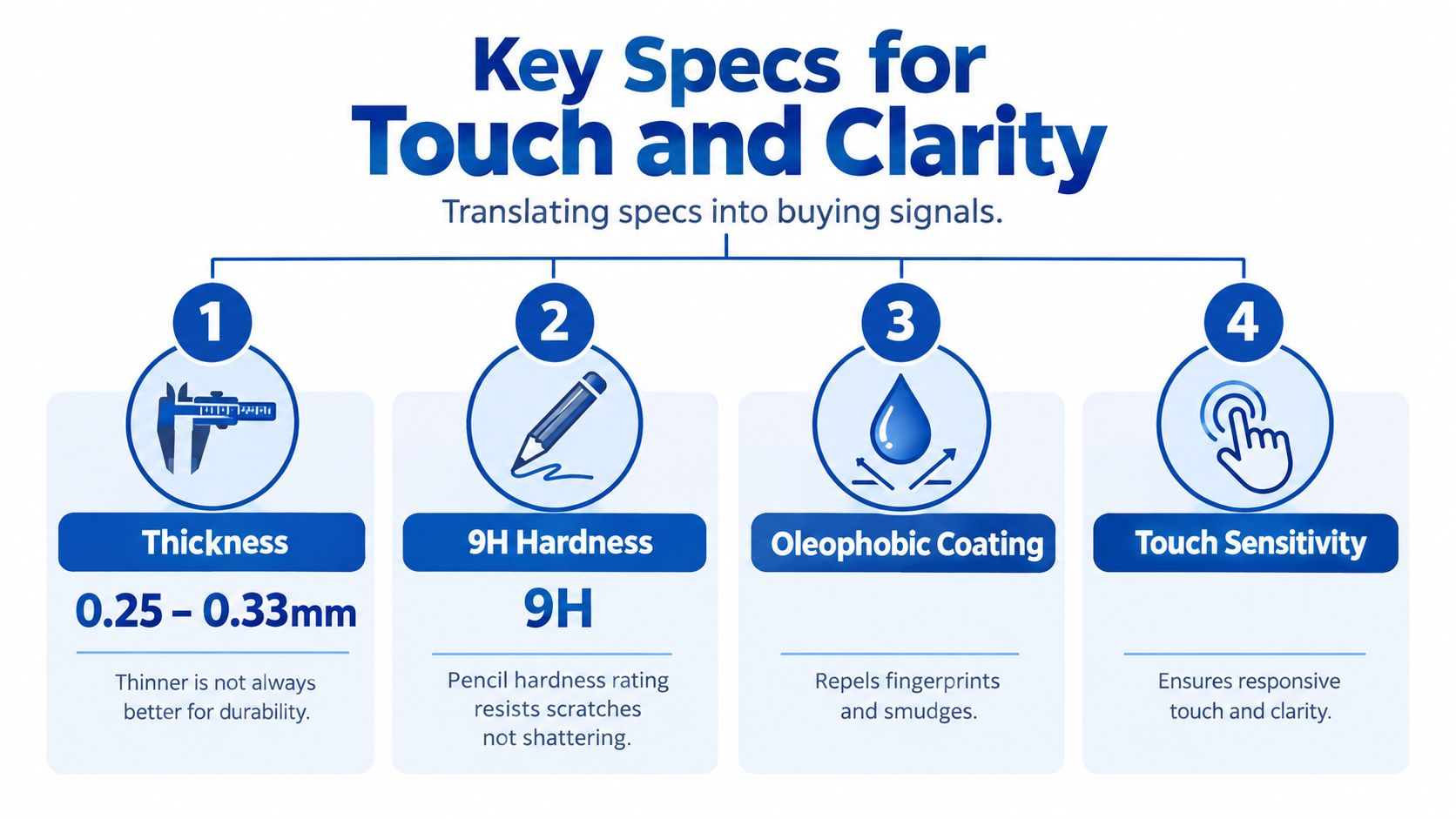
A commonly cited construction for phone protector glass is around 0.25–0.33 mm, paired with heat treatment or chemical strengthening to balance slimness, scratch resistance, and impact behavior, according to this glass versus film construction guide.
Thinner isn't automatically better. Very thin glass can preserve edge gestures and reduce case interference, but it leaves less rigid material between the impact and the display. A thicker protector can feel more noticeable, raise the edge under a case, or interfere with swipes if the dimensions are poorly chosen.
Decode 9H correctly
9H is about scratch resistance. It doesn't certify protection against shattering, and no drop test is required to earn that label. A protector can resist a pencil mark yet offer only moderate protection in a real fall, as explained in this guide to screen protector hardness and drop protection.
The Mohs distinction is more useful for pocket decisions. Typical glass sits around Mohs 6–7, so keys may be harmless while grit remains a serious scratching hazard. Don't read “9H” as “harder than every mineral you'll encounter.”
Coatings control the feel over time
An oleophobic coating is a thin fluorine-based layer that repels oil, reduces smudging, and helps your fingertip glide. It wears through abrasion, which means a protector can remain uncracked while feeling noticeably worse.
One independent guide reports that electroplated coatings may begin losing noticeable oil repellency after 3 to 4 months, while spray-on coatings can degrade after 4 to 6 weeks. Those timelines aren't universal guarantees, but they illustrate why coating quality and application method deserve attention, as outlined in this oleophobic coating guide.
Look for product information that clearly identifies:
- Full-surface adhesive: Helps prevent air gaps that can reduce clarity and touch consistency.
- Model-specific dimensions: A precise cut is more useful than a generic “full cover” promise.
- Coating information: A listing that discusses fingerprint resistance and glide gives you more to evaluate than 9H alone.
- Touch compatibility: This matters especially for under-display fingerprint readers and stylus use.
For Pixel owners, this fingerprint-unlock glass protector for Google Pixel models addresses a concern that generic glass listings often ignore.
Compatibility With Phones Cases and Sensors
A protector can be made from excellent glass and still fail at the first corner because the case pushes against it. The usual symptoms are a lifted edge, a crescent of trapped air, or touch input that becomes unreliable near the border.
Check the phone before checkout
Use this sequence before ordering:
- Confirm the exact model. “Galaxy S24” and “Galaxy S24 Ultra” don't share the same display shape or cut dimensions. Check the model name and regional variant shown in your phone's settings or packaging.
- Inspect the display contour. Flat screens can accept rigid glass more easily. Curved edges and foldable panels may require a flexible TPU or hybrid design that can move with the display.
- Measure the case relationship. A case-friendly protector usually stops short of the outermost edge. That small inset gives the case bezel room to grip without pressing on the adhesive.
- Check sensor areas. Look for the camera, speaker, proximity sensor, and any under-display fingerprint reader. A badly positioned opaque area can interfere with sensing or calls.
- Plan for installation clearance. Alignment frames help, but they can't correct a protector that was designed for a different screen revision.
Face ID generally works through a clear protector when the sensor area remains unobstructed. Under-display fingerprint readers can be more sensitive to adhesive gaps, surface texture, and added thickness, so re-registering fingerprints may help after installation, but it can't fix a poor fit.
Cases and protectors share the impact job
A raised case lip can keep the display from touching a table, while glass handles surface abrasion and some concentrated impacts. If the two parts overlap, the case may lift the protector every time you squeeze the phone.
For curved and folding designs, flexibility can be the better engineering choice. Market research points to hybrid film and self-healing materials as practical responses to these shapes. The best protector for a foldable may not be glass, because a rigid surface can crack or detach where the phone needs to flex.
Installation Removal Care and Replacement Timing
Installation quality determines whether the protector behaves like one continuous layer or a thin sheet floating above the screen. Dust, fingerprints, and rushed alignment create weak spots before the phone ever takes a drop.
Use a controlled installation workflow
- Prepare a low-dust space. Clean the desk, wash your hands, and avoid installing immediately beside fabric, paper, or active airflow.
- Clean the display completely. Use the supplied alcohol wipe if appropriate, then finish with a lint-free cloth. Inspect under a bright light because a tiny fiber can become a permanent bubble.
- Dry-fit the protector. Without exposing the adhesive, check the camera, speaker, edges, and case clearance.
- Align once. Hold the protector by its edges, position it carefully, and lower it without sliding across the display. Repeated lifting invites dust and weakens the installation.
- Let the adhesive spread. Press from the center outward with a clean finger or soft card wrapped in microfiber. Small edge bubbles may settle, but trapped dust requires lifting that area carefully and removing the particle.
Remove it without stressing the display
If the protector is cracked, cover it with clear tape before removal to keep fragments together. Warmth from normal room conditions can make adhesive release more smoothly, but don't apply aggressive heat to the phone.
Start at a corner with a fingernail or a thin plastic pick. Lift gradually, keep the tool shallow, and pull the protector across the surface rather than sharply upward. Clean remaining residue with a screen-safe cloth and appropriate cleaner.
For routine maintenance, a screen cleaner spray and wipe kit is more suitable than household glass cleaner, which may contain chemicals that attack coatings.
Replace based on function
Replace the protector when:
- The coating feels sticky: Fingerprints spread instead of wiping away easily.
- Micro-scratches affect viewing: Fine marks catch light or distract during reading.
- An edge chip appears: A chip can become a crack and may leave a sharp touch point.
- A crack crosses the touch area: Even if the phone still works, the sacrificial layer has already spent its protective capacity.
- The protector lifts: A raised edge lets dust in and can interfere with touch.
A coating failure doesn't always mean the glass is structurally broken. It does mean the experience has changed, and power users who care about smooth swiping may prefer to replace it before the next impact.
Smart Buying Checklist for Mobile Power Users
A good purchase starts with a use case, not a product title. Decide what annoys you most: visible fingerprints, side glances, reflections, edge lifting, scratches from outdoor work, or a protector that changes the feel of gaming gestures.
Use this quick audit before checkout:
- Choose clarity first if you edit photos, read small text, or play touch-sensitive games. Standard clear glass is usually the safest direction for a flat display.
- Choose privacy first if your phone contains work messages or financial information and you regularly use it in public. Accept the narrower viewing angle.
- Choose matte first if overhead lighting and outdoor reflections interrupt navigation or gaming. Expect a different texture and potentially softer fine detail.
- Choose flexibility first for foldables and strongly curved screens. A properly designed TPU or hybrid film can remain attached where rigid glass lifts.
- Check the case before the protector. Look for bezel height, edge pressure, and whether the case manufacturer recommends a particular protector shape.
- Verify the sensors. Under-display fingerprint readers need a clean, well-adhered surface. Camera and proximity cutouts should match the exact model.
- Treat 9H as one signal. It speaks to pencil-scratch resistance, not guaranteed drop survival.
- Inspect the coating promise. Fingerprint resistance and glide often determine whether the protector still feels good after regular use.
- Plan the replacement. Visible cracks, chips, lifting, and coating wear are practical reasons to swap it, even when the phone remains usable.
For another plain-language perspective on material, fit, and usage trade-offs, consult this myhalo screen protector guide. It's especially useful when you're comparing glass with flexible film rather than assuming one material suits every phone.
The best phone screen protector glass is the one that matches your display shape, case, sensors, and daily environment. A commuter may value privacy, an outdoor worker may need flexible coverage, and a flat-screen power user may prefer clear tempered glass with a reliable oleophobic surface.
DigiDevice curates practical mobile accessories and maintenance tools for people who care about how their devices perform every day, not just how they look in a listing. Visit DigiDevice to compare phone protection, cleaning gear, chargers, cases, and other focused electronics, then choose the screen solution that fits your phone and routine.