

Magnetic Phone Case That Sticks to Anything: How It Works
A magnetic phone case that sticks to anything sounds like a neat shortcut until you test it against real surfaces. In practice, the surface decides the outcome, not the slogan. Steel can feel almost effortless, while glass, wood, and painted walls expose the limits fast.
That's the part most shoppers miss. A good magnetic case is an engineered attachment system, not magic, and understanding that difference saves money, frustration, and a lot of failed experiments.
What "Sticks to Anything" Really Means
The phrase “sticks to anything” is mostly marketing shorthand, not a literal promise. In real use, a magnetic phone case behaves very differently on steel, glass, wood, and painted surfaces, because the case can only grab what the material allows. That's why the same phone can feel rock-solid on a steel locker and slide off a hotel mirror in seconds.
I've seen the confusion start with the expectation that the case itself creates the grip. It doesn't. The surface is the active part of the setup, and the case just provides the magnetic half of the equation.
Practical rule: if the material on the other side isn't ferromagnetic, the case usually needs help.
That's why a magnetic case can feel convincing in a car, on a refrigerator, or on other steel-rich surfaces, but disappoint on smooth non-porous surfaces unless you add an anchor point. For shoppers who want a surface-specific accessory, a magnetic metal plate for car phone holder is the kind of add-on that turns a vague promise into a usable mounting point.
The market itself shows this is a serious category, not a gimmick. The global magnetic phone case market was valued at USD 467 million in 2025 and is projected to reach USD 854 million by 2034, with global production at about 34.13 million units in 2025 and an average price of USD 15 per unit Intel Market Research. That price point tells you the category is still mass-market, even as the engineering gets more specialized.
A better mental model is simple. The case is the magnet, the surface is the target, and success depends on how the two meet. Once you see it that way, the whole category becomes easier to evaluate.
The Physics Behind a Magnetic Phone Case
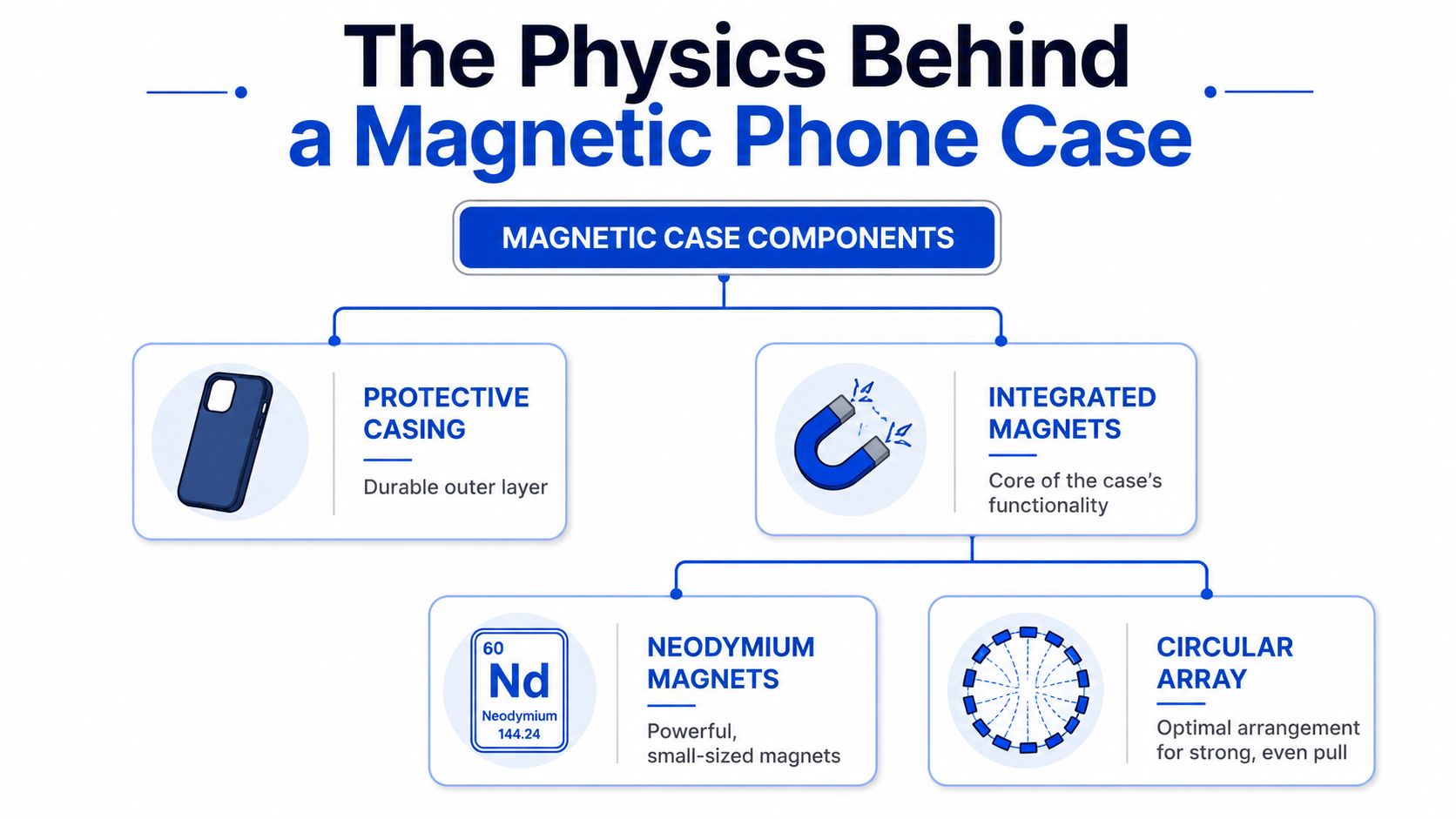
What's inside the case
A magnetic case is usually built around a circular neodymium array, with the magnets arranged to match the accessory interface instead of acting like one oversized block. Smartish describes premium layouts with 12 to 20 N52 magnets, set about 2 mm below the case surface and surrounded by shielding near the magnetic zone Smartish. That arrangement spreads the hold more evenly, which helps the case meet an accessory or mount without creating one uneven pressure point.
The ring pattern is doing alignment work as much as holding work. In plain terms, it lines up the phone and the mount so the pull stays centered instead of tugging from one side.
Why the ring shape beats a random magnet
A random strong magnet can cling, but it can also feel sloppy in use. A ring gives the phone a centered target, which matters for both charging coils and attachment. Alibaba's magnetic iPhone case guide says true MagSafe-compatible cases use carefully arranged neodymium magnets and points to an Apple pull-force standard of 18 to 22 N for dependable charging and accessory retention Alibaba.
Pull strength gets so much attention because it is only part of the job. Smartish says premium consumer cases often deliver about 10 to 15 N of pull strength, enough for everyday accessory use and car mounts without making removal frustrating Smartish.
Why thickness and placement matter more than brute force
Magnetic-field strength alone does not decide whether the setup works well. Case thickness and centering set limits, and better designs aim for roughly 3 to 4.5 mm to stay compatible, while wireless charging generally works through cases up to about 5 mm thick YGCases. The same source says misalignment of more than 0.5 mm can reduce charging efficiency by as much as 40% YGCases.
That is the tradeoff in simple terms. Stronger magnets help, but correct geometry helps more.
Surfaces That Actually Work and the Ones That Fail
Steel usually wins, glass and wood usually need help
The cleanest way to think about this category is surface first, case second. Independent guidance says MagSafe-style magnetic cases cling reliably to ferromagnetic metal like steel, while glass or mirrors generally need add-on adhesive magnet pads, and painted or textured walls are poor fits because adhesion can fail or damage the surface PackHacker.
That matches real-world testing. On a steel beam or fridge door, the phone can feel planted. On a smooth mirror, it may hold briefly, then creep downward. On painted drywall, the failure is often the paint, not the magnet.
Surface by surface compatibility
| Surface | Holds Without Accessory | Holds With Metal Plate | Notes |
|---|---|---|---|
| Steel | Yes | Yes | Best natural match for magnetic cases |
| Stainless steel | Sometimes | Yes | Performance depends on the grade and finish |
| Glass | No | Yes | Needs an adhesive anchor or pad |
| Wood | No | Yes | Needs a plate, pad, or mount point |
| Painted drywall | No | Sometimes | Risk of poor adhesion or surface damage |
| Textured wall | No | No | Too rough for reliable contact |
| Dashboard | Sometimes | Yes | Depends on the material and texture |
| Tile | No | Sometimes | Smooth tile can work with an added plate |
A mount-based setup often solves these limits faster than a bigger magnet. For a reusable surface option, a silicone suction pad for mobile phone fixture can make more sense than hoping the case alone will behave like a universal hook.
The common mistake is assuming a magnetic case creates adhesion on its own. It usually only works where the surface or add-on gives it something to grab.
A good example is a wooden nightstand. Ordinary magnets won't meaningfully attach to wood, so the case alone won't solve the problem. Add a plate or use a different mount style, and the setup changes completely.
Wireless Charging, Cards, and Sensors
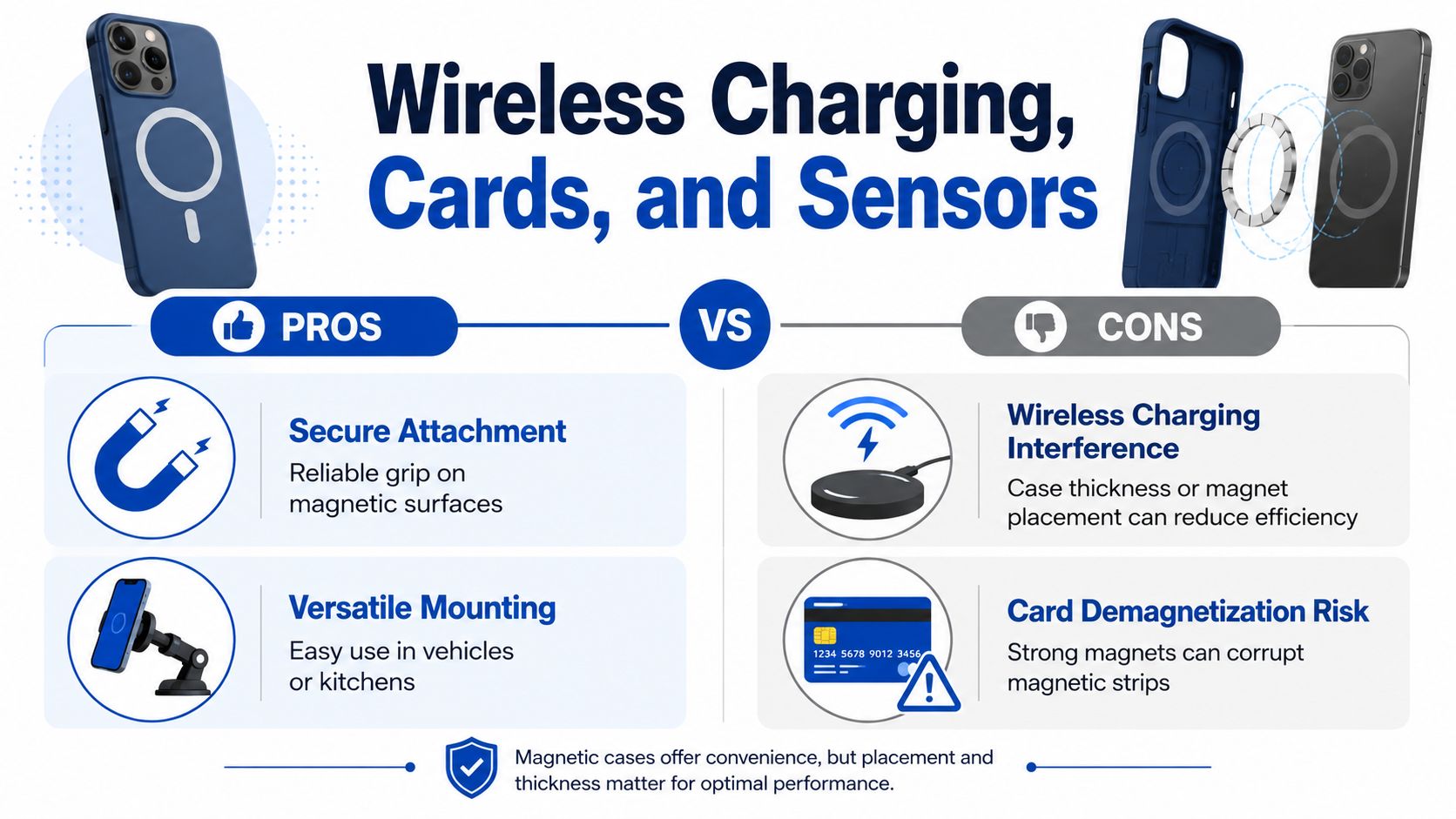
Charging works best when alignment stays tight
Wireless charging and magnets can work together, but the margin is small. A magnetic case has to stay thin, keep the coil centered, and avoid slipping the phone out of position. Case guides and accessory notes, including this wireless charging update, keep coming back to the same point, alignment matters more than raw magnet strength.
The practical takeaway is simple. A case can feel rock solid on a mount and still charge poorly if the ring sits off-center or the shell adds too much distance between the phone and the charger. The magnet holds the phone in place, while the coil still has to line up like two puzzle pieces that only work when the edges meet cleanly.
Cards and automotive sensors deserve attention
Magnetic cases also call for care around hotel key cards, credit cards, and anything else with a magnetic strip. Keep those items in a separate pocket or slot, because strong magnets can interfere with strips and make a card unreliable at the worst possible moment. Slim wallets and folio-style setups make that mix-up easier, which is why separating the phone from stored cards is still the safer habit.
Car use raises a different question. The issue is not only whether the phone stays attached, but also how nearby electronics are arranged. If you want a clear refresher on how automotive sensors work, it helps to see why clean placement around dashboards and vents matters, especially when a case, mount, and vehicle controls all sit close together.
Stronger isn't always better
A heavier magnetic case can hold more firmly, but that does not automatically make it the better choice. Stronger magnets can add bulk, make accessory pairing less predictable, and make fine alignment harder than shoppers expect. In practice, a well-centered case with enough pull for everyday use is usually a better fit than the biggest magnet that will fit inside the shell.
That is the tradeoff people often miss. The goal is not maximum force; it is the right balance between holding power, charging behavior, and compatibility with the things you use.
How Magnetic Cases Compare to Other Mounting Solutions
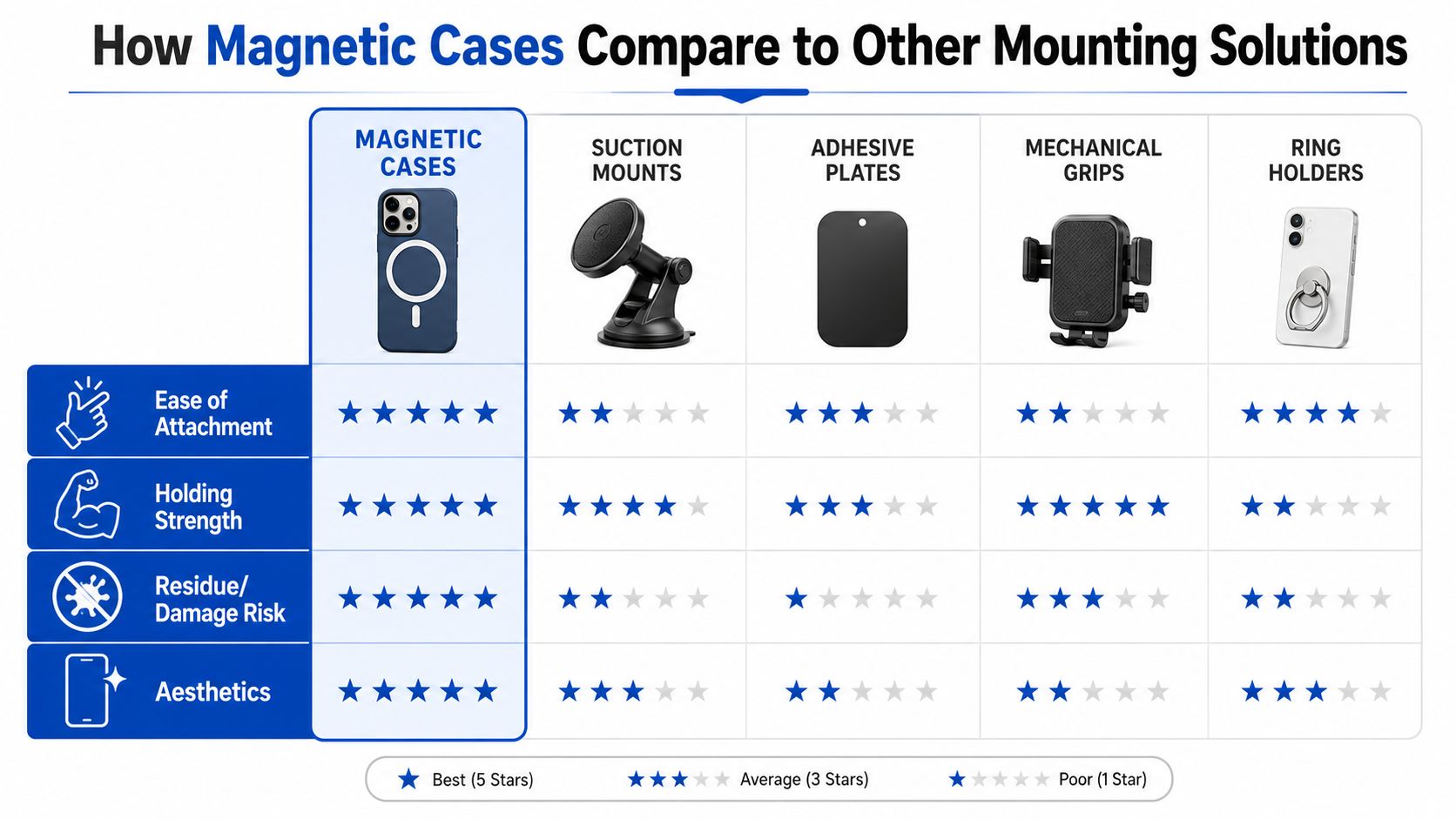
The right tool depends on the surface
Magnetic cases are strong when the surface is friendly, but they're not the only good option. Suction mounts are often better on glass, adhesive plates create new anchor points, mechanical grips work on rougher or more unpredictable surfaces, and ring holders help with hand use more than mounting.
That's why the true comparison isn't about which accessory is “best.” It's about which one matches your environment. A car dashboard, kitchen fridge, gym locker, and travel setup all punish different weaknesses.
Side by side decision cues
- Magnetic Cases: Best for steel, lockers, and other metal-rich surfaces, but weaker on wood and textured walls.
- Suction Mounts: Better for smooth glass and mirrors, but they depend on a clean, flat surface.
- Adhesive Plates: Good when you need a permanent or semi-permanent mount point, especially on wood or glass.
- Mechanical Grips: Useful when the surface is rough, angled, or inconsistent.
- Ring Holders: Best for hand support and casual viewing, not for true mounting strength.
In a review of MagBak, Digital Trends notes that the case uses industrial-strength rare-earth magnets to stick to metallic surfaces and includes a small aluminum piece that can be affixed to wood or glass, creating an instant mount point where ordinary magnets would not attach Digital Trends. That's a useful reminder that hybrid solutions often beat pure magnet solutions.
If you want a broader reference for choosing a mount style, practical magnetic phone mount buying advice gives a good external framing for matching accessory type to use case.
For shoppers comparing in-car options, the magnetic car phone holder stand sits in the category where magnetic convenience matters most.
A magnetic case shines when you want quick on-off use, travel-friendly setup, and fewer moving parts. A suction or grip system wins when the surface is less cooperative. The best choice is the one that fits the environment you use every day.
A Realistic Buying Checklist Before You Click Add to Cart
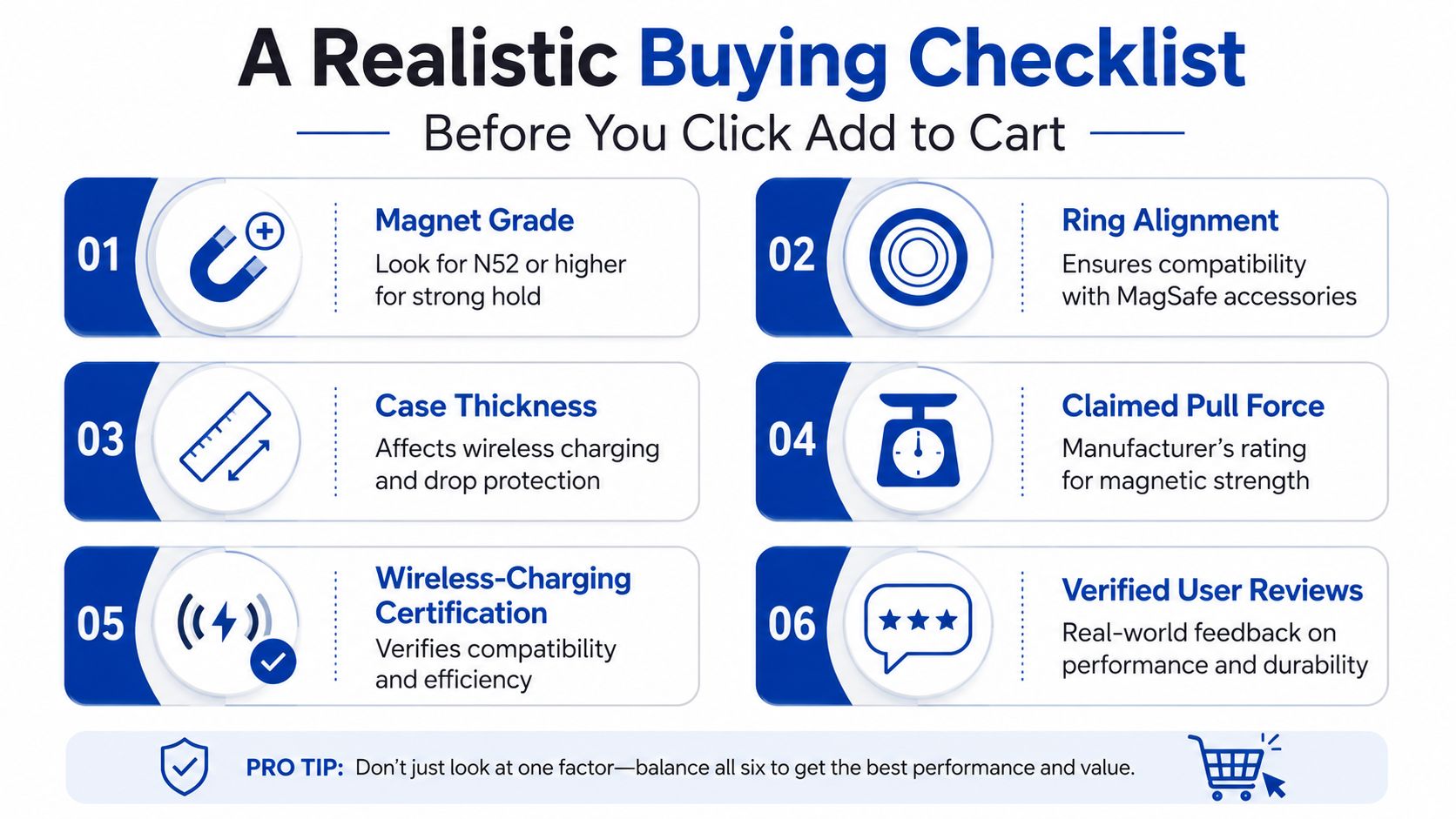
Check the magnetic spec, not the slogan
A good listing should tell you more than “super strong.” Alibaba's phone-holder guide recommends N42 to N52 neodymium magnets and at least 8 to 12 lbs of pull force for reliable performance, and it says tested pull-force values matter more than vague marketing language Alibaba. That's a much better benchmark than a slogan on a product page.
If the seller won't name magnet grade or pull force, treat that as a warning sign. A precise spec is easier to trust than a cheerful adjective.
What to look for before buying
- Magnet grade: Look for N52 or a clearly stated high-grade neodymium spec.
- Ring alignment: Make sure the magnet ring is centered for MagSafe-style accessories.
- Case thickness: Thicker shells can weaken charging and make the phone feel bulky.
- Pull force: A real number is more useful than “ultra strong.”
- Wireless-charging support: Confirm that the case is made for charging through the shell.
- Reviews with use context: Look for comments about car mounts, desks, and everyday carry.
That list becomes even more important when you shop for bulk or team use. If you're comparing packaging, accessory bundles, or distribution-friendly options, the LuminAID cases and bulk orders page is the kind of reference that helps you think beyond a single consumer purchase.
Buy for the surface you'll use most. A case that looks universal on paper can still fail in your actual workspace, car, or home.
I'd also watch for missing shielding, overly thick shells, and claims that the case works equally well on every material. Those are the listings most likely to disappoint once the box is open. For a broader protection-first lens, the best phone cases for protection piece pairs well with this checklist.
Where the Category Is Heading in 2026
The big shift is away from one magical case and toward modular ecosystems. Recent market behavior shows growing interest in specialized solutions like double magnetic rings and stick-anywhere MagSafe mounts, which makes sense because the surface problem isn't going away OpenCase. People want a case that works with accessories, then a couple of add-ons that solve specific surfaces.
The market size also supports that direction. A separate estimate places the worldwide MagSafe phone case segment at USD 365.2 million in 2020, growing to USD 1.85 billion in 2025 and projected to reach USD 4.22 billion by 2032, with a 12.52% CAGR P Market Research. That kind of growth usually brings more specialization, not less.
Three rules of thumb are holding up well:
- Choose the case for alignment first, not just holding power.
- Choose the accessory for the surface, not the marketing phrase.
- Treat stronger magnets as a tool, not a universal fix.
That's the honest verdict. A magnetic case can be excellent, but the winning setup is usually a case plus the right plate, pad, or mount for the environment in front of you. If you shop that way, you stop chasing the promise of “sticks to anything” and start building a setup that works.
If you want a practical place to start, DigiDevice carries mobile accessories built for real-world use, including magnetic cases, mounts, chargers, and other phone essentials. Browse DigiDevice for gear that fits the way you use your phone, then pick the mount and case combination that matches your surfaces instead of gambling on a slogan.