

Cell Phone Signal Booster for Outdoors: A Practical 2026
Usable outdoor readings generally fall between about -50 dBm and -103 dBm for reliable improvement. Once the outside signal drops below about -120 dBm, a cell phone signal booster for outdoors doesn't have anything real to amplify, so it's the wrong tool for the job.
That's the dividing line on a rural lane, beside a metal-roof shop, or at a campsite where your phone shows one bar for a few minutes and then nothing. If the donor antenna can still see a tower, even weakly, a booster can help. If it can't, you need a different connectivity strategy.
Why Your Outdoor Signal Drops and What a Booster Can Realistically Do
A lot of outdoor signal problems look the same from the phone screen. A ranch driveway shows one bar near the mailbox, the workshop goes dead as soon as the doors close, and an overland stop has enough signal to load a text but not enough to finish a call. The instinct is to buy a stronger box, but outdoor cellular performance starts with a simpler question, can the antenna outside still hear a tower at all?
That answer is the whole job. A cell phone signal booster for outdoors does not create coverage from nothing, it amplifies an existing outside signal, and the useful range is usually around -50 dBm to -103 dBm. Once the outside signal falls below about -120 dBm, there is nothing usable left to capture, which is why boosters fail in places where the phone is basically blind, even if the issue feels like a coverage problem best signal boosters for rural cell coverage.
Practical rule: if the outside reading is weak but measurable, a booster may help. If the outside reading is effectively gone, stop shopping for gain and start solving backhaul.
That is why a field test matters more than a product page. Check the outside reading first, then decide whether the site has enough raw signal for a booster to work. Antenna placement, coax quality, and tower aim carry more weight than brand names at a marginal site.
A booster can still move the needle when the donor signal is there. In a rural setup with a decent outside reading, the kind of gain people talk about in the field can turn a phone from flaky one-bar behavior into a stable connection that holds, especially when the antenna is aimed cleanly at the tower and the cable run is kept short best signal boosters for rural cell coverage. That matters on a field truck, a cabin porch, or a metal shop where the phone works only when you stand in exactly the right spot.
Insert image of a rural property with a phone test screen and a roof-mounted antenna before buying.
If the outside reading is too weak to work with, stop forcing a booster onto the problem. If the reading exists but comes and goes, the booster is often the cleanest fix. For a plain-language primer on the hardware itself, see the practical guide to what a mobile signal booster is.
How an Outdoor Booster System Works
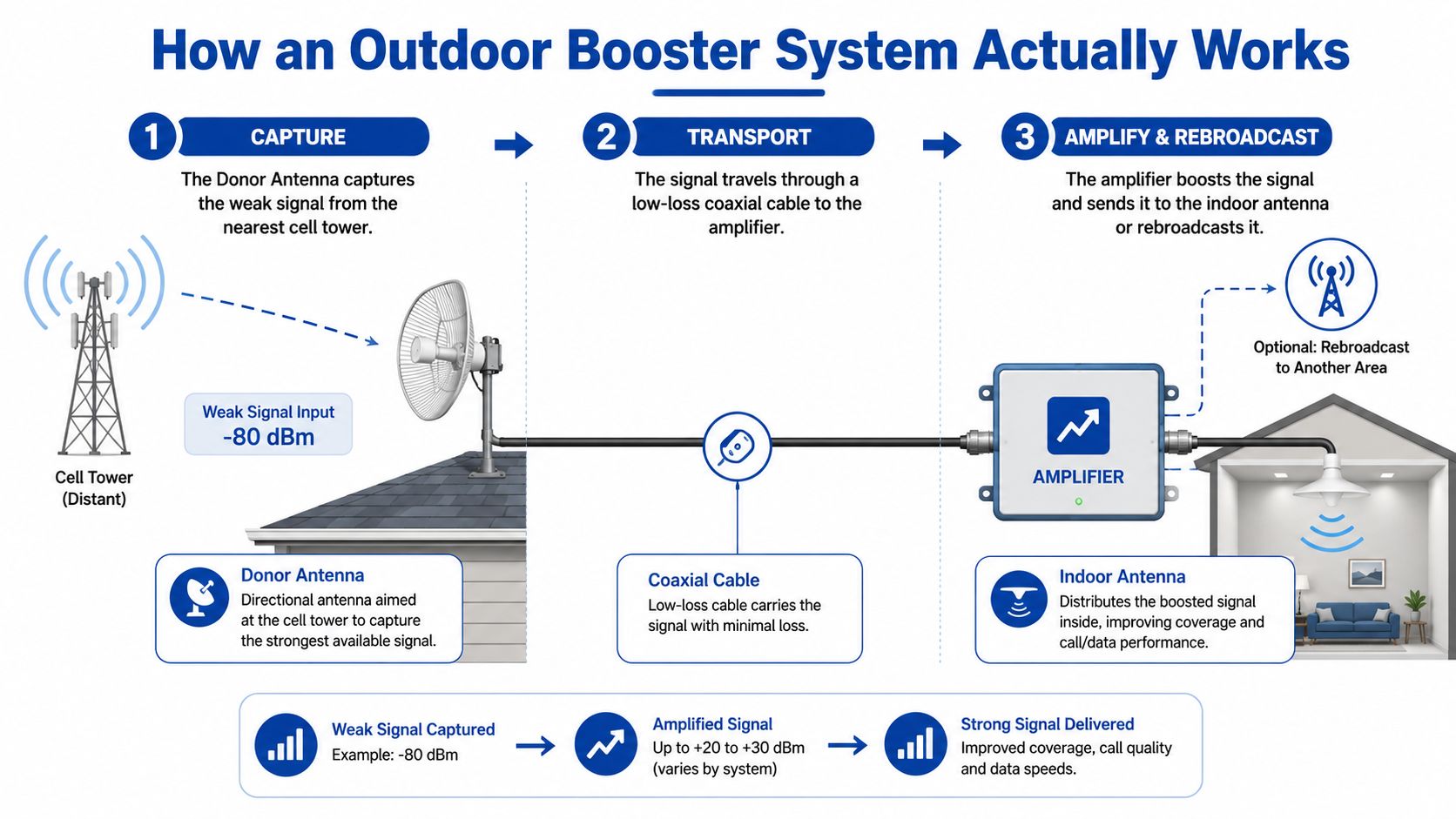
An outdoor booster system has a simple job, capture the best usable signal outside, carry it to the amplifier with as little loss as possible, then send it back out where people can use it. That chain only works as well as its weakest link. If the antenna sees junk, the amplifier can only make louder junk.
The setup breaks into three parts. The donor antenna collects the outdoor signal, the coax moves that signal to the hardware, and the amplifier raises it enough to feed the coverage area. If the coax is too long, poorly shielded, or badly terminated, the benefit drops fast. That is why field installs live or die on placement and cable discipline, not on marketing claims.
Why the antenna position matters first
Outdoor systems work because the donor antenna sits where the tower is visible. The antenna is the system's signal-capture stage, and the booster can only amplify what it receives, as explained in T-Mobile guidance on signal boosters. A rooftop mount usually beats a lower wall mount because height often clears trees, vehicles, and building clutter that block the path.
A directional antenna earns its keep when the serving tower is known and the path is reasonably clean. It narrows the pickup pattern, so the system spends its gain on one target instead of listening to every direction at once. On rural properties and obstructed lots, that focused pickup is usually what turns a marginal outside reading into something the amplifier can work with. For a plain-language overview of booster hardware, the primer on what a mobile signal booster is is a useful reference.
Where losses add up
The amplifier gets the attention, but the losses usually build in the cable path. Long coax runs, low-grade connectors, and poor weather sealing can eat away at the signal before it ever reaches the coverage antenna. A badly chosen antenna pattern does the rest, especially when the donor side is already fighting trees, metal siding, roof edges, or uneven terrain.
Here is the practical check I use on remote installs. If the antenna is seeing a clean weak signal, the rest of the system has something usable to work with. If the antenna is pointed into blockage, or the path to the tower is shadowed by hills or heavy cover, the booster cannot create signal that is not there. It only raises what arrives at the input.
Insert image of a rooftop donor antenna aimed at a tower and a short, protected cable run.
A booster still depends on the site it is fed from. That is the part many buyers miss. Once the donor antenna is in the right spot, the rest of the install is mostly about protecting that signal on the way in and keeping the gain where people need it.
Active Versus Passive Systems and Directional Versus Omni Antennas
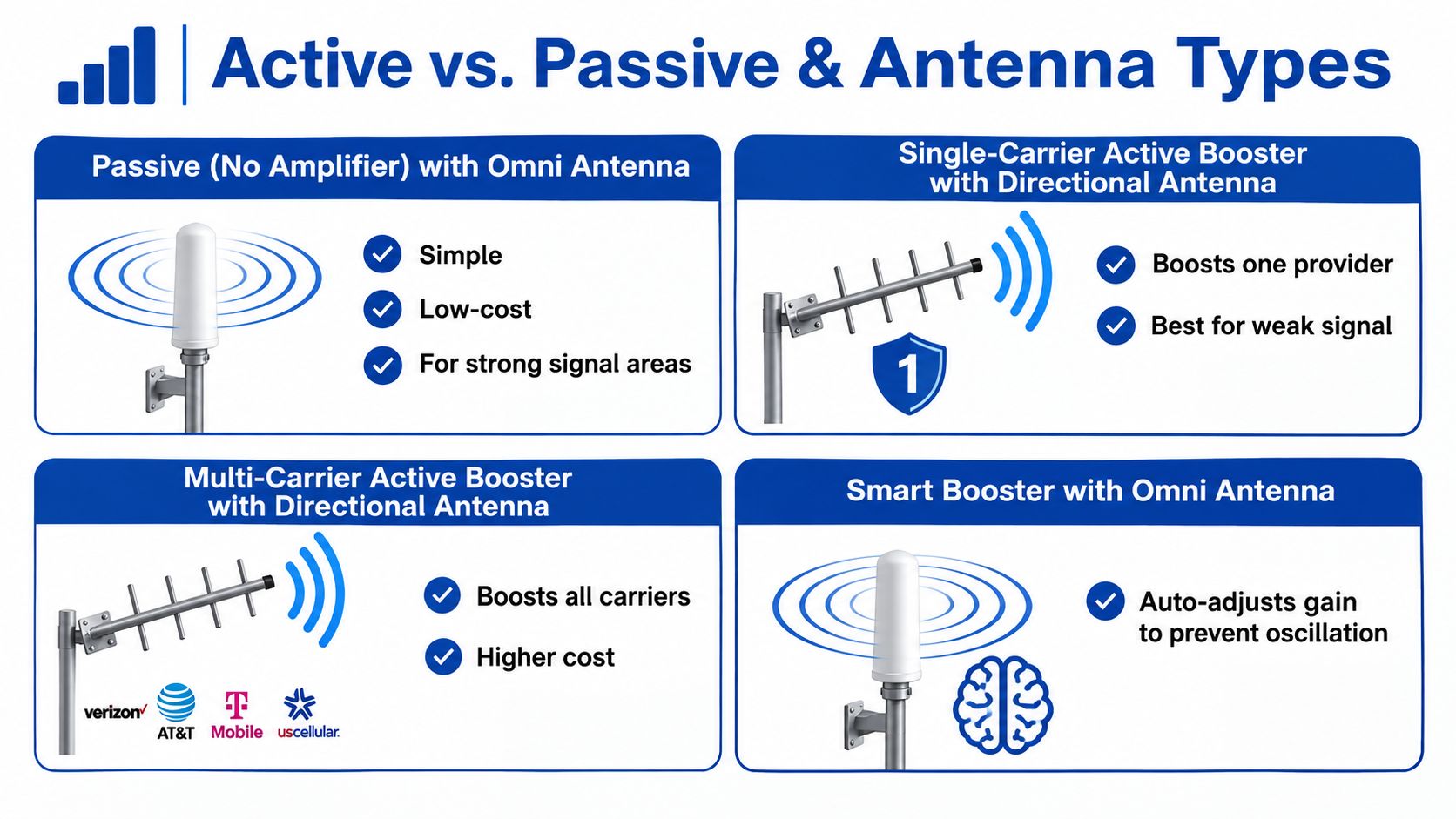
Outdoor buyers usually run into two separate decisions at once. The first is whether they need an active booster or a simpler passive approach, and the second is whether the donor antenna should be directional or omnidirectional. Treat those as separate choices, because they solve different problems.
Passive systems don't amplify cellular signal at all, so they only make sense when the outdoor signal is already strong enough to distribute cleanly. Active boosters add real gain, which is why they're the normal answer for weak-signal property edges, outbuildings, and remote work sites. In that category, single-carrier units can be a fit when one provider matters most, while multi-carrier systems make more sense when a household or jobsite uses mixed networks and can't afford to optimize for only one.
Directional or omni, which one actually fits
Directional antennas focus on one tower, so they're the right move when a property has a known serving cell and a clear path to it. Omni antennas are easier to mount and less fussy about aiming, which helps when tower direction changes, the property is wooded, or the user moves around more often.
A directional antenna is usually the right answer when the site is weak but predictable. An omni is the compromise when the site is less predictable and simplicity matters more than peak pull.
The right choice depends on terrain as much as on signal strength. Flat rural land with a visible carrier tower often rewards a pointed yagi or panel, while a more chaotic property, like mixed trees, rolling ground, or a campsite rotation, can justify the easier omni approach.
Where MIMO changes the conversation
For data-heavy outdoor use, MIMO matters because it supports more than one signal path instead of leaning on a single chain. That doesn't magically fix a dead zone, but it does matter when users care about mobile data stability, video calls, or hotspot performance. If the property is mostly about voice, MIMO isn't the first thing I'd pay for. If the jobsite lives on data, it moves up the list.
For readers comparing outdoor hardware by use case, the best next stop is a category like mobile accessories built for field use.
Reading the Spec Sheet Without Getting Misled
Manufacturers love spec sheets because they can make an ordinary outdoor booster look far better than it is. In the field, I care about a smaller set of numbers, and I only trust them when they match the site conditions. The headline figure is system gain, because gain is what helps overcome coax loss, antenna loss, and building attenuation once the outside signal is already usable.
A practical benchmark for outdoor boosters is 64–72 dB of system gain, while the FCC's maximum legally allowed downlink output power is 17 dBm Waveform booster guide. That is a useful reality check. A booster can be strong enough to matter and still be constrained by legality, oscillation control, and antenna isolation.
The numbers that matter
Gain in dB tells you how much the system multiplies what it receives. More gain helps when the donor antenna has to fight cable loss or when the signal starts weak but still usable.
dBi tells you how focused the antenna pattern is. Higher focus can help when you know where the tower sits, but it can hurt if the aim is off.
Downlink output power affects how loudly the booster re-radiates the captured signal. More output is not always better if it pushes the system toward feedback or violates limits.
Noise figure matters because a booster that amplifies hiss is less useful than one that preserves the quality of the captured signal. In the field, that is why better outdoor systems pair sensible impedance, outdoor antenna gain, and modest noise performance instead of chasing the biggest printed number.
Don't buy the biggest number blindly
A spec sheet that only screams “high gain” can hide weak band support or poor isolation behavior. For outdoor work, I would rather see a balanced system than a loud one that oscillates, clips, or turns data into mush.
Installer's rule: the best booster is the one that matches the outside reading, the cable path, and the antenna geometry, not the one with the flashiest headline gain.
If you are comparing outdoor kits by performance class, the best signal boosters for 5G Ultra Wideband UWB are worth a look when your site depends on that band mix.
Matching the Booster to Your Outdoor Use Case
Outdoor use punishes the system in different ways depending on the site. A rural house, a metal shop, and a moving RV all need better signal, but they do not need the same antenna pattern or the same amount of aiming precision. The mistake I see most often is buying for the property label instead of the way the site is used.
The five common outdoor scenarios
- Rural home with one bar of LTE: A directional outdoor antenna is the cleanest bet when the tower location is known. Pair it with a solid active booster and enough gain to recover from long cable runs, because this is the classic weak-but-usable deployment.
- Suburban dead zone inside a metal-roof workshop: The outside donor antenna has to live where it can still see real signal, while the indoor rebroadcast side handles the building attenuation. Metal is a brutal signal blocker, so the outdoor capture point matters more than the building itself.
- RV or overlanding rig: Mobility changes the equation. An omni antenna and a compact active system are easier to live with because tower direction shifts from place to place, and the priority is steady usability, not peak tuning.
- Remote jobsite trailer: Work crews usually want predictable voice plus usable data. Mid-gain active systems make sense here, especially when the site stays put long enough to justify better mounting and cable management.
- Ranch or multi-acre property: The antenna and mounting plan have to respect distance. A directional antenna on a higher mast often does more than a heavier amplifier, because the outdoor signal capture stage is the bottleneck.
For buyers comparing carrier mix and deployment style, the FCC-approved multi-carrier amplifier selection is the right product family to review before narrowing by band support. If the outside reading is weak enough that the donor antenna cannot hear a clean signal, no booster spec will fix that problem.
Remote sites also tend to reward restraint. A system with decent gain and proper antenna geometry usually outperforms a louder unit that is aimed poorly or mounted where the donor signal is already polluted by terrain, trees, or roofline clutter.
Site Survey, Mounting, and Cable Best Practices for Outdoor Installs
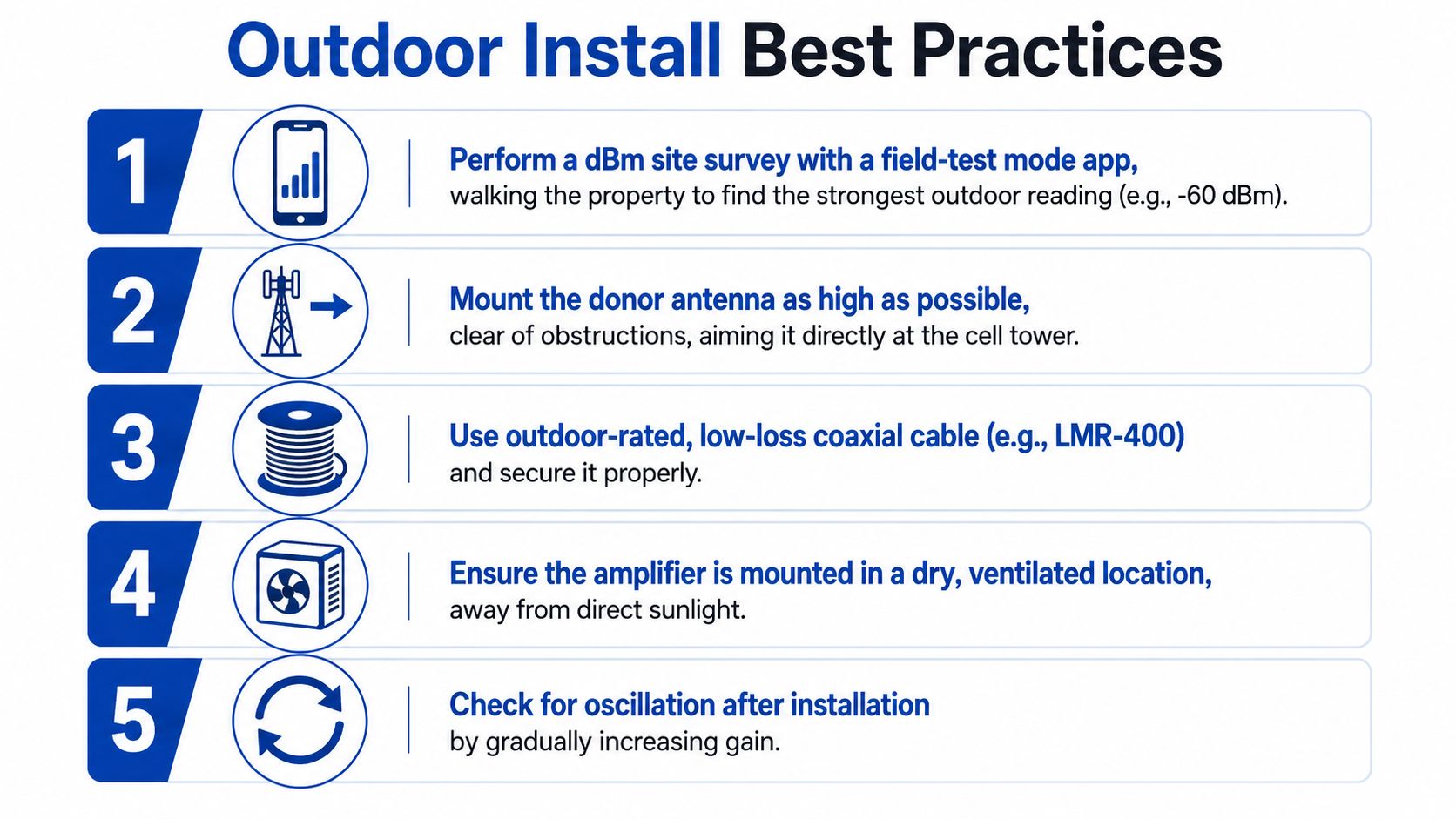
The cleanest outdoor installs start with a walk, not a purchase. I've seen too many people mount the first antenna they bought and then blame the booster when the problem was really the location. A proper site survey tells you where the best outdoor reading lives, and it usually isn't where you first guessed.
The field sequence that saves time
- Survey the property first. Use field-test mode or a dBm app and walk the roof, yard, or fence line to find the strongest usable outside reading.
- Mount high and clear. Aim for the best line-of-sight you can get without turning the mast into a lightning problem.
- Choose low-loss coax. Long outdoor runs punish cheap cable faster than most buyers expect.
- Protect every connector. Weatherproofing matters because water intrusion and corrosion don't show mercy.
- Check for oscillation after install. If the system feeds back, the antenna layout needs correction before you chase anything else.
The U.S. Forest Service notes that cell phone amplifiers can extend phone range from several miles to 10 miles or more in flat terrain, which shows how much line-of-sight and terrain shape outdoor performance Forest Service backcountry guide. In practical terms, that means mounting height is not decoration, it's part of the signal path.
A separate install rule that holds up in the field is antenna separation. Keep roughly 15–20 feet of vertical separation or 50+ feet of horizontal separation between outdoor and indoor antennas to reduce feedback and oscillation HiBoost rural install guidance. If you can't get that separation, the booster may oscillate instead of helping.
If you're building out a tougher site, the practical companion reference is the guide to external antennas for mobile phones.
FCC Rules, Oscillation Control, and Troubleshooting the Usual Problems
Outdoor boosters operate under hard limits for a reason. For mobile boosters, the FCC caps maximum gain at 50 dB when using an inside antenna, 23 dB for direct contact coupling, and 15 dB when directly connected. FCC rules also limit uplink power to 1 watt composite conducted power and EIRP, and downlink power to 0.05 watt, which is 17 dBm FCC booster rules summary.
What those limits mean in plain English
Those caps keep a booster from shouting over the carrier network. FCC approval means the unit is built to improve weak-signal coverage without creating interference, not to overpower a tower or force coverage where the donor signal never reaches. Outdoors, that matters more than indoors because the antenna picture changes with every foot of mast height, every ridge, and every bend in the coax run.
If the booster is legal and installed correctly, it should make weak service more usable, not turn a dead zone into a miracle zone.
The FCC's own guidance lines up with that. Signal boosters are meant to improve coverage in weak-signal areas such as homes or cars, and they may let users complete calls where they previously could not, but they are designed to work with existing service rather than create coverage in a zero-signal dead zone FCC booster FAQ.
The usual failure modes
- Blinking red or obvious feedback: The antennas are too close, aimed too directly at each other, or the system is pushing too much gain at once. Reduce gain and increase separation.
- No improvement despite a decent outside reading: The donor antenna is pointed wrong, the coax is losing too much signal, or the booster is amplifying the wrong band.
- Full bars but slow data: Voice can improve before throughput does, especially when the outside signal is weak or noisy.
- Intermittent dropouts: Wind movement, marginal aim, or a bad connector is usually the cause.
For metal buildings, a carrier-approved booster still depends on clean antenna placement and enough isolation. If the layout is wrong, even a compliant system will not fix the install. For a more focused example of what works in that environment, see the FCC-approved boosters for metal buildings.
The Outdoor Booster Buyer Checklist and Where to Look Next
A field install usually comes down to three checks. First, the outside signal has to be weak but usable, not missing altogether. Second, the booster and antenna set has to match the bands your carrier uses. Third, the mounting plan has to give the donor antenna a clear view and enough separation from the indoor side to stay stable.
If those three boxes are not checked, the gear choice does not matter much. A clean donor capture beats a fancy spec sheet every time.
| Outdoor Scenario | Donor Antenna | Target Gain | FCC Class |
|---|---|---|---|
| Rural home | Directional | Mid to high active system | FCC-approved consumer kit |
| Metal workshop | Directional, roof mounted | Mid to high active system | FCC-approved consumer kit |
| RV or overlanding rig | Omni | Mid active system | FCC-approved mobile kit |
| Remote jobsite | Directional or omni, depending on tower access | Mid active system | FCC-approved consumer or mobile kit |
| Ranch or multi-acre property | Directional on a higher mast | Higher gain active system | FCC-approved consumer kit |
Use the table as a quick filter, not a shopping script. If the site has a known tower direction and enough room for isolation, directional hardware is usually the cleaner buy. If the site moves, or the tower picture changes from place to place, an omni setup can be easier to live with, but it will usually give up some performance.
For the next step, compare the mobile accessories catalog with the kit type that fits your use case, then check the tower direction, coax run, and antenna spacing before you place the order. That order of operations avoids the common mistake of buying hardware before the site can support it.
DigiDevice carries practical gear for users who need better field connectivity, including accessory-ready options that fit real outdoor installs and FCC-approved signal booster choices for U.S. carriers. If your signal keeps falling off at the edge of the property, compare the booster category against your outside reading before you buy.